Don’t cut foreign aid, Malala Yousafzai urges UK

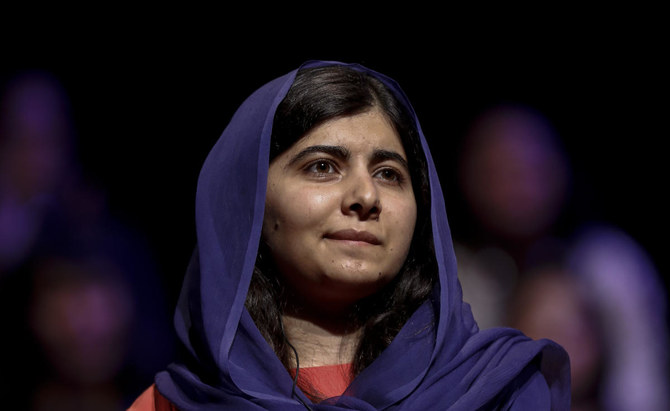
Nobel laureate Malala Yousafzai has urged Britain not to cut overseas aid, ahead of a major announcement by the country’s finance minister on Nov. 25, 2020. (AFP)
Short Url
Updated 25 November 2020
Follow

Don’t cut foreign aid, Malala Yousafzai urges UK

  • The British finance minister is expected to suspend a legal commitment to spend 0.7 percent of gross national income on international development

LONDON: Nobel laureate Malala Yousafzai has urged Britain not to cut overseas aid, ahead of a major announcement by the country’s finance minister on Wednesday.
Rishi Sunak is expected to suspend a legal commitment to spend 0.7 percent of gross national income on international development.
Reports suggest he will cut the level of aid to 0.5 percent in his Spending Review, as the government seeks to support the coronavirus-ravaged economy and looks for savings from an aid budget worth £15 billion ($20 billion, EUR17 billion).
In a tweet late on Tuesday, Yousafzai reminded Sunak and Prime Minister Boris Johnson of the 0.7 percent pledge, renewed in last year’s Conservative election manifesto.
“When you announce spending priorities... I hope you’ll deliver on that promise,” she wrote.
The Pakistani education campaigner wrote that leaders must “prioritize education” as “Covid-19 could force 20 million more girls out of school.”
Her plea came as five former prime ministers also opposed the planned cut.
Among them was former Conservative leader John Major, quoted by The Times newspaper on Wednesday as saying the spending cut was “morally wrong and politically unwise.”
Former Labour prime minister Tony Blair said on Saturday that Britain’s overseas aid budget had an impact “measured literally in millions of lives.”
David Cameron, whose coalition government enshrined the 0.7 percent in law, has said abandoning it would be a “moral, strategic and political mistake.”
Johnson’s government has repeatedly committed to maintaining the spending and his Conservatives made it a key plank of the election manifesto last year.
The government also promised not to grab ring-fenced aid money when it merged the foreign and development ministries earlier this year.
But Sunak on Sunday told Sky News the UK was under “enormous pressure and stress” and faced an “economic shock.”
Any cut — even a temporary one — is likely to trigger a battle with Conservative MPs.
Tom Tugendhat, who chairs parliament’s Foreign Affairs Committee, wrote in The Times: “If we cut aid we’ll fall behind.”
He retweeted Yousafzai’s message, saying the UK needs “others to join us” as other G7 nations spend less on foreign aid.
The leaders of 187 charities including Save the Children, Greenpeace UK and Christian Aid on Friday urged Johnson not to cut the aid budget.


Epstein files reveal links to cash, women, power in Africa

Updated 26 February 2026
Follow

Epstein files reveal links to cash, women, power in Africa

  • Documents attest to Epstein’sclose ties with Karim Wade, son of former Senegalese president Abdoulaye Wade
  • They also reveal his ties to Nina Keita, niece of Ivorian president Alassane Ouattara

PARIS: Jeffrey Epstein built close ties with powerful figures in Senegal and Ivory Coast, files released by the US government last month show, detailing the late sex offender’s influence network across Africa.
Emails, scheduled meetings, investment projects, and loans reviewed by AFP attest to the disgraced New York financier’s close relationship with Karim Wade, son of former Senegalese president Abdoulaye Wade.
They also reveal his ties to Nina Keita, niece of Ivorian president Alassane Ouattara.
Wade and Epstein met in 2010 through Emirati businessman Sultan Ahmed bin Sulayem, who recently resigned as CEO of port giant DP World after mounting pressure over his close friendship with Epstein.
The pair quickly struck up a rapport.
“Thanks for coming. I think there are many things to consider... I feel confident that we will have fun,” Epstein wrote to Wade on November 15, 2010 after their first meeting in Paris.
“Have a safe trip back to your paradise Island,” Wade replied.
While Wade’s exchanges show no link to Epstein-related sex trafficking crimes, they do reveal conversations on potential business ventures in various sectors, such as finance and energy.
Nicknamed the “Minister of Heaven and Earth” for the multiple portfolios he held including international cooperation, energy, and air transport, Wade was a powerful figure in Senegal until April 2012, when his father’s bid for a third term sparked deadly riots.
Epstein saw him as “one of the most important players in africa” and invited him to meet close contacts such as Ehud Barak, then Israel’s defense minister.
He also put him in touch with Chinese businessman Desmond Shum to discuss “offshore banking.”
The US Department of Justice documents show Shum and Wade met in Beijing on May 9, 2011.
That same month, Wade planned an African tour through Senegal, Mali, and Gabon for Epstein.

‘You will not suffer’ 

Epstein and Wade’s relationship became even more apparent after the latter’s fortunes reversed when his father left office in 2012.
That autumn, Epstein proposed that his “friend” — under the Dakar authorities’ scrutiny over his assets — use his house in Florida.
“You and your family are welcome to use my house in palm beach, staff is there, pool etc. you will not suffer,” Epstein wrote.
“Txs a lot Brother for the advise,” Wade replied a few weeks later to another email, in which Epstein urged him to “stay mentally strong.”
Numerous files suggest Epstein became financially involved on Karim Wade’s behalf after his arrest in 2013 and his 2015 sentencing to six years in prison for corruption.
Karim Wade’s lawyer, Mohamed Seydou Diagne, sent two invoices in May 2014 and July 2015 of $500,000 to one of Epstein’s companies.
Contacted by AFP on Monday, Diagne said he “did not consider it useful to comment.”
Other archives suggest that Epstein covered at least $50,000 in fees for the US lobbying firm Nelson Mullins, hired by Wade’s entourage to secure his release.
Epstein regularly exchanged emails with Robert Crowe, a partner at the firm who kept him informed of their efforts in the US and Senegal.
In a June 16, 2016 email thread where Epstein and Crowe discussed whether then Senegalese president Macky Sall would pardon Wade, Crowe writes: “He has told my friends high up at State that he was going to do it. They have been putting pressure on him!“
Karim Wade was released from prison eight days later, on June 24, and went into exile in Qatar, which he credited for efforts toward his release.
Jeffrey Epstein was told by Sultan Ahmed bin Sulayem and Nina Keita.

‘A very interesting person!’

The DOJ documents show Nina Keita was close to both Epstein and Karim Wade and that she acted as a regular intermediary while Wade was in prison.
Keita also helped put Epstein in contact with her uncle, president of Ivory Coast since May 2011, and his team.
“He thought you were a very interesting person! ... they were all very happy to have you here,” she wrote on January 20, 2012, after the financier’s visit to Abidjan.
She had booked him the “ministerial suite” of the luxury Hotel Ivoire for that trip.
Ahead of the visit, Epstein had said he hoped to see “very pretty girls there, as well as interesting places.”
“You will!” Keita replied.
Emails show Keita, a former model, at least once sent photos and the phone number of a young woman to Epstein.
He then met this woman at the Ritz hotel in Paris on August 31, 2011.
“ask sadia to send pictures of her sister. i prefer under 25,” Epstein wrote to Keita after the meeting.
Now the deputy general director of Ivorian petroleum stocks company GESTOCI, Keita also appears in a February 2019 will in which Epstein requested that debts owed to him by a number of people be canceled upon his death.
AFP received no response to its requests for comment from both Keita and the Ivorian presidency, or from Karim Wade, who was contacted through his entourage.
The mere mention of a person’s name in the Epstein files does not in itself imply wrongdoing.