KARACHI: Pakistan expects $517 million from Saudi Arabia and $7 million from the United Arab Emirates under the Debt Service Suspension Initiative (DSSI) announced by leaders of the world’s 20 biggest economies, or G20 countries, between May to December 2020, the Pakistani Ministry of Economic Affairs has said.
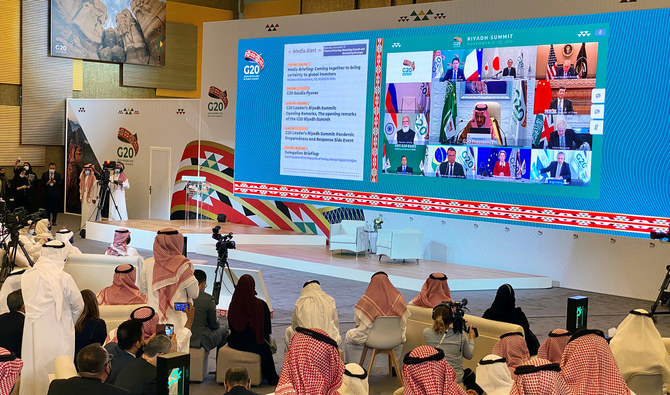
G20 nations on Sunday endorsed a plan to extend a freeze in official debt service payments by the poorest countries to mid-2021 and backed a common approach for dealing with their debt problems.
The G20 debt relief initiative — launched shortly after the start of the pandemic in the spring — has helped 46 of 73 eligible countries defer $5.7 billion in 2020 debt service payments, freeing up funds for countries to fight the pandemic and shore up their economies.
But lack of private-sector participation and countries’ concerns about marring future access to capital markets have limited the success of the debt freeze, which was initially projected to generate some $12 billion in extra liquidity.
“The government has engaged 21 bilateral creditor countries for the purpose of rescheduling $1,704 million of its debt, which was to be paid between May and December 2020,” Samar Ihsan, the economic affairs ministry spokesperson, told Arab News.
The amount includes $517 million to be returned to Saudi Arabia and $7 million to the UAE by the end of the year, she said.
Pakistan has formally secured $839 million in debt relief out of the expected $1,704 million from 16 bilateral creditors.
“Among the 21 bilateral creditors, the quantum of debt relief expected from countries like Japan, Saudi Arabia, Russia, the United Arab Emirates and United Kingdom is about $865 million,” the spokesperson said, adding: “The amounts that we were required to pay to KSA [Kingdom of Saudi Arabia] and the UAE is $517 million and $7 million, respectively.”
Ihsan said Pakistan had already requested Saudi Arabia and the UAE for debt relief under the DSSI for the period ending December 2020. “We are now waiting for their response,” Ihsan continued.
Pakistan also expects about $900 million in additional debt relief from G20 creditors during the next moratorium period, which begins in January.
“It is expected that between January and June 2021, Pakistan may get an additional relief of $800 million to $900 million under the G20 DSSI framework,” Ihsan added.
Pakistan’s de facto finance minister, Abdul Hafeez Shaikh, told Arab News in June this year that Pakistan was expecting $1.8 billion in debt relief from G20 countries, adding that the amount would be utilized to provide relief to people affected by COVID-19.


![]()

Pakistan expects $524 million from Saudi Arabia, UAE under G20 debt relief initiative
Short Url
https://arab.news/radv6
Pakistan expects $524 million from Saudi Arabia, UAE under G20 debt relief initiative
- The G20 initiative has helped 46 of 73 eligible countries defer $5.7 billion in 2020 debt service payments
- Pakistan has formally secured $839 million in debt relief out of an expected $1,704 million from 16 bilateral creditors
Latest updates


© 2026 SAUDI RESEARCH & PUBLISHING COMPANY, All Rights Reserved And subject to Terms of Use Agreement.