

Shara Art Fair brings together Saudi artists

Cutouts hang from the ceiling of the gallery symbolize the urban landscaping and the style of the houses. (Photo/Huda Bashatah)
Short Url
Updated 25 November 2020
Follow

Shara Art Fair brings together Saudi artists

  • With the global pandemic closing art galleries and canceling live events, artists took a hit like many other workers

JEDDAH: The Saudi Art Council brought together a wide range of local artists after the months-long lockdown for the 6th Shara Art Fair, which was recently launched in Jeddah at the council’s headquarters.

With the global pandemic closing art galleries and canceling live events, artists took a hit like many other workers. The Shara Art Fair, however, allowed artists from all across the country to exhibit their talents in seven art galleries.

The participating galleries included Athr Gallery, Hafez Gallery, 6th Sense Art, Noor Gallery, Tasami Creative Lab, BHAC, and Visual Stations.

Heba Abed, a visual artist and painter, said that her life during the pandemic was a combination of “watching TV, eating, and painting.”

Inspired by her surroundings, Abed’s artwork was a collection of one hundred paintings that exhibit the emotions she felt during the hundred days of quarantine.

“Some of the paintings express the feelings I had while in quarantine, while others are inspired by fairy tales because there was a lot of time for our minds to wander while we were stuck at home,” she told Arab News. 
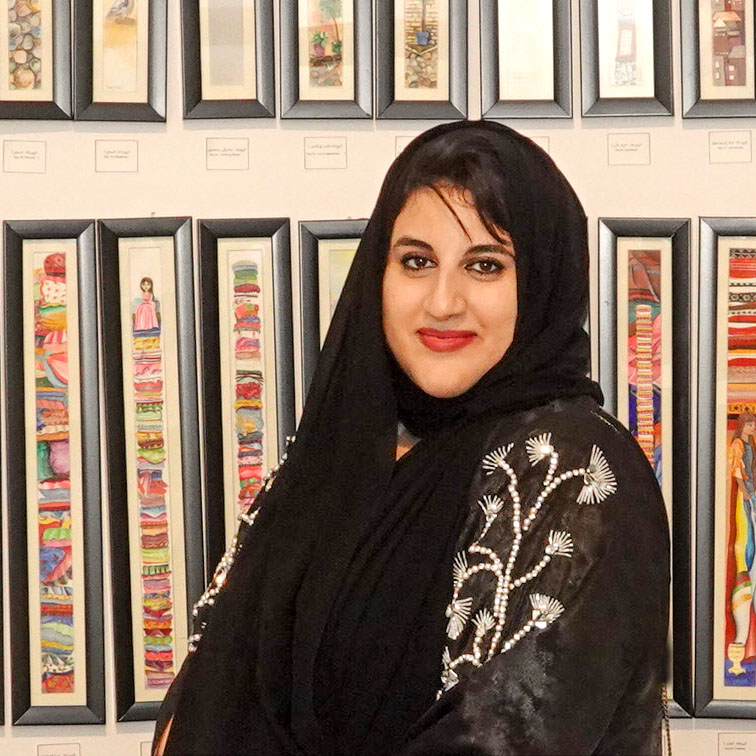


Heba Abed

She added: “I would sometimes paint more than one painting a day during the lockdown. While we were all bored, I decided to practice the thing I loved most. I found inspiration in my life, in society and in everything that happened around me.”

Artist Elham Dawsari, on the other hand, used the 1990s as inspiration for her artwork, “Nefa,” which means a spacious place with few to no walls. The installation, featuring clay women set over acrylic boxes with mirrors inside, is meant to symbolize the women’s untold stories.

“The idea behind the piece was to represent the lives of the women in the 90s,” she said.

Cutouts hang from the ceiling of the gallery around the art, which according to Dawsari, symbolize the urban landscaping at the time and the style of the houses.

HIGHLIGHTS

• The Shara Art Fair allowed artists from all across the country to exhibit their talents in seven art galleries.

• The participating galleries included Athr Gallery, Hafez Gallery, 6th Sense Art, Noor Gallery, Tasami Creative Lab, BHAC, and Visual Stations.

“They also show how those designs imposed themselves on our lives,” she said. “They show certain aspects of society and how we behaved and how our bodies looked because of the limited space we had to walk around in; they were fuller but also more muscular because of all the hard work the women used to do.”

The clay figures of the women are based on Dawsari’s memory and the collective memory of her family.

Another piece featured large wooden dolls perched on a table. As time passed, the artist painted more dolls. The founder of Dar Malak, Malak Masallati, was the designer and director of the project and expressed the hope that her wooden dolls would become the next “Saudi Wooden Dolls.”

“I wanted to create wooden dolls that represent our country and its culture and that could become an icon. I called the project ‘Nasana’,” she told Arab News.

Dar Malak worked with designers and artisans to translate the idea of Masallati into actual objects.

Masallati worked with a wood factory that handled the woodturning and scaling for her.

“I did my research on the proportions of the human body, using examples of different bodies to create the variety you see here,” she added.


Saudi Arabia, Estonia strengthen cyber defense cooperation

Updated 09 February 2026
Follow

Saudi Arabia, Estonia strengthen cyber defense cooperation

  • Renowned for its leadership in digital governance, Estonia sees cybersecurity as central to its partnership potential with Saudi Arabia, building on years of regional engagement through its technology firms

RIYADH: Estonia aims to deepen defense, cybersecurity, and artificial intelligence cooperation with Saudi Arabia as both nations look to advance technology‑driven defense and cybersecurity capabilities.

Hanno Pevkur, Estonia’s minister of defense, told Arab News at the World Defense Show in Riyadh on Monday that Estonia’s defense industry is eager to contribute to the Kingdom’s fast‑growing defense ecosystem.

“In the modern world, cooperation built on trust and technology is the best defense,” he said. “It is important for us to be here because we clearly see there is a possibility to increase cooperation, not only bilaterally between Saudi Arabia and Estonia, but across the region.”

At Estonia’s pavilion, a cooperation agreement was signed between an Estonian company and a Saudi firm during the show, he noted.

Pevkur also said Estonia’s defense sector has expanded rapidly in recent years, driven by technological innovation and partnership.

“Our defense industry is growing very rapidly, and we continue to see strong momentum,” he said.

He said Estonia’s strengths lie in digital and smart‑system integration rather than large‑scale weapons production.

“We will not build airplanes or tanks, but what we can do is integrate robotics, automation and drones to make existing systems smarter,” he said.

The minister said effective defense collaboration must link businesses and governments to achieve meaningful results.

“When we want to have real cooperation, we need it on all levels,” he said. “The biggest client for any defense company is the government, so we must treat this as one ecosystem where the public and private sectors work hand in hand.”

Renowned for its leadership in digital governance, Estonia sees cybersecurity as central to its partnership potential with Saudi Arabia, building on years of regional engagement through its technology firms.

Pevkur said several Estonian companies, including Nortal, have already assisted Gulf governments in developing open IT and digital‑service systems.

“As the most digitalized nation in the world, almost every service in Estonia can be done online, except getting married,” he said. “But with such digitalization, we also need strong cyberdefense.”

He said data protection and digital resilience are treated as matters of national sovereignty in Tallinn, the capital of Estonia.

“Data is what we own. When someone steals that data, it becomes a serious threat,” he added. “That is why cyberdefense is not just about technology, it is about trust, sovereignty and protection.”

Pevkur said Saudi Arabia’s advances in AI offer promising opportunities for collaboration.

“I know that Saudi Arabia is doing great work when it comes to AI,” he said. “For us, as a small country with limited human resources, AI is essential not just for defense but for everyday life.”

Pevkur added that Estonia has launched a national AI strategy to promote responsible development and closer coordination between government and industry. One Estonian company, he said, has developed a system that allows a single operator to control hundreds of drones through AI.

“It is quite easy to put a weapon into the hands of a robot, but we also need to define who is accountable for its actions,” he said.

“The big question for the future is whether we can allow a war to be fought entirely by AI, or if humans must always make the final ethical decisions.”

He said in his conclusion that governments must reach a common understanding on how AI will be used and regulated on the battlefield.