

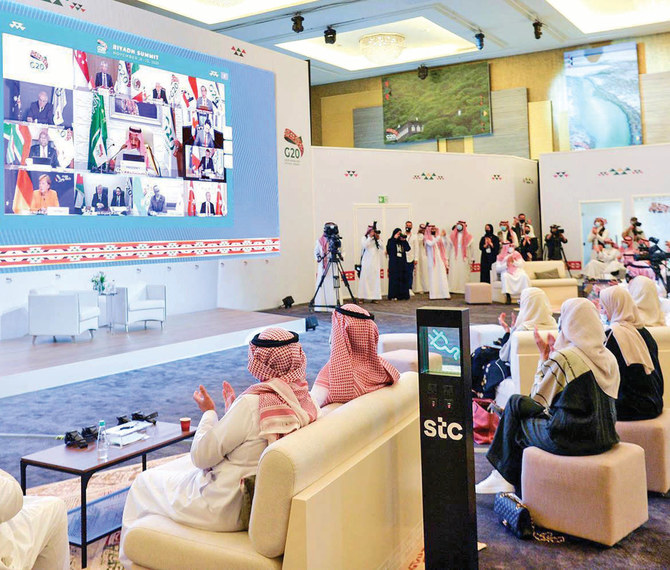

RIYADH: The G20 heads of state on Saturday emphasized the need for a continued coordinated response to the coronavirus pandemic, especially to support the most vulnerable segments of society, as well as the need to increase spending on research and vaccines.
“From the onset of the pandemic and in an attempt to jump-start the global response, we met in an extraordinary summit last March where we all took swift and collective actions to counter this crisis. We continue to do so,” said King Salman, addressing the meeting.
“The pandemic has demonstrated that international cooperation is the optimal way to overcome crises. We must focus on the most vulnerable segments. We must provide support for all countries of the world, for we will not be safe until everyone is safe,” he added.
“In April, the Kingdom joined forces with international organizations and global leaders to launch the Access to COVID-19 Tools (ACT) Accelerator. We co-led the Global Coronavirus Pledging Event to meet the global shortage in developing and distributing vaccines and diagnostic tools, where the Kingdom contributed $500 million towards that end.”
The king said the pandemic is a true test for global health systems, so “through the G20 presidency, we utilized a number of vital initiatives to close the pandemic preparedness and response gaps.”
He added: “During our presidency, with the support of the G20 members, we proposed the Access to Pandemic Tools (APT) initiative, which aims at ensuring a focus on sustainable preparedness and response to counter any future pandemic. We look forward to furthering this discussion and implementation during the Italian presidency next year.”
Together, King Salman said, people can protect their lives and livelihoods while shaping a better world.
Italian Prime Minister Giuseppe Conte said the G20 “has taken unprecedented measures, which allowed us to reach important milestones. The ACT Accelerator is one of those milestones.”
Argentinian President Alberto Fernandez said: “In Argentina, we have worked on a comprehensive approach, putting the protection of people’s lives first.”
He added that cooperation and solidarity are the two key elements to fighting the pandemic. “This is not only a responsibility of governments but every one of us, members of the international community, to defeat the pandemic,” said Fernandez.
French President Emmanuel Macron said the only effective response to the pandemic is a coordinated global one based on solidarity.
“We can reasonably expect that before the end of the year a vaccine will be available, which is totally unprecedented,” he added.
“But an even more difficult fight must be fought — that of universal access to health technologies against COVID-19.”
Macron said it is time to come together with the idea of “common good” and providing primary healthcare access to all.
German Chancellor Angela Merkel said: “A global challenge, which is what the pandemic undoubtedly is, can only be overcome with a global effort. The G20 has a crucial responsibility in this area. For example, we have launched the ACT Accelerator and its COVAX facility. This unique global platform serves to promote the development, production and distribution of medicines, diagnostics and vaccines.”
“Each country is striving to find its own responses to the pandemic, as well as to contribute to the necessary worldwide response … (This) can only be overcome with a global effort,” said Merkel, adding that the G20 has a crucial responsibility in this regard.
She said in order to halt the pandemic, every country needs to have access to, and be able to afford, a vaccine.
South Korean President Moon Jae-in said: “I would like to express my gratitude to King Salman for granting me the time to introduce Korea’s experience in responding to COVID-19. At the outset of the pandemic, Korea had the second-highest COVID-19 infections in the world, but could overcome the crisis thanks to our people, who readily cooperated with infectious disease control measures.”
He added that his country conceived the idea of drive-through and walk-through screening stations, which enabled massive testing in a short period of time.
“From a ‘Corona Map’ that spots the location of infection, to self-quarantine and epidemiological investigation apps, various mobile apps helped in fighting the pandemic,” he said.
His country will continue to beef up cooperation with the International Vaccine Institute, headquartered in Seoul, and scale up humanitarian assistance, he said.
South African President Cyril Ramaphosa said inclusive economic recovery and collective efforts would be of great help to combat future epidemics.
To help African countries rebuild their economies, “the African Union has proposed several measures, including debt relief in the form of interest payment waivers and deferred payments to be prepared for the future,” he added. “We must invest in funding and research.”
Ngozi Okonjo-Iweala, board chair of Gavi, the Vaccine Alliance, said: “Only through adequate financing for a global exit strategy like the ACT Accelerator can economic vitality be restored at home and catastrophe in the poorest countries be averted.”


