BEIRUT: Lebanese President Michel Aoun said on Saturday that a forensic audit of the central bank was vital to combat corruption, and that he would get it back on track after the consultancy contracted to carry it out withdrew.
Aoun said “interest-driven roadblocks” had derailed the audit, which is a key condition for foreign donors to help Lebanon out of a deep financial crisis that has posed the biggest threat to its stability since its 1975-1990 civil war.
Among Lebanon’s multiple crises are growing poverty, a political vacuum, coronavirus and the fallout from a massive explosion at Beirut port in August that killed 200 people.
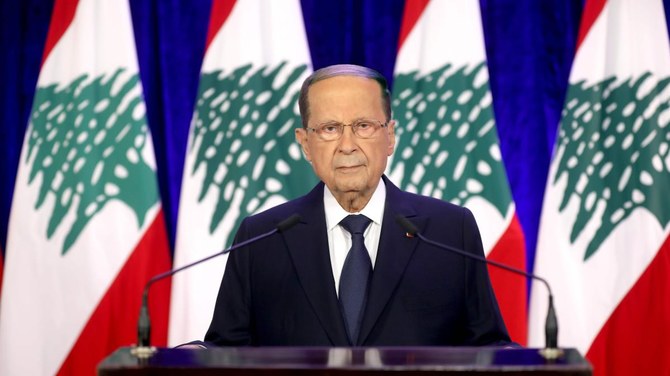
“Our reality today is not promising,” the president said in a televised speech to mark Independence Day, adding that Lebanon was a prisoner of corruption, political scheming and external dictations.
“If we want statehood, then we must fight corruption ... and this begins by imposing the forensic financial audit,” he said, adding he would not “back off” on the issue.
The caretaker finance minister announced on Friday that the restructuring consultancy Alvarez & Marsal had pulled out of the audit because the central bank had not provided all the information required to carry out the task, citing bank secrecy.
Lebanon has not yet formed a new government since the last one was brought down by the blast. Saad Al-Hariri, the Sunni prime minister-designate under a sectarian power-sharing agreement, is struggling to form a cabinet amid turf wars.


Lebanon’s president pledges to revive forensic audit of central bank
https://arab.news/r2xc8
Lebanon’s president pledges to revive forensic audit of central bank

- Among Lebanon’s multiple crises are growing poverty, a political vacuum and the coronavirus
- “If we want statehood, then we must fight corruption ... and this begins by imposing the forensic financial audit,” Aoun said


Iraq majority bloc backs Nouri al-Maliki as next PM: statement
- The Coordination Framework said that it “decided, by majority vote, to nominate” Al-Maliki for the position
- The statement spoke of Al-Maliki’s “political and administrative experience and his record in running the state“
BAGHDAD: Iraq’s main Shiite alliance, which holds a parliamentary majority, endorsed on Saturday former prime minister and powerbroker Nouri Al-Maliki as the country’s next premier.
The Coordination Framework, an alliance of Shiite factions with varying links to Iran, said in a statement that it “decided, by majority vote, to nominate” Al-Maliki for the position “as the candidate of the largest parliamentary bloc.”
The statement spoke of Al-Maliki’s “political and administrative experience and his record in running the state.”
A shrewd politician, Al-Maliki, 75, has long been a central figure in Iraq’s politics and its only two-term prime minister (2006-2014) since the US invasion of 2003, which ended decades of rule by the autocratic Sunni president Saddam Hussein.
Since the invasion and by convention in Iraq, a Shiite Muslim holds the powerful post of prime minister, a Sunni is parliament speaker, and the largely ceremonial presidency goes to a Kurd. After Iraq’s November general election, the Coordination Framework, which includes Al-Maliki, formed the majority bloc.
Soon after, it held heated talks to choose the next prime minister, along with other discussions with Sunni and Kurdish parties regarding other posts.
Iraq’s parliament chose a speaker last month and should convene next to elect a new president, who will then appoint a prime minister to replace the incumbent Mohammed Shia Al-Sudani.
Al-Maliki, leader of the State of Law Coalition, remains influential in Iraqi politics despite his controversial past, including widespread accusations of corruption, stoking sectarian tensions, and failing to stop the Daesh group.


