Forensic auditor pulls out of Lebanon central bank probe

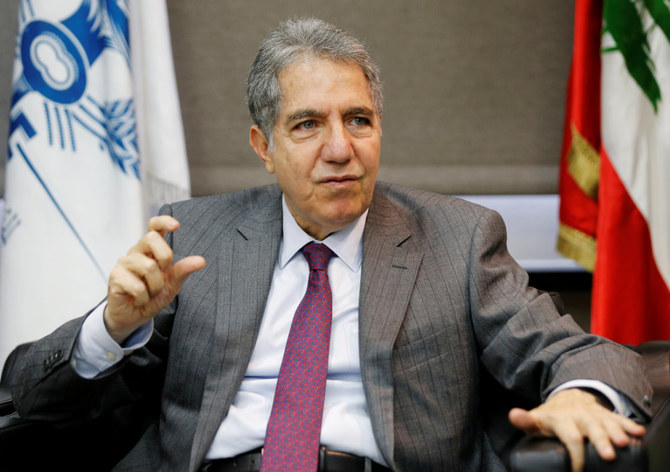
Lebanon's Finance Minister Ghazi Wazni gestures as he speaks during an interview with Reuters in Beirut on March 12, 2020. REUTERS/Mohamed Azakir/File Photo
Short Url
Updated 21 November 2020
Follow

Forensic auditor pulls out of Lebanon central bank probe

  • Alvarez & Marsal tells caretaker government it ‘has not received the information it needs to carry out the task’

BEIRUT: Restructuring consultancy Alvarez & Marsal has pulled out of a forensic audit of Lebanon’s central bank because it did not receive information required to carry out the task, caretaker Finance Minister Ghazi Wazni told Reuters on Friday.

The decision to walk away from the contract is a blow to Lebanon as it attempts to extricate itself from a deep financial crisis that has crashed its currency, paralyzed banks and prompted a sovereign debt default.

The International Monetary Fund has said the audit is a vital step toward securing financial aid.

The presidency issued a statement saying Wazni had informed President Michel Aoun of the consultancy’s decision to quit.

The statement said the firm told Wazni “it was not certain it would receive the information” it sought, even with a three-month extension announced on Nov. 5 for the central bank to provide data it had withheld.

Neither Alvarez & Marsal nor Lebanon’s central bank immediately responded to a Reuters request for comment.

The central bank, which has faced growing scrutiny since the financial crisis came to a head in October 2019, has previously said it provided its own accounts for the audit.

It has called on the government to submit full state accounts to “spare the central bank from violating legally binding bank secrecy laws.”

The caretaker government, whose talks with the IMF had stalled, has urged the central bank to hand over all data for the audit.

A parliamentary bloc this month submitted a proposed law to temporarily lift the bank secrecy law solely for the audit. No date has been set for a session on the proposed law.

The IMF and foreign donors have pressed for the audit to tackle endemic waste and corruption.

Prime Minister-designate Saad Hariri, named last month, has been trying to navigate sectarian politics to form a cabinet to bring in reforms needed to tackle Lebanon’s worst crisis since its 1975-1990 civil war, including spreading poverty.

UN special coordinator for Lebanon Jan Kubis said in a Twitter post that a meeting of the International Support Group for Lebanon on Friday in Beirut discussed “with grave concerns” the country’s deepening crisis.

He said the group, which includes the five permanent members of the UN Security Council, deplored lack of progress on a new government “but also the absence of a more determined action of existing state and financial institutions.”


Multilateralism strained, but global cooperation adapting: WEF report

Updated 10 January 2026
Follow

Multilateralism strained, but global cooperation adapting: WEF report

DUBAI: Overall levels of international cooperation have held steady in recent years, with smaller and more innovative partnerships emerging, often at regional and cross-regional levels, according to a World Economic Forum report.

The third edition of the Global Cooperation Barometer was launched on Thursday, ahead of the WEF’s annual meeting in Davos from Jan. 19 to 23.

“The takeaway of the Global Cooperation Barometer is that while multilateralism is under real strain, cooperation is not ending, it is adapting,” Ariel Kastner, head of geopolitical agenda and communications at WEF, told Arab News.

Developed alongside McKinsey & Company, the report uses 41 metrics to track global cooperation in five areas: Trade and capital; innovation and technology; climate and natural capital; health and wellness; and peace and security.

The pace of cooperation differs across sectors, with peace and security seeing the largest decline. Cooperation weakened across every tracked metric as conflicts intensified, military spending rose and multilateral mechanisms struggled to contain crises.

By contrast, climate and nature, alongside innovation and technology, recorded the strongest increases.

Rising finance flows and global supply chains supported record deployment of clean technologies, even as progress remained insufficient to meet global targets.

Despite tighter controls, cross-border data flows, IT services and digital connectivity continued to expand, underscoring the resilience of technology cooperation amid increasing restrictions.

The report found that collaboration in critical technologies is increasingly being channeled through smaller, aligned groupings rather than broad multilateral frameworks.  

This reflects a broader shift, Kastner said, highlighting the trend toward “pragmatic forms of collaboration — at the regional level or among smaller groups of countries — that advance both shared priorities and national interests.”

“In the Gulf, for example, partnerships and investments with Asia, Europe and Africa in areas such as energy, technology and infrastructure, illustrate how focused collaboration can deliver results despite broader, global headwinds,” he said.

Meanwhile, health and wellness and trade and capital remained flat.

Health outcomes have so far held up following the pandemic, but sharp declines in development assistance are placing growing strain on lower- and middle-income countries.

In trade, cooperation remained above pre-pandemic levels, with goods volumes continuing to grow, albeit at a slower pace than the global economy, while services and selected capital flows showed stronger momentum.

The report also highlights the growing role of smaller, trade-dependent economies in sustaining global cooperation through initiatives such as the Future of Investment and Trade Partnership, launched in September 2025 by the UAE, New Zealand, Singapore and Switzerland.

Looking ahead, maintaining open channels of communication will be critical, Kastner said.

“Crucially, the building block of cooperation in today’s more uncertain era is dialogue — parties can only identify areas of common ground by speaking with one another.”