Tens of thousands attend funeral of hardline Pakistani cleric in Lahore

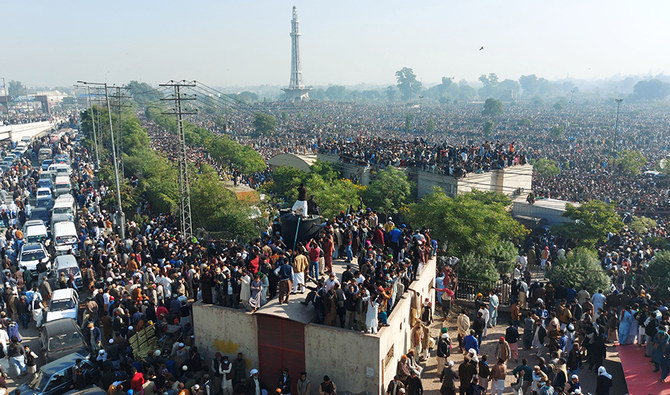
Activists and supporters of Tehreek-e-Labbaik Pakistan (TLP) gather for the funeral prayer of Khadim Hussain Rizvi, founder of TLP, in Lahore on November 21, 2020. (AFP)
Short Url
Updated 21 November 2020
Follow

Tens of thousands attend funeral of hardline Pakistani cleric in Lahore

  • Rizvi’s son, Saad Rizvi, has been appointed the next leader of the Tehreek-e-Labaik Pakistan
  • The cleric's critics accuse him of weaponizing the issue of blasphemy in a country where religious sensitivities usually run high

ISLAMABAD: Tens of thousands of people gathered near a prominent national monument in Lahore on Saturday to offer the funeral prayers of the founding leader of Tehreek-e-Labbaik Pakistan (TLP), Khadim Hussain Rizvi, who died at the age of 54 on Thursday.
Rizvi’s son, Saad Rizvi, has been appointed new leader of the group.
Rizvi’s last political activity was to lead an anti-France demonstration on the outskirts of Islamabad to protest the publication of caricatures disparaging Prophet Muhammad (pbuh).
The cause of his death could not be determined, though it was claimed that he was suffering from high fever and experienced breathing difficulties before his death.
Most people who participated in his funeral were not wearing face masks, though the country has been swept by a second wave of the coronavirus pandemic and most cities have made it mandatory for their residents to take precautionary measures at public places.
The TLP party emerged after Mumtaz Qadri, a police commando, assassinated Punjab governor Salman Taseer in Jan. 2011 for defending a Pakistani Christian woman sentenced to death for committing blasphemy.
Rizvi and his associates launched a campaign for Qadri’s release, saying he had acted to protect the honor of the Prophet (pbuh).
Anti-blasphemy protests organized by TLP in 2017 paralyzed Islamabad for several weeks, and were only dispersed after a military-brokered deal. Rizvi and his party also held nationwide protests against Bibi’s acquittal in Oct. 2018.
Pakistan’s mainstream media usually avoid covering TLP protests, but the group reached the masses through social media.
A controversial preacher who used strong language to revile his critics, Rizvi was accused of weaponizing the issue of blasphemy in a country where religious sensitivities usually run high.
His recent demonstration forced the government to consider the possibility of expelling the French ambassador after taking up the issue in parliament.


Pakistan reports decline in polio cases in 2025

Updated 4 sec ago
Follow

Pakistan reports decline in polio cases in 2025

  • Cases drop to 30 from 74 in 2024, with no new infections recorded since September
  • Authorities plan intensified targeted drives in 2026 to halt remaining transmission

ISLAMABAD: Pakistan reported a sharp decline in polio cases in 2025, with infections falling to 30 from 74 a year earlier, as intensified vaccination campaigns and improved surveillance helped curb the spread of the virus, health authorities said on Wednesday.

No new polio cases have been recorded anywhere in the country since September, said a statement, as Pakistan carried out six polio campaigns, including five nationwide drives, trying to reach children in high-risk areas and improve monitoring of virus circulation.

Despite the decline, the authorities cautioned that poliovirus continues to circulate in some districts, requiring sustained vigilance to prevent a resurgence.

“Targeted interventions, robust community engagement, and ongoing vaccination efforts remain essential to reach every missed child and prevent any resurgence,” the official statement said.

“Frontline health workers, security personnel, and local authorities continue to work in close coordination to maintain high immunity levels and ensure that Pakistan remains on course toward becoming polio-free,” it added.

The most recent nationwide campaign, conducted from Dec. 15 to 21, achieved more than 98 percent coverage across the country, including all four provinces, Azad Jammu and Kashmir, Gilgit-Baltistan and the capital, Islamabad.

Authorities reported an 18 percent reduction in the number of missed children compared with the previous round, with notable improvements in access and operations in southern Khyber Pakhtunkhwa, a longstanding challenge area.

Pakistan’s polio eradication drive relies on close coordination between health workers, security personnel and local authorities, amid ongoing resistance in some communities and access constraints in remote or insecure regions.

Officials said district-specific interventions, including improved microplanning, better deployment of vaccination teams and enhanced community outreach, were being used to address remaining gaps, particularly in parts of southern Khyber Pakhtunkhwa.

The statement said Pakistan plans to intensify targeted efforts in 2026 to interrupt the remaining transmission chains and move closer to eliminating the disease.