

Burkina Faso to vote in shadow of extremist threat

1 / 4
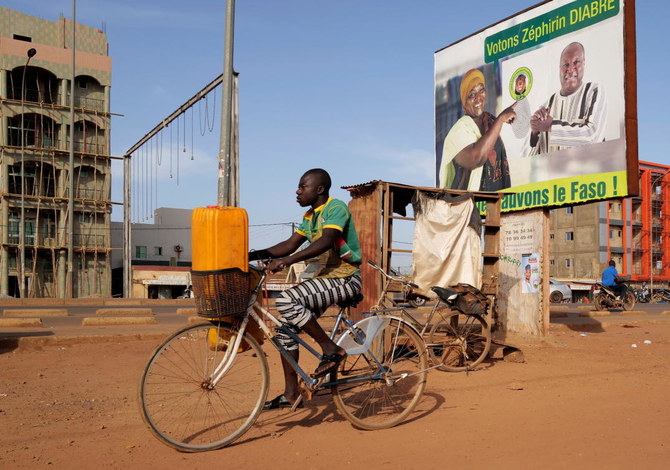
A man rides a bicycle past a campaign poster of presidential candidate Zephirin Diabre in Ouagadougou, Burkina Faso, November 20, 2020. (Reuters)
2 / 4
Women and children who fled from militant attacks in Soum province, sit on a pile of rocks that they will turn into powder for sale to construction workers, Ouagadougou, Burkina Faso, Nov. 19, 2020. (Reuters)
3 / 4
Burkina Faso President Roch Kabore attends a campaign rally in Bobo-Dioulasso, Nov. 5, 2020. (AP Photo)
4 / 4
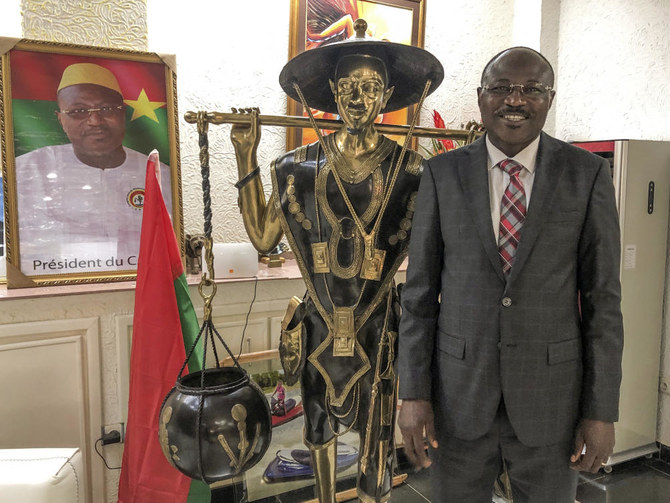
Burkina Faso’s opposition leader Eddie Komboigo, head of the Congress for Democracy and Progress party, at his office in Ouagadougou, Nov. 6, 2020. (AP Photo)
Short Url
Updated 20 November 2020
Follow

Burkina Faso to vote in shadow of extremist threat

  • Fourteen soldiers were killed in an ambush in the north claimed by the Daesh group earlier this month, one of the deadliest attacks on the military in the five-year insurgency
  • Emmanuel Macron — president of Burkina Faso’s former colonial ruler France, which has troops in the country — waded into the debate, ruling out negotiating with extremists

OUAGADOUGOU: Burkina Faso will vote in a general election Sunday in the shadow of a growing extremist insurgency, with President Roch Marc Christian Kabore expected to win re-election.

But no votes in the presidential and parliament polls will be cast in one-fifth of the country’s territory, where large swathes remain outside the state’s control and extremist attacks strike almost daily.

The violence has forced one million people — five percent of the 20 million population — from their homes in the last two years, and at least 1,200 have been killed since 2015.

The security crisis has dominated the campaign and voting will take place under heavy surveillance in the landlocked West African country, one of the world’s poorest.

Most of the 12 opposition candidates running against Kabore have criticized the incumbent’s failure to stem the bloodshed.

But the opposition did not unite behind a single candidate and Kabore is aiming for a first round victory — as he won in 2015 — to stave off a run-off vote.

He faces stiff competition from 2015’s runner-up, veteran opposition leader Zephirin Diabre, and Eddie Komboigo, standing for the party of former president Blaise Compaore.

Compaore, who was ousted by a popular uprising in 2014 after 27 years in power, is now in exile but some voters are nostalgic for his regime.

Komboigo told a rally in the capital Ouagadougou Friday that Compaore would “return with all honors,” praising his “sacrifice for the development of Burkina Faso.”

Fourteen soldiers were killed in an ambush in the north claimed by the Daesh group earlier this month, one of the deadliest attacks on the military in the five-year insurgency.

Days later, the Daesh propaganda arm published a picture of two extremists killing a man wearing an army uniform — but the military denied there had been a new attack.

Extremist violence in the north — as in neighboring Sahel states Mali and Niger — has become intertwined with clashes between ethnic groups.

The Fulani community has in particular been targeted for recruitment by extremists, and attacks regularly spark reprisal attacks, continuing the cycle of violence.

Humanitarian groups have condemned massacres of Fulani civilians by pro-government militias or the army.

Despite regularly claiming successes, the poorly equipped and trained army has slumped from loss to loss.

Security expert Mahamoudou Savadogo told AFP that the initial diagnosis of the threat “was poor and the response was neither adequate nor appropriate.”

Almost all of Kabore’s challengers have called for dialogue with the extremists to be explored — a suggestion Kabore has emphatically rejected.

Diabre said that “military action on its own has never been able to defeat terrorism in any part of the world.”

“Alongside military action, there must be other actions.”

Emmanuel Macron — president of Burkina Faso’s former colonial ruler France, which has troops in the country — waded into the debate on Friday, ruling out negotiating with extremist groups in the Sahel.

“We don’t talk with terrorists. We fight,” he said in an interview.

One of Kabore’s efforts has been the creation earlier this year of volunteer militias supervised by the state, called Volunteers for the Defense of the Nation (VDP).

Their role in Sunday’s election remains unclear, but a Western source in Ouagadougou said the presidential party “could be accused of using its troops” to push for Kabore votes.

A VDP leader in a central region assured that the militia will remain “neutral.”

“We will be there to support the army and protect polling stations,” the VDP leader said.

Political scientist Drissa Traore said that because the opposition “did not manage to unite behind a single candidate,” Kabore hopes to get more than 50 percent of the vote on Sunday to avoid facing only one of them in a in a second round.

Throughout the campaign, Kabore has promised to restore peace.

“Once the election is over, we will take care of serious matters,” he said in a meeting.

Around 6.5 million people will vote in Sunday’s election, with enrolment not taking place in nearly 1,500 of the country’s 8,000 villages, nor in 22 of more than 300 communes, because of the security risks.


Progress for Ukraine talks in Paris uncertain with US focus shifting to Venezuela

Updated 5 sec ago
Follow

Progress for Ukraine talks in Paris uncertain with US focus shifting to Venezuela

  • Ukraine’s allies are meeting in Paris to discuss security guarantees after a potential ceasefire with Russia. The Trump administration’s focus on Venezuela could complicate progress
  • France and the UK lead efforts to strengthen post-ceasefire defenses for Ukraine, possibly with European forces

PARIS: Ukraine’s allies are meeting Tuesday in Paris for key talks that could help determine the country’s security after a potential ceasefire with Russia. But prospects for progress are uncertain with the Trump administration’s focus shifting to Venezuela.
Before the US capture of Venezuelan leader Nicolás Maduro, French President Emmanuel Macron had expressed optimism about the latest gathering of so-called “coalition of the willing” nations. For months, they have been exploring how to deter any future Russian aggression should it agree to stop fighting Ukraine.
In a Dec. 31 address, Macron said that allies would “make concrete commitments” at the summit “to protect Ukraine and ensure a just and lasting peace.”
Macron’s office said Tuesday’s meeting will gather an unprecedented number of officials attending in person, with 35 participants including 27 heads of state and government. The US will be represented by President Donald Trump’s envoys, Steve Witkoff and Jared Kushner.
Macron’s office said the US delegation was initially set to be led by Secretary of State Marco Rubio, who changed his plans for reasons related to the military intervention in Venezuela.
Participants seek concrete outcomes on five key priorities once fighting ends: ways to monitor a ceasefire; support for Ukraine’s armed forces; deployment of a multinational force on land, at sea and in the air; commitments in case there’s another Russian aggression; and long-term defense cooperation with Ukraine.
But whether that’s still achievable Tuesday isn’t so clear now, as Trump deals with the aftermath of his decision to effect leadership change in Venezuela.
Ukraine seeks firm guarantees from Washington of military and other support seen as crucial to securing similar commitments from other allies. Kyiv has been wary of any ceasefire that it fears could provide time for Russia to regroup and attack again.
Recent progress in talks
Before the US military operation targeting Maduro, Witkoff had indicated progress in talks about protecting and reassuring Ukraine.
In a Dec. 31 post, Witkoff tweeted that “productive” discussions with him, Rubio, and Kushner on the US side and, on the other, national security advisers of Britain, France, Germany and Ukraine had focused on “strengthening security guarantees and developing effective deconfliction mechanisms to help end the war and ensure it does not restart.”
France, which with the United Kingdom has coordinated the monthslong, multination effort to shore up a ceasefire, has only given broad-brush details about the plan’s scope. It says Ukraine’s first line of defense against a Russian resumption of war would be the Ukrainian military and that the coalition intends to strengthen it with training, weaponry and other support.
Macron has also spoken of European forces potentially being deployed away from Ukraine’s front lines to help deter future Russian aggression.
Important details unfinalized
Ukraine’s President Volodymyr Zelensky said during the weekend that potential European troop deployments still face hurdles, important details remain unfinalized, and “not everyone is ready” to commit forces.
He noted that many countries would need approval from parliament even if leaders agreed to military support for Ukraine. But he recognized that support could come in forms other than troops, such as “through weapons, technologies and intelligence.”
Zelensky said that post-ceasefire deployments in Ukraine by Britain and France, Western Europe’s only nuclear-armed nations, would be “essential” because some other coalition members ”cannot provide military assistance in the form of troops, but they do provide support through sanctions, financial assistance, humanitarian aid and so on.”
“Speaking frankly as president, even the very existence of the coalition depends on whether certain countries are ready to step up their presence,” Zelensky said. “If they are not ready at all, then it is not really a ‘coalition of the willing.’”