Internet giants say their services may become unavailable under Pakistan’s new rules 

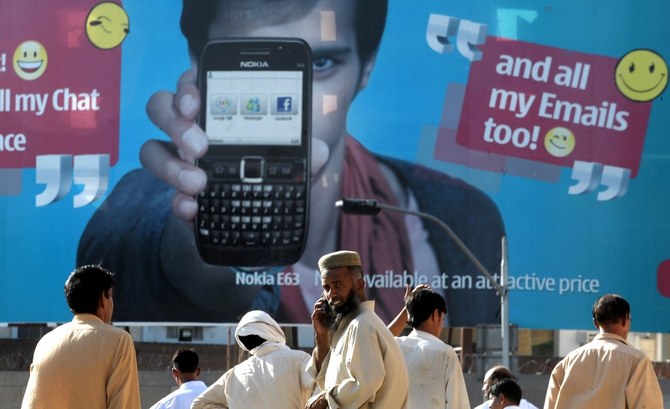
Pakistani pedestrians stand in front of an advertisement for a cellular telephone in Rawalpindi on May 14, 2010. (AFP/File)
Short Url
Updated 20 November 2020
Follow

Internet giants say their services may become unavailable under Pakistan’s new rules 

  • Social networking websites are required to remove unlawful content in 24 hours after receiving a government directive
  • A service provider or social media company could face a fine up to Rs500 million ($3.14 million) for noncompliance

ISLAMABAD: Leading global internet companies may be unable to operate in Pakistan under the country’s new social media rules, Asia Internet Coalition (AIC) said in a statement on Thursday.
Under the Removal and Blocking of Unlawful Online Content (Procedure, Oversight and Safeguards) Rules 2020, notified by the Pakistani government on Wednesday, social media companies are bound to block access to unlawful online content within 24 hours — or in emergency cases, within six hours — after being reported by a government authority.
A service provider or social media company could face a fine up to Rs500 million ($3.14 million) for noncompliance, which would in turn trigger a mechanism preventing the uploading and live streaming, particularly related to “terrorism, hate speech, pornography, incitement to violence and detrimental to national security.”
“The Rules would make it extremely difficult for AIC members to make their services available to Pakistani users and businesses,” said the Internet coalition which comprises Amazon, AirBnb, Apple, Booking.com, Expedia Group, Facebook, Grab, Google, LinkedIn, LINE, Rakuten, Twitter and Yahoo.
The new rules were approved initially by Prime Minister Imran Khan’s cabinet in February, but while the government promised to initiate a consultation with the tech industry, according to AIC the talks “never occurred” and members of the group are “alarmed by the scope of Pakistan’s new law targeting Internet companies, as well as the government’s opaque process by which these rules were developed.”
Islamabad has been struggling to regulate online content by blocking and removing fake news and propaganda against the country’s national security institutions, including the army, blasphemous content, and other sensitive material that violates cultural and ethnic norms of the country. Last month, the Pakistan Telecommunication Authority (PTA) blocked TikTok for failing to filter out “immoral and indecent” content.
“It’s chilling to see the PTA’s powers expanded, allowing them to force social media companies to violate established human rights norms on privacy and freedom of expression,” AIC said.
“The draconian data localization requirements will damage the ability of people to access a free and open Internet and shut Pakistan’s digital economy off from the rest of the world.“
PTA spokesman Khurram Mehran told Reuters the rules were meant for a better coordination with foreign-based social media companies, which usually “don’t respond to legal requirements.”


Pakistan, global crypto exchange discuss modernizing digital payments, creating job prospects 

Updated 05 December 2025
Follow

Pakistan, global crypto exchange discuss modernizing digital payments, creating job prospects 

  • Pakistani officials, Binance team discuss coordination between Islamabad, local banks and global exchanges
  • Pakistan has attempted to tap into growing crypto market to curb illicit transactions, improve oversight

ISLAMABAD: Pakistan’s finance officials and the team of a global cryptocurrency exchange on Friday held discussions aimed at modernizing the country’s digital payments system and building local talent pipelines to meet rising demand for blockchain and Web3 skills, the finance ministry said.

The development took place during a high-level meeting between Finance Minister Muhammad Aurangzeb, Pakistan Virtual Assets Regulatory Authority (PVARA) Chairman Bilal bin Saqib, domestic bank presidents and a Binance team led by Global CEO Richard Teng. The meeting was held to advance work on Pakistan’s National Digital Asset Framework, a regulatory setup to govern Pakistan’s digital assets.

Pakistan has been moving to regulate its fast-growing crypto and digital assets market by bringing virtual asset service providers (VASPs) under a formal licensing regime. Officials say the push is aimed at curbing illicit transactions, improving oversight, and encouraging innovation in blockchain-based financial services.

“Participants reviewed opportunities to modernize Pakistan’s digital payments landscape, noting that blockchain-based systems could significantly reduce costs from the country’s $38 billion annual remittance flows,” the finance ministry said in a statement. 

“Discussions also emphasized building local talent pipelines to meet rising global demand for blockchain and Web3 skills, creating high-value employment prospects for Pakistani youth.”

Blockchain is a type of digital database that is shared, transparent and tamper-resistant. Instead of being stored on one computer, the data is kept on a distributed network of computers, making it very hard to alter or hack.

Web3 refers to the next generation of the Internet built using blockchain, focusing on giving users more control over their data, identity and digital assets rather than big tech companies controlling it.

Participants of the meeting also discussed sovereign debt tokenization, which is the process of converting a country’s debt such as government bonds, into digital tokens on a blockchain, the ministry said. 

Aurangzeb called for close coordination between the government, domestic banks and global exchanges to modernize Pakistan’s payment landscape.

Participants of the meeting also discussed considering a “time-bound amnesty” to encourage users to move assets onto regulated platforms, stressing the need for stronger verifications and a risk-mitigation system.

Pakistan has attempted in recent months to tap into the country’s growing crypto market, crack down on money laundering and terror financing, and promote responsible innovation — a move analysts say could bring an estimated $25 billion in virtual assets into the tax net.

In September, Islamabad invited international crypto exchanges and other VASPs to apply for licenses to operate in the country, a step aimed at formalizing and regulating its fast-growing digital market.