


Emiratis claim four Guinness world records with feats of skill, daring — and love

1 / 4
Three Emiratis broke four world records as part of the annual Guinness World Records (GWR) Day which was celebrated globally on Wednesday, Nov. 18. (Supplied)
2 / 4
Three Emiratis broke four world records as part of the annual Guinness World Records (GWR) Day which was celebrated globally on Wednesday, Nov. 18. (Supplied)
3 / 4
Three Emiratis broke four world records as part of the annual Guinness World Records (GWR) Day which was celebrated globally on Wednesday, Nov. 18. (Supplied)
4 / 4
Three Emiratis broke four world records as part of the annual Guinness World Records (GWR) Day which was celebrated globally on Wednesday, Nov. 18. (Supplied)
Short Url
Updated 19 November 2020
Follow

Emiratis claim four Guinness world records with feats of skill, daring — and love

LONDON: Three Emiratis broke four world records as part of the annual Guinness World Records (GWR) Day which was celebrated globally on Wednesday, Nov. 18.

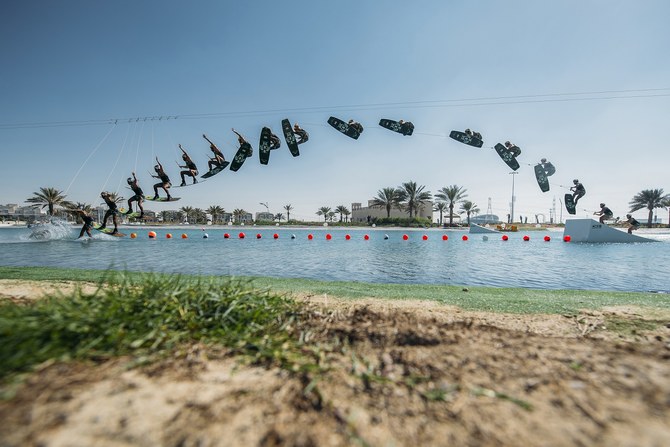
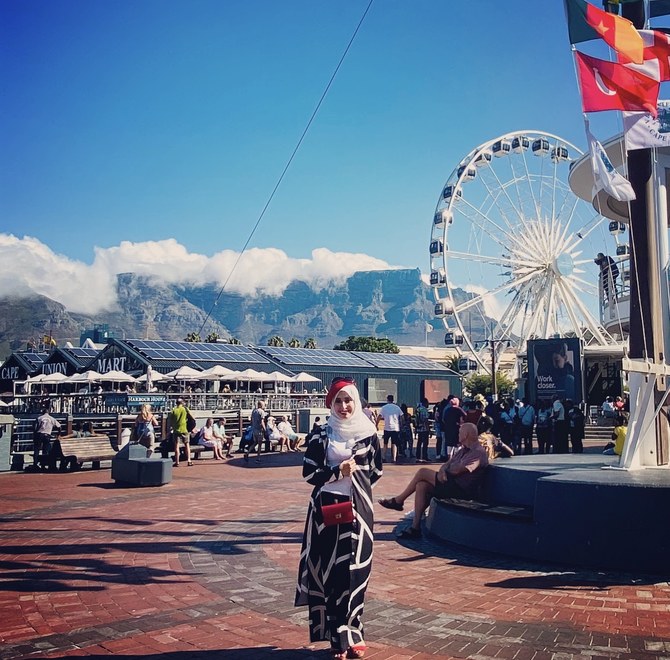
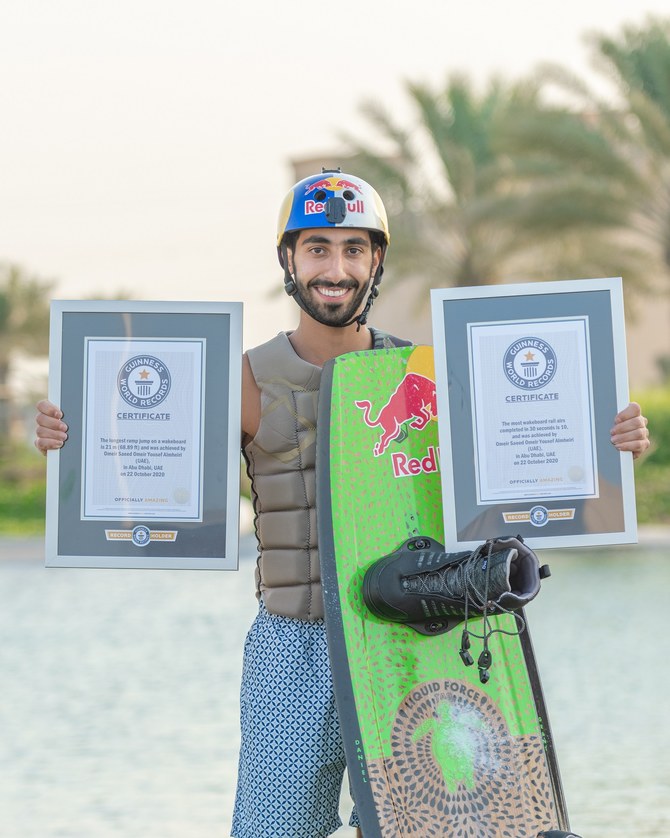
Omeir Saeed broke two world records — for furthest wakeboard ramp jump by a male and the most wakeboard rail airs in 30 seconds — while Dr. Khawla Al-Romaithi claimed the world record for the fastest time to travel to all seven continents, a feat he achieved in three days, 14 hours, 46 minutes and 48 seconds.


Meera Al-Hosani made the “largest sock word” by shaping the garments into the word “Happiness” in Arabic, breaking the current record while also raising awareness about inclusivity for people with Down’s syndrome in the UAE.

Saeed, 23, achieved an impressive 21-meter jump, smashing the previous record of 15 meters held by Jerome Macquart of France since 2004, as well as landing 10 rail airs in 30 seconds — double Macquart’s record of five set in 2005.

“If there is one thing I learned from this experience, it is that we hold a big responsibility to inspire the younger generation, to transfer the message and share the passion. Having this global recognition makes me proud as an Emirati. This is certainly the jewel in the crown of so many years of achievement and success,” Saeed said.

Al-Romaithi’s record-breaking time traveling to all seven continents beat the previous mark set by Kasey Stewart and Julie Berry from the US in December 2017 which stood at three days, 20 hours, 4 minutes and 19 seconds.

“To travel the world at a time when almost the whole globe is in lockdown is challenging, but to be the fastest to do it is even more challenging,” she said. “Since I started my trip in February 2020, the whole world has changed, and I think it makes this achievement even more worthy. Being an Emirati mom with all this makes me the proudest ever.”

Al-Hosani said that “love for my little Latifa” inspired her to write the word “Happiness” in Arabic using 1,447 socks.

“This was a great way to help raise awareness about these amazing, cheerful individuals,” Al-Hosani said. “I have been blessed with Latifa, who spreads joy everywhere she goes. I cannot be more thankful to be recognized as a Guinness World Records title holder, and contribute to sending this message of hope from the UAE.”

More than 50 countries took part in the GWR Day. Among those attempting to create world records was Deena Shipwright in Bahrain who was hoping to take the highest number of football penalties in a 24-hour period.

Other stories from around the world:

* In China, 105-year-old Yu Te-Hsin took on the challenge of oldest male to tandem paraglide.

* Japanese pair Hijiki Ikuyama and Angora Soncho will combine in an attempt for the most alternate skips by a pair in 30 seconds. With 60 skips to beat in the timeframe, the pair from Tokyo were determined to set themselves a goal, keep fit and achieve something special during what they called a “difficult year.”

* In the UK, Londoner Tinuke O’Yediran, a professional roller-skater and circus performer, is attempting two records — most cartwheels on roller skates in one minute and most 360 spins on e-skates in one minute.

* In the the US, sports and entertainment titans the Harlem Globetrotters have spent much of their year at home after tours and shows were canceled due to the coronavirus pandemic. With months to practice and hone skills, they are attempting the furthest behind-the-back basketball shot, highest throw and catch of a spinning basketball and most bounced basketball figure-eight moves in one minute.


Not Italy’s Devil’s Island: Sardinia bristles at mafia inmate plan

Updated 07 February 2026
Follow

Not Italy’s Devil’s Island: Sardinia bristles at mafia inmate plan

  • A third of top-risk mafia prisoners could go to Sardinia
  • Officials say clans may follow relatives and infiltrate economy

NUORO: In Nuoro, a remote city on the Italian island of Sardinia, a high stone wall rings the local prison, a fortress-like complex once renowned for holding high-profile mobsters and convicted terrorists far from the mainland.

Only a handful of top mafiosi remain detained there and Sardinia is no longer seen as a dumping ground for criminals, instead building an international reputation around tourism.

But that could change under a plan of Prime Minister Giorgia Meloni’s government which has alarmed residents. In December, a justice undersecretary said about 750 prisoners held under the rigid “41bis” regime would be concentrated in just a few dedicated facilities across Italy, overseen by special guard units to improve security.

Sardinia has been told it may get nearly a third of them, split between Sassari in the north, already housing about 90, the capital Cagliari, where around 90 are due to arrive this month, and Nuoro — reviving old stigma concerns.

“Sardinia does not deserve to be seen as Italy’s Cayenne,” said Governor Alessandra Todde, invoking the notorious former French Guiana penal colony on Devil’s Island.

Worries of Mafia infiltration

Italy’s 41bis regime, named after the law that regulates it, is among the most restrictive in Europe. Introduced in 1992 after the murder of anti-mafia ‌judge Giovanni Falcone, ‌it imposes near-total isolation on prisoners and was designed to stop bosses running their operations from behind ‌bars.

The ⁠law says it should “preferably” ‌be enforced on Italy’s islands. The late boss of the Sicilian mafia, Salvatore “Toto” Riina, was among those once held in Sardinia.

Locals and authorities fear the government plan could prompt mafia clans to move from mainland Italy to be near jailed relatives, creating opportunities to launder illicit money and infiltrate business, particularly in less developed areas, such as Nuoro, a city of 30,000 people.

Silvio Lai, a Sardinian lawmaker with the opposition Democratic Party, visited the city prison last month and said renovation work was already ongoing, potentially making room for at least 30 new maximum-security inmates.

“Weak economies can be infiltrated easily, and Nuoro is about an hour’s drive from the Costa Smeralda,” Lai said, suggesting a mafia foothold in the city could swiftly spread to the island’s luxurious tourist resort.

The Justice Ministry did not respond to a request to comment on the work.

Improving ⁠national security

Autonomous mafia groups have never emerged in sparsely populated Sardinia, but magistrates say investigations have been opened into alleged clan penetration in the north of the island, possibly encouraged by the presence of detained ‌mobsters.

“Prosecutors are keeping a close watch on the phenomenon of Camorra (a mafia group based around Naples) ‍investments... especially in the tourism, hospitality and restaurant sectors,” said Cagliari chief prosecutor ‍Luigi Patronaggio.

At a December meeting with regional officials, Justice Undersecretary Andrea Delmastro Delle Vedove downplayed the risk of a mass move to Sardinia, minutes show, ‍arguing that families of 41bis detainees do not typically leave clan-controlled areas.

“This (plan) will ensure greater national security... will make individual prisons safer because only specialized prison guard units will be deployed,” Delmastro said.

However, Maria Cristina Ornano, head of the sentence enforcement tribunal in Cagliari, said police and the judiciary will need increased security resources if more mobsters arrive.

“Once organized crime takes root here, we will not be able to get rid of it. We can see it in parts of southern Italy, which are among the most