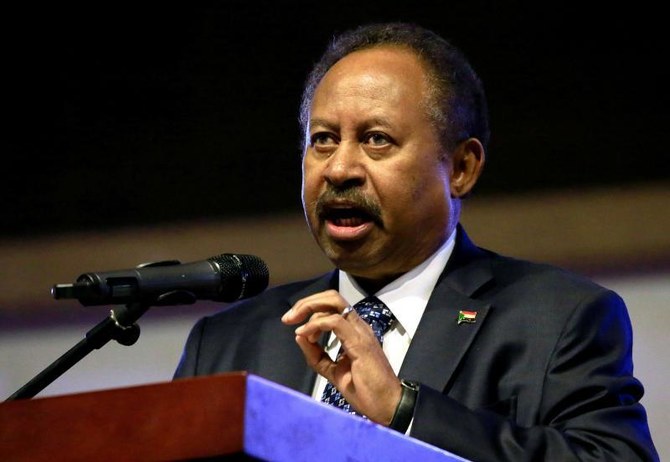
KHARTOUM: Sudan’s Prime Minister Abdalla Hamdok welcomed rebel leaders to the capital Khartoum on Sunday, as crowds celebrated what they hoped was the end of war following a landmark peace deal.
“We have been looking forward to this day,” Hamdok said as he greeted the leaders, according to a broadcast by the official news agency SUNA.
“Today we are taking the first steps to put an end to the suffering of our people.”
It was the first time the leaders of the Sudan Revolutionary Front (SRF), a coalition of rebel and political groups, had come to the capital since the signing of an October 3 peace agreement in neighboring South Sudan.
“We have come to put the peace agreement into effect on the ground,” said Minni Minawi, who leads a faction of the Darfur-based Sudan Liberation Movement, according to SUNA.
“We must work to assume responsibility and abandon the political quarrels to move toward democracy.”
The peace deal is hoped to end decades of fighting, including the war in the western Darfur region that erupted in 2003.
The United Nations estimates at least 300,000 people were killed and 2.5 million were displaced in the Darfur conflict.
“This is the first time in Sudan’s history we reached a deal that truly addresses the roots of the Sudanese crisis,” said Hamdok.
Jubilant crowds packed a central square in Khartoum, chanting and carrying banners to celebrate.
The SRF — founded in 2011 — is an alliance of armed rebel groups and political movements including from Darfur, South Kordofan and Blue Nile states.
Conflict in South Kordofan and Blue Nile erupted in 2011, following unresolved issues from bitter fighting there in Sudan’s 1983-2005 civil war.
Sudan’s transitional government seized power after the April 2019 ouster of longtime president Omar Al-Bashir, following unprecedented street protests against his rule.
Bashir has been jailed in Khartoum’s high security Kober prison and was found guilty last December of corruption.
He is currently on trial in Khartoum for his role in the 1989 coup that brought him to power, and has also been indicted by the International Criminal Court (ICC) accused of genocide in Darfur.


![]()

Sudan welcomes rebels back to Khartoum after peace deal
Short Url
https://arab.news/mwk5j
Sudan welcomes rebels back to Khartoum after peace deal
- “We have been looking forward to this day,” Hamdok said as he greeted the leaders


Latest updates


© 2026 SAUDI RESEARCH & PUBLISHING COMPANY, All Rights Reserved And subject to Terms of Use Agreement.