GILGIT: Vote counting has begun in Pakistan’s Gilgit-Baltistan region, signaling an end to a legislative assembly election that has been called the most significant and hotly contested election the neglected northern region has ever held.
For the last few weeks, campaigning has been on in full swing in the area, with candidates from Pakistan’s major political parties promising to build infrastructure projects and end decades of neglect in a region that has never officially been part of Pakistan, but forms part of the portion of disputed Kashmir that Pakistan controls.
Both Delhi and Islamabad have claimed all of Kashmir since gaining independence 73 years ago, and have fought two wars over the territory.
Senior journalist Muhammad Younus, who observed the election process at over a dozen polling stations in Gilgit district, told Arab News: “The election remained peaceful at all polling station. But at many polling stations the polling process was very slow.”
Power outages reported at some polling stations slowed down the voting process as staff used torches to register voter data. In Ghizer, Hunza, Sost and Baltistan, heavy snowfall restricted some citizens to their houses. Hundreds of passengers headed to the region to cast their votes were also stranded near Bisham since Saturday night due to a blockade on the Karakoram Highway.
Shahid Iqbal, an official at the local police station’s public relation branch, said a paramilitary soldier was killed in a landslide accident near a polling station while one member of police from Khyber Pakhtunkhwa province on guard duty died of a cardiac arrest.
A scuffle also broke out in Arando, a village of district Shigar, between members of two opposing parties, because of which polling had to be halted for half an hour.
Over 13,000 law enforcement officials, including those brought in from around the country, were deployed across polling stations in the region to secure the voting process, which ran from 8am to 5pm.
According to data from the Gilgit-Baltistan election commission, 745,361 people had registered to vote, of which 339,992 are women. Nearly 1,234 polling stations were set up in 24 constituencies, of which 415 were declared ‘extremely sensitive.’
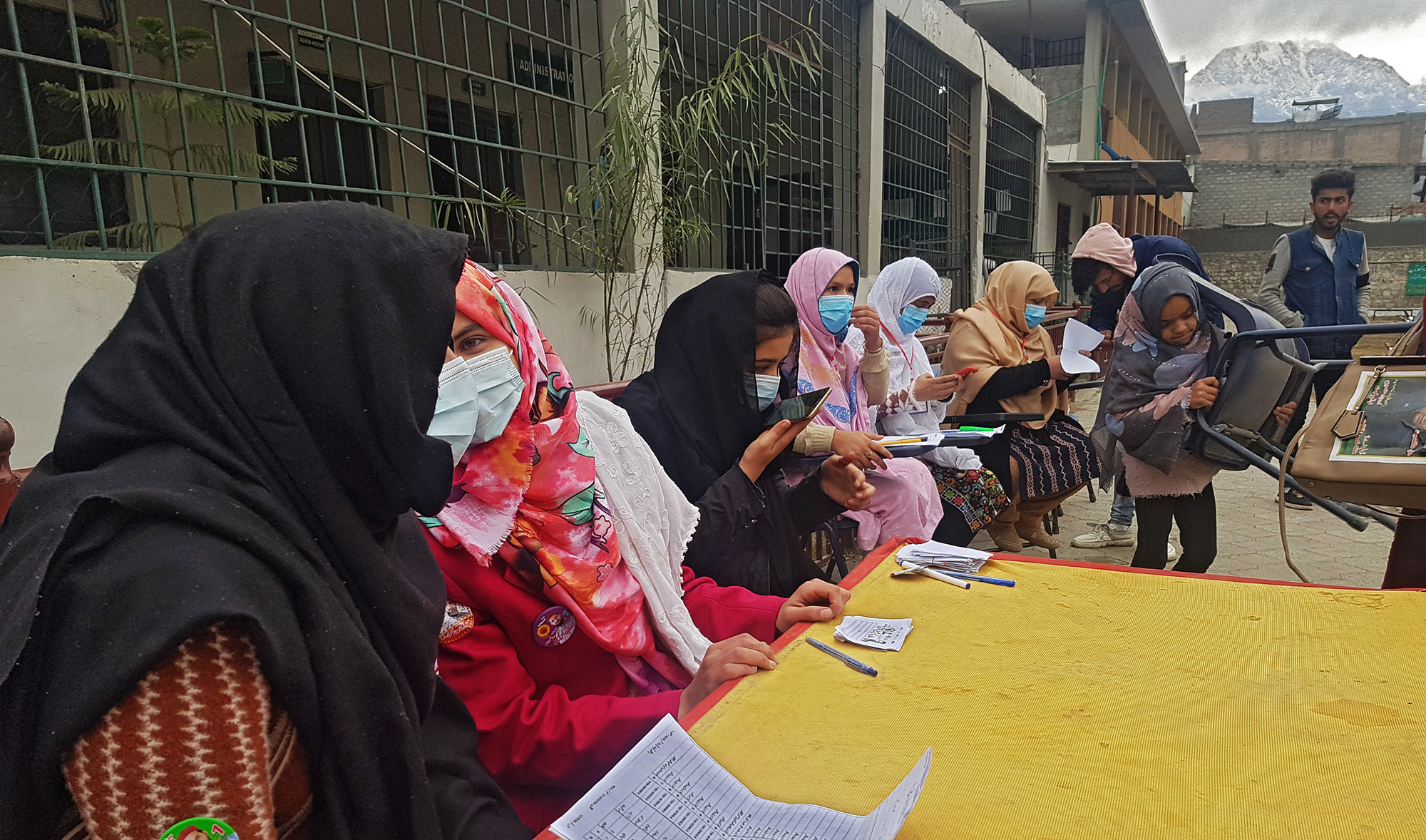
Women voting officers check serial numbers for voters at the gate of a polling station in Gilgit district of Gilgit-Baltistan, Pakistan, on Nov. 15, 2020. (AN photo by Nisar Ali)
As many as 330 candidates, including four women, vied for 24 general seats in the third legislative assembly of Gilgit-Baltistan.
The Gilgit-Baltistan government had ordered that voters maintain a distance of six feet from each other to help curb the spread of the coronavirus, and 8,000 bags containing face covers, masks, gloves and sanitisers were provided for staff at polling booths.
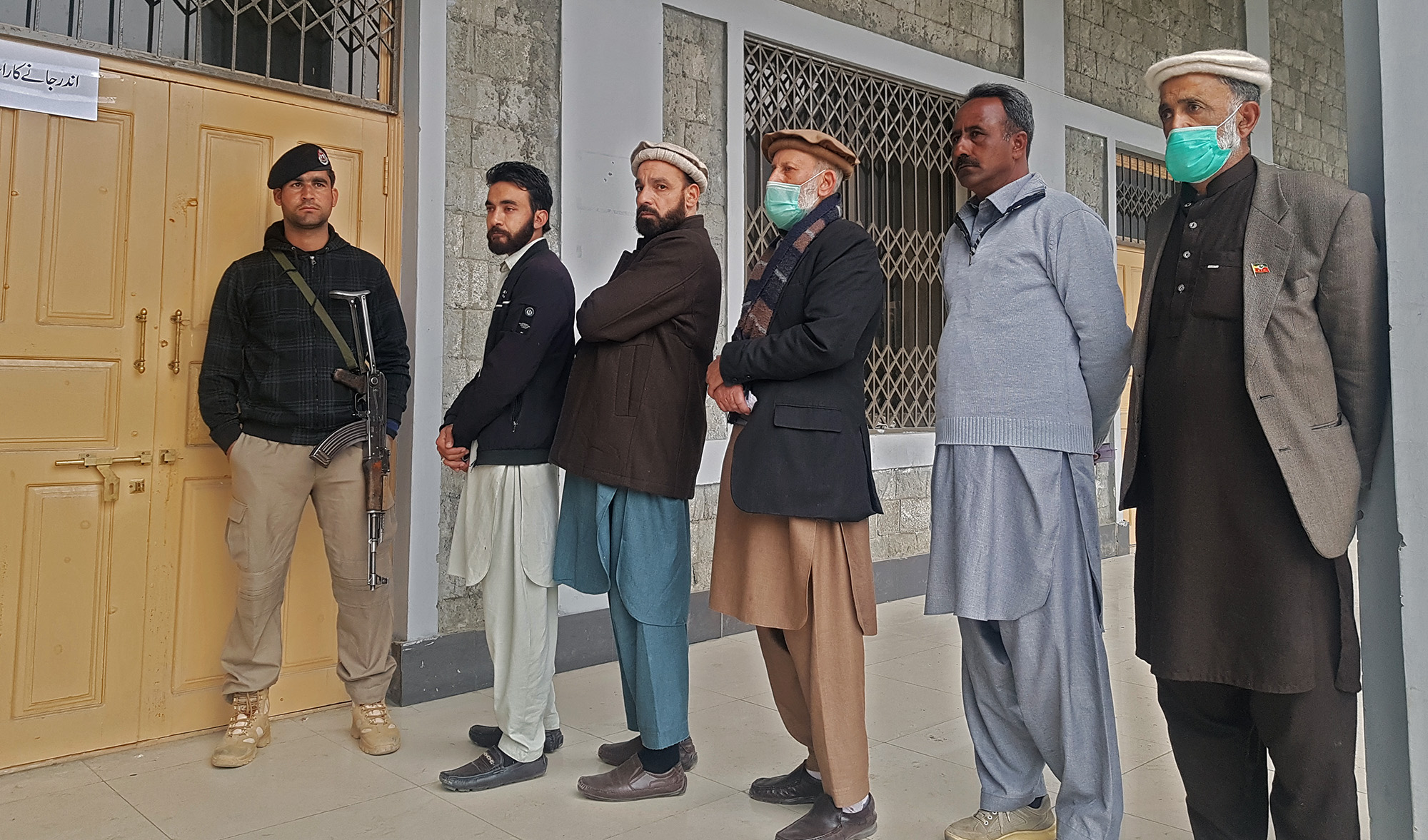
Men stand in line outside a polling station in Gilgit district of Gilgit-Baltistan, Pakistan, on Nov. 15, 2020. (AN photo by Nisar Ali)
A former official in the chief minister’s office, Shahzada Maqpon, cast his vote in the Majini Muhallah of Gilgit and said a large number of people were voting in the hopes that a new local government would work for the development of the impoverished area.
“Vote is the fundamental right of people and everyone is coming to polling stations to choose the best representatives for the region,” he said.
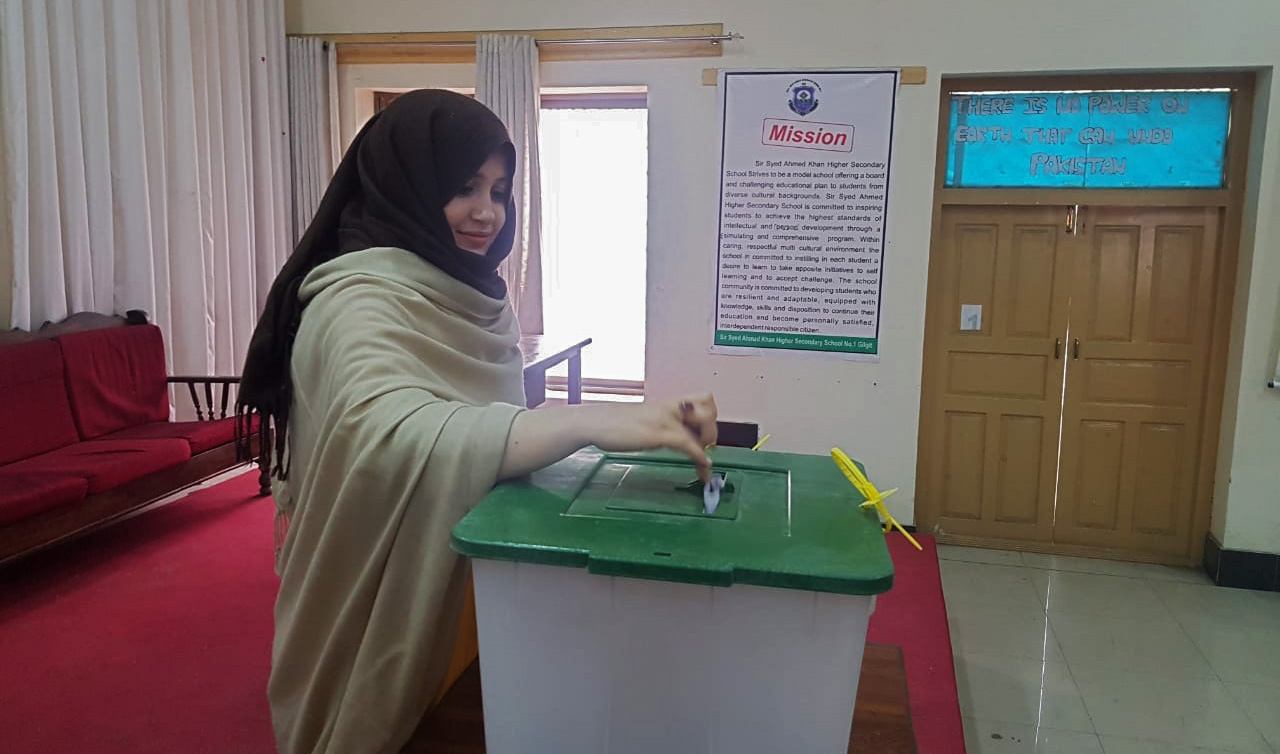
A woman casting her vote in Gilgit district of Gilgit-Baltistan, Pakistan on Nov. 15, 2020. (AN photo by Nisar Ali)
Women too came out to vote in a region where women have never voted in several constituencies and few have run for office.
“In the last election, my husband didn’t allow me to cast my vote, saying it is not necessary for women,” Zahra Bibi told Arab News outside a polling station. “Today I am happy that I have voted for a female candidate.”
Senior journalist Qasim Shah, who has been covering elections in the area for the last two decades, said a “greater” turnout was expected than in any elections in the past.
Earlier this month, the federal government said it had decided to elevate the impoverished region’s status to that of a province, which would give it greater political representation.
The announcement came a year after India changed the status of the portion of Kashmir it controls, taking away the region’s autonomy. India rejects Pakistan’s plan to change Gilgit-Baltistan’s status, and has called the election there an exercise to cover up Pakistan’s occupation of the region. Islamabad denies this.