

Indian and Pakistani troops exchange fire, at least 15 dead

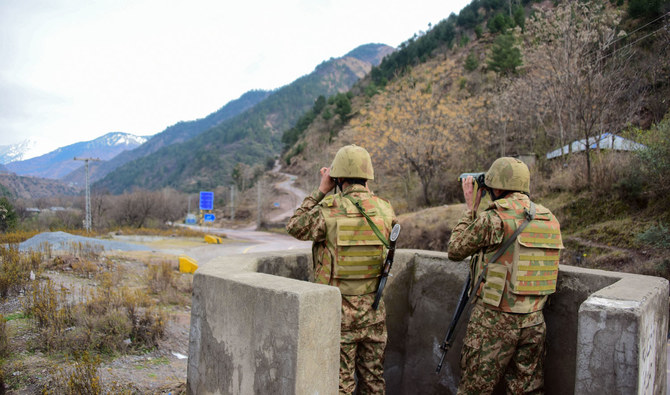
In this file photo, Pakistani soldiers watch over potential Indian troop movements with binoculars in a bunker at the Chakothi post, some 52 km from Muzaffarabad near Pakistan-India border on Feb. 23, 2019. (AFP)
Short Url
Updated 13 November 2020
Follow

Indian and Pakistani troops exchange fire, at least 15 dead

  • The skirmish has been one of the deadliest this year along the heavily militarized Line of Control
  • According to official data, more than 40 civilians have been killed in firing between India and Pakistan in 2020

SRINAGAR/MUZAFFARABAD: At least 10 civilians and five security personnel were killed in cross-border shelling between India and Pakistan on Friday, in one of this year's deadliest days along the heavily militarized frontier separating the nuclear-armed rivals, officials said.

Indian officials said the barrage of mortars and other weapons along several parts of the Line of Control — the de-facto border — began after Indian troops foiled an infiltration attempt from Pakistan in northern Kashmir.

Pakistan's military said in a statement it had responded to unprovoked and indiscriminate firing by the Indian army.

Indian officials said six civilians, three soldiers and a border guard were killed on their side. The Pakistan military said four civilians and one soldier were killed on the Pakistani side.

Both India and Pakistan claim Kashmir in full. Each rules part of the region, with New Delhi long accusing its neighbor of fueling an insurgency, which Pakistan denies.

Indian and Pakistani troops regularly exchange fire across the mountainous border, but the shelling on Friday was particularly intense, according to Indian officials. Both sides also accused the other of firing at civilian areas.

"As usual they targeted civilian populations without any remorse," said Syed Shahid Qadri, a government official in Pakistan-administered Kashmir, where a woman was among the dead and 27 others were injured.

Across the border in Indian-administered Kashmir, officials said an 8-year-old child was among those killed in the shelling that started in the morning and continued late into the evening.

Mukhtar Ahmad, a resident of Uri in Indian Kashmir said there was panic in the hillside town after loud explosions were heard from areas closer to the de facto border.

"Several families have fled the area and taken shelter in Uri town," he said.

More than 40 civilians have been killed in firing between Indian and Pakistani troops this year, according to official data, with both sides suffering similar fatalities.


Pakistan’s seafood exports to China rise 24% to $240 million in 2025

Updated 17 sec ago
Follow

Pakistan’s seafood exports to China rise 24% to $240 million in 2025

  • The Chinese embassy cites strong growth in agricultural trade with Pakistan
  • Islamabad aims to expand food exports amid effort to boost foreign reserves

ISLAMABAD: Pakistan’s seafood exports to China rose 24% year-on-year to $240 million in the first 11 months of 2025, the Chinese embassy in Islamabad said on Wednesday, highlighting growing agricultural trade between the two countries.

China is one of Pakistan’s largest seafood export markets, alongside destinations such as Thailand, Vietnam and countries in the Middle East. Pakistan exports fish, shrimp and other marine products sourced from coastal areas in Balochistan and Sindh, including Gwadar, Pasni and Karachi, with shipments typically consisting of frozen fish, frozen shrimp and a smaller volume of processed seafood.

The figure cited by the Chinese embassy fits into a longer upward trend, supported by rising Chinese demand, improvements in cold-chain logistics and market access approvals for Pakistani exporters.

“Pakistan’s seafood exports to China hit [nearly] $240 million from Jan-Nov 2025, soaring by 24% compared with the same period in 2024, which fully shows the strong vitality of the agricultural trade between China & Pakistan,” the embassy said. “[China looks] forward to more export of high-quality Pakistani products to China in the future.”

China is Pakistan’s closest regional ally and a key destination for its agricultural and food exports, which Islamabad has been seeking to expand to bolster foreign exchange earnings.

The two countries enjoy strong strategic and economic cooperation, with Chinese support seen as vital to Pakistan’s efforts to diversify its export base beyond textiles and reduce reliance on external financing.

Beijing and Islamabad are also working closely on energy and infrastructure projects as part of broader efforts to enhance regional connectivity and support industrial development in Pakistan.