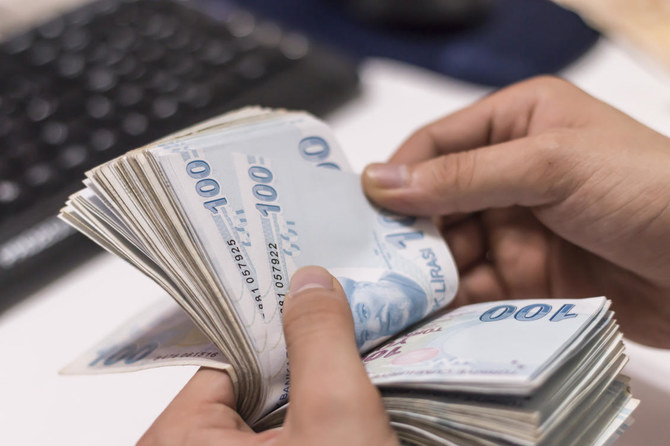
ISTANBUL: Turkey’s lira firmed on Friday to its strongest level in seven weeks, notching a weekly gain of some 12%, after President Tayyip Erdogan’s pledge to adopt a new economic model raised expectations of a sharp rate hike from the central bank.
The lira hit 7.6150 to the dollar in morning trade, its firmest level since Sept. 25. It subsequently eased back to 7.6700 by 0825 GMT from Thursday’s close of 7.6625.
The currency’s rally this week, after touching a record low of 8.58 last Friday, was sparked by expectations of a more orthodox economic policy after the central bank governor and the finance minister left office over the weekend.
Erdogan shifted to a more market-friendly tone on Wednesday, promising economic growth based on stability and international investment — a turnaround from blaming foreigners and high rates for Turkey’s woes.
The central bank is seen raising its policy rate next week to 15% from 10.25%, a Reuters poll showed. Erdogan’s speech was viewed as implying he would condone such a hike.
Bankers say foreign investors are leading the purchase of Turkish assets on optimism for economic policy changes.
“In a scenario where locals are also on the sell side (for dollar holdings), we see a high probability for a tendency to a trend between 7.53-7.73” in the dollar-lira exchange rate, said Orkun Godek, a strategist at Deniz Invest.
Turkish locals’ forex and gold holdings hit a record high of $224.23 billion on Nov. 6, indicating a rise of some $30 billion this year due to a lack of confidence in the lira.
The central bank raised its policy rate by 200 points in September but held steady last month, leading to a sell-off in the lira. The bank’s use of backdoor policies, funding the market above the policy rate, has brought the weighted average cost of funding to 14.46% as of Thursday.
The lira also firmed sharply against the euro this week, to as much as 8.9823 on Friday.
Turkey’s economy has been recovering after a contraction of nearly 10% year-on-year in the second quarter due to restrictions aimed at slowing the spread of the coronavirus.
Industrial production jumped 8.1% year-on-year in September, data showed on Friday.
A rate hike could stall the economy’s rebound from the coronavirus fallout but could help avert broader balance of payments problems by boosting the lira.

Turkish lira notches weekly gains of 12% on cenbank’s new look
https://arab.news/mn284
Turkish lira notches weekly gains of 12% on cenbank’s new look
- Erdogan shifted to a more market-friendly tone on Wednesday, promising economic growth based on stability and international investment
- The lira also firmed sharply against the euro this week, to as much as 8.9823 on Friday
First EU–Saudi roundtable on critical raw materials reflects shared policy commitment
RIYADH: The EU–Saudi Arabia Business and Investment Dialogue on Advancing Critical Raw Materials Value Chains, held in Riyadh as part of the Future Minerals Forum, brought together senior policymakers, industry leaders, and investors to advance strategic cooperation across critical raw materials value chains.
Organized under a Team Europe approach by the EU–GCC Cooperation on Green Transition Project, in coordination with the EU Delegation to Saudi Arabia, the European Chamber of Commerce in the Kingdom and in close cooperation with FMF, the dialogue provided a high-level platform to explore European actions under the EU Critical Raw Materials Act and ResourceEU alongside the Kingdom’s aspirations for minerals, industrial, and investment priorities.
This is in line with Saudi Vision 2030 and broader regional ambitions across the GCC, MENA, and Africa.
ResourceEU is the EU’s new strategic action plan, launched in late 2025, to secure a reliable supply of critical raw materials like lithium, rare earths, and cobalt, reducing dependency on single suppliers, such as China, by boosting domestic extraction, processing, recycling, stockpiling, and strategic partnerships with resource-rich nations.
The first ever EU–Saudi roundtable on critical raw materials was opened by the bloc’s Ambassador to the Kingdom, Christophe Farnaud, together with Saudi Deputy Minister for Mining Development Turki Al-Babtain, turning policy alignment into concrete cooperation.
Farnaud underlined the central role of international cooperation in the implementation of the EU’s critical raw materials policy framework.
“As the European Union advances the implementation of its Critical Raw Materials policy, international cooperation is indispensable to building secure, diversified, and sustainable value chains. Saudi Arabia is a key partner in this effort. This dialogue reflects our shared commitment to translate policy alignment into concrete business and investment cooperation that supports the green and digital transitions,” said the ambassador.
Discussions focused on strengthening resilient, diversified, and responsible CRM supply chains that are essential to the green and digital transitions.
Participants explored concrete opportunities for EU–Saudi cooperation across the full value chain, including exploration, mining, and processing and refining, as well as recycling, downstream manufacturing, and the mobilization of private investment and sustainable finance, underpinned by high environmental, social, and governance standards.
From the Saudi side, the dialogue was framed as a key contribution to the Kingdom’s industrial transformation and long-term economic diversification agenda under Vision 2030, with a strong focus on responsible resource development and global market integration.
“Developing globally competitive mineral hubs and sustainable value chains is a central pillar of Saudi Vision 2030 and the Kingdom’s industrial transformation. Our engagement with the European Union through this dialogue to strengthen upstream and downstream integration, attract high-quality investment, and advance responsible mining and processing. Enhanced cooperation with the EU, capitalizing on the demand dynamics of the EU Critical Raw Materials Act, will be key to delivering long-term value for both sides,” said Al-Babtain.
Valere Moutarlier, deputy director-general for European industry decarbonization, and directorate-general for the internal market, industry, entrepreneurship and SMEs at European Commission, said the EU Critical Raw Materials Act and ResourceEU provided a clear framework to strengthen Europe’s resilience while deepening its cooperation with international partners.
“Cooperation with Saudi Arabia is essential to advancing secure, sustainable, and diversified critical raw materials value chains. Dialogues such as this play a key role in translating policy ambitions into concrete industrial and investment cooperation,” she added.


