



JEDDAH: Saudi police launched a manhunt on Wednesday after a bomb blast targeted foreign diplomats attending a war memorial ceremony in Jeddah.
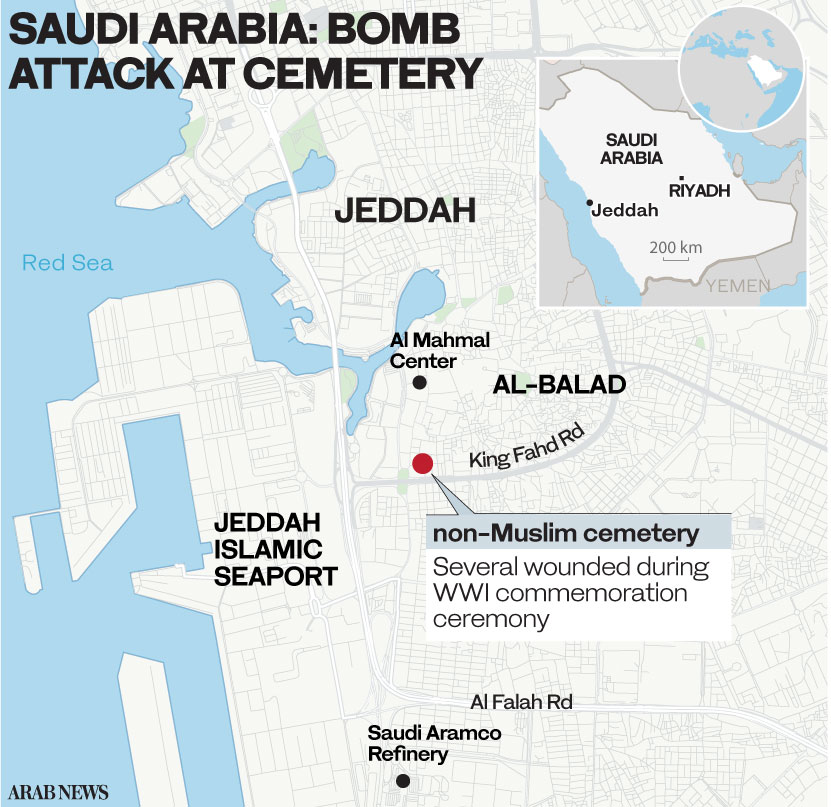
At least two people were injured when the device exploded at Khawajat cemetery during a speech by the French consul at the event commemorating the annual Armistice Day, which marks the end of the First World War.
“At the end of the speech we heard an explosion. We didn’t quite understand it at first, but we then realised that we were the target,” witness Nadia Chaaya told French television. “We were panicking and feared there could be a second explosion.”
A Saudi police officer and a Greek policeman who lives in the Kingdom suffered minor injuries from the blast. Saudi security forces immediately cordoned off the scene and blocked roads leading to the cemetery just south of the city center as an investigation began.
Makkah region authorities described the attack as “cowardly” and “unsuccessful,” and said that an employee of the Greek consulate and a Saudi security officer were injured during a Remembrance Day ceremony held by the French consulate in Jeddah.
A Saudi government source told Arab News the incident is being investigated and a report will be issued very soon.
The cemetery where the explosion took place is located in the south of the city near the downtown area of Jeddah. Supervision of the cemetery rotates annually between Western consulates.
"The annual ceremony commemorating the end of World War I at the non-Muslim cemetery in Jeddah, attended by several consulates, including that of France, was the target of an IED [improvised explosive device] attack this morning, which injured several people," France's foreign ministry said.
"The embassies that were involved in the commemoration ceremony condemn this cowardly attack, which is completely unjustified," the ministry added.
“Such attacks on innocent people are shameful and entirely without justification," said a joint statement issued by the embassies of the five countries in attendance.
The French embassy in Riyadh urged its nationals in Saudi Arabia to exercise “extreme vigilance” since a security guard at its Jeddah consulate was stabbed on Oct. 29, the same day a knife-wielding man killed three people at a church in Nice in southern France.
In reaction to the incident, the UAE issued a statement condemning what it called a “cowardly attack,” adding that it stood in solidarity with and supported the Kingdom in any measure to preserve its security.
Egypt condemned the “brutal attack that targeted the cemetery in Jeddah” and said it supports Saudi Arabia with any measures the Kingdom takes to protect its security.
The Embassies of France, Greece, Italy, the UK and the US, which were associated with Wednesday’s ceremony condemned the “cowardly” and unjustified attack.
They also thanked the “brave Saudi first responders who assisted those at the scene” and pledged their support to “the Saudi authorities as they investigate this attack and prosecute its perpetrators.”
The Organization of Islamic Cooperation (OIC), the Muslim World League (MWL) and the Arab Parliament also condemned the attack.
MWL Secretary-General, Sheikh Dr. Muhammad bin Abdul Karim Al-Issa said: “This cowardly and isolated attack only represents itself, and can only be committed by a spiteful criminal.”
Al-Issa concluded by expressing his sincere prayers for those injured.
The French consulate in the UAE issued a statement Wednesday confirming several people had been wounded in the incident.
“Once again, France was the target of an attack during the commemorations of November 11, organized by the Consulate General of France, in Jeddah, Saudi Arabia. This attack left several wounded,” it said.
The French Embassy in the UAE said it was in close contact with the UAE authorities and that both remained “committed to ensuring a high level of stafety for our communities.”
The statement added that the Embassy and the Consulate General reiterated calls for people to show restraint and remain vigilant, especially when traveling, in particular in places visited by tourists and expatriate communities.
The Greek foreign ministry released a statement, saying: “We unequivocally condemn today’s terrorist attack, which targeted a ceremony at Jeddah’s non-Muslim cemetery commemorating the end of World War I. A Greek police officer who is serving at the Consulate General in Jeddah, and who was accompanying an employee of the Consulate General to the ceremony, was injured in the attack.
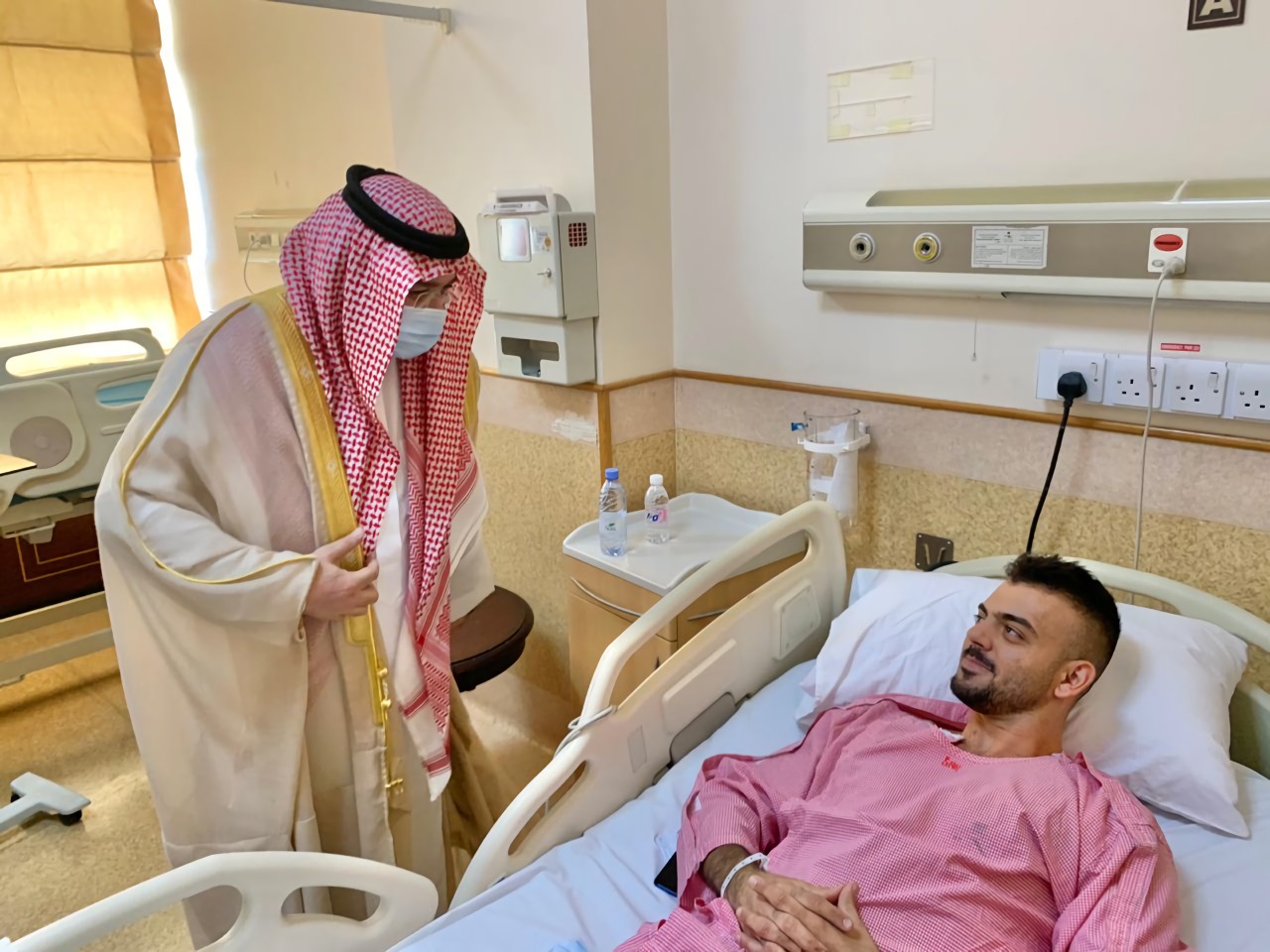
The governor of Jeddah checks up on the health of a Greek consulate employee who was wounded during the attack at a cemetery in Jeddah. (SPA)
“The police officer, who has been hospitalized, is in good health and out of danger. He has the support of the Consulate General and our Embassy in Riyadh, which remain in ongoing contact with the Saudi Arabian authorities. We wish him a speedy recovery.
“We also express our warm thanks to the Saudi Arabian authorities for the support and sympathy they showed from the very outset and for the efforts they are making to investigate the incident,” it added.
Djibouti’s Ambassador to Saudi Arabia Dya-Eddine Said Bamakhrama condemned the attack and wished those wounded a speedy recovery.
“While we wish the wounded a speedy recovery, we affirm our absolute solidarity with Saudi Arabia against all cowardly terrorist acts that will not affect the great position of this glorious country,” Bamakhrama said.
A statement by the EU delegation to the Kingdom of Saudi Arabia expressed support and solidarity with the Kingdom and the countries whose representatives were present at the ceremony.
“We join these countries in condemning such cowardly attack against innocent people attending a peaceful commemoration. We wish a prompt recovery to those who were injured. We thank the Saudi emergency services for their intervention at the scene and look forward to a prompt and thorough investigation of the incident and to the prosecution of its perpetrators,” the statement said.
The UK's Minister for the Middle East and North Africa James Cleverly said: “I have full confidence the Saudi authorities will investigate this attack and prosecute those responsible for this cowardly act.”


