ADNOC delivers first shale gas from the UAE

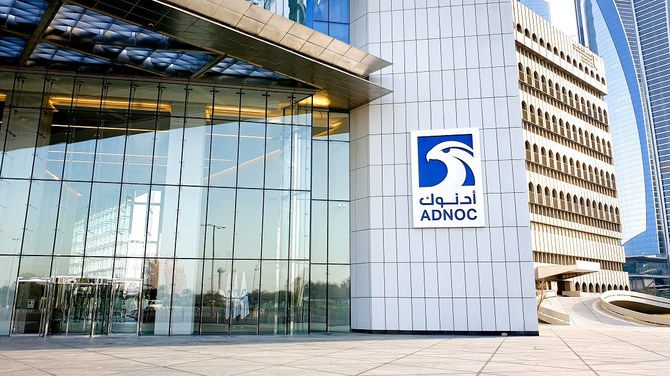
In November 2018, ADNOC signed a deal with TOTAL granting it a 40 percent stake in the Ruwais Diyab Unconventional Gas Concession. (File/Shutterstock)
Short Url
Updated 11 November 2020
Follow

ADNOC delivers first shale gas from the UAE

  • Abu Dhabi has announced the discovery of some 160 trillion standard cubic feet of unconventional gas recoverable resources
  • In recent years the growth of the shale oil and gas sector has disrupted the market, especially in the US

LONDON: The UAE has delivered its first unconventional gas as it takes a step closer to becoming self-sufficient in the energy feedstock.
The Abu Dhabi National Oil Company (ADNOC) and TOTAL said the unconventional gas was delivered from the Ruwais Diyab concession located 200 kilometers west of Abu Dhabi city.
The pair are targeting the production of 1 billion standard cubic feet of gas from the concession before 2030, ultimately enabling gas self-sufficiency for the UAE. It comes two years after the signing of the region's first unconventional gas concession agreement.
"This achievement marks another important milestone in the development of the UAE’s unconventional gas resources as we deliver on our integrated gas strategy and work to achieve gas self-sufficiency for the nation," said Yaser Saeed Almazrouei, ADNOC upstream executive director.
The big oil and gas economies of the Middle East have long been conventional producers, able to extract hydrocarbons at relatively cheap cost from close to the surface or in shallow waters offshore.
In recent years the growth of the shale oil and gas sector has disrupted the market, especially in the US, where the Permian Basin that straddles Texas and New Mexico has provided plentiful supplies of oil and gas trapped between layers of rock and sand.
Now Gulf energy producers are also starting to tap unconventional gas supplies with Saudi Arabia also planning some $100 billion of investment in a vast unconventional gas development in the Jafurah basin.
For countries such as the UAE and Saudi Arabia that need gas both to provide domestic energy as well as a feedstock to make higher value petrochemicals, such unconventional finds are crucial in diversifying their economies.
However the emerging unconventional producers in the region face a number of challenges in extracting tight gas including access to the vast amounts of water that typically needed for fracking as well as finding contractors with relevant experience in the industry.

Abu Dhabi has announced the discovery of some 160 trillion standard cubic feet of unconventional gas recoverable resources.
In November 2018, ADNOC signed a deal with TOTAL granting it a 40 percent stake in the Ruwais Diyab Unconventional Gas Concession.


Egypt, China agree $1.15bn of new industrial projects in SCZONE 

Updated 8 sec ago
Follow

Egypt, China agree $1.15bn of new industrial projects in SCZONE 

RIYADH: Egypt’s Suez Canal Economic Zone is set to host three new industrial projects with a combined investment of $1.15 billion, bringing total investments in the zone to $5.1 billion in the first half of the 2025/26 fiscal year. 

The contracts, expected to generate around 5,400 direct job opportunities, expand the footprint of industrial developer TEDA-Egypt in the Ain Sokhna Industrial Zone. The agreements were signed between TEDA-Egypt and China’s Xin Feng Ming Group, Chaoyang Langma Tyre, and Tongling Jieya Biotechnology, according to an official statement issued by the Egyptian Cabinet Presidency.

This aligns with SCZONE’s earlier forecast that revenue will exceed $4 billion this year, slightly above 2024 levels, with gradual growth expected from the next fiscal year. 

The Suez Canal generated about $40 billion between 2019 and 2024 and remains Egypt’s largest source of foreign currency.  

A Facebook post on the official Egyptian Cabinet Presidency page stated: “Prime Minister Mostafa Madbouly emphasized that the signing of these three projects reflects the growing confidence of major international companies in Egypt’s investment climate and underscores the advanced infrastructure offered by the SCZONE, as well as its logistical integration through the connection between industrial zones and ports.” 

It added: “This supports the Egyptian state’s strategy to deepen local manufacturing, increase exports, and create more job opportunities.”  

The largest project, led by Xin Feng Ming, involves the construction of an integrated polyester fiber and polymer complex with investments exceeding $800 million, according to SCZONE Chairman Walid Gamal El-Din. 

The facility will be built over about 400,000 sq. meters and developed in three phases, with a combined annual production capacity of 1.08 million tonnes. It is expected to create around 3,000 jobs. 

Gamal El-Din further pointed out that construction of the first phase is scheduled to begin in May 2026, with production expected to start in the fourth quarter of 2027. The second and third phases are set to come online between 2029 and 2030.  

A second project with Chaoyang Langma will establish a $190 million tyre manufacturing complex producing heavy-duty truck and passenger car tyres. The facility will span 200,000 sq. meters and employ about 1,400 workers. 

Once fully operational, it is expected to produce one million truck tyres and 4.5 million passenger car tyres annually, targeting both regional and international markets. 

Gamal El-Din said the project will be implemented in two phases, starting with construction and the installation of a heavy truck tire production line in April 2026. 

A second phase, beginning in September 2028 and lasting 12 months, will expand the heavy-duty truck line and add a passenger car tire line, including trial runs for both.  

The third project, led by Tongling Jieya Biotechnology, will involve a $160 million investment in a health products and nonwoven fabrics complex covering 160,000 sq. meters. 

The facility is expected to produce up to 10 billion wet wipes, 2 billion baby diapers and 100,000 tonnes of nonwoven fabrics a year, generating about $270 million in annual revenue at full capacity and employing around 1,000 people.