US not expanding military objectives in Iran, Hegseth says

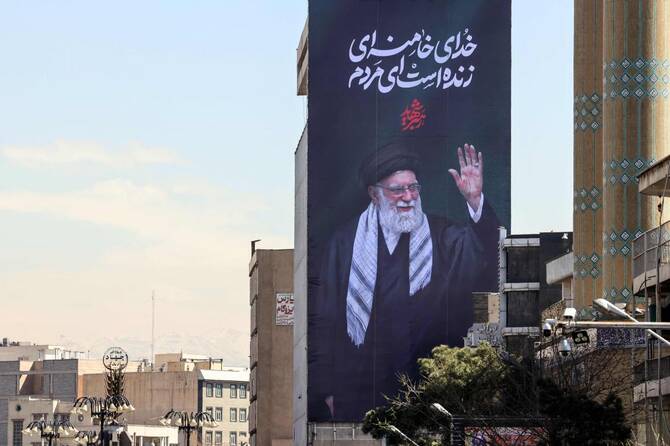
This photograph shows a large billboard of Iran’s slain supreme leader Ayatollah Ali Khamenei reading in Persian "His God is still alive" in Tehran on March 3, 2026. The US president said the war, which began on February 28, with a strike that killed Iran's supreme leader Ayatollah Ali Khamenei, was going "substantially" ahead of schedule but warned it could go on for more than four weeks. (Photo by AFP)
Short Url
Updated 06 March 2026
Follow

US not expanding military objectives in Iran, Hegseth says

  • Iran’s regional retaliation strengthen US alliances, Hegseth says
  • US forces destroy 30 ‌Iranian warships, including drone carrier

TAMPA, Florida: US Defense Secretary Pete Hegseth said on Thursday the United States ​was not expanding its military objectives in Iran, after President Donald Trump told Reuters the United States must be involved in choosing the next leader of Iran.
The Pentagon earlier this week said the military campaign, known as Operation Epic Fury, is focused on destroying Iran’s offensive missiles, missile production and navy, while not allowing Tehran to have a nuclear weapon.
“There’s no expansion in our objectives. We know exactly what we’re trying to achieve,” Hegseth said.
He added that Trump was “having a heck of a ‌say in who ‌runs Iran given the ongoing operation.”
In a telephone interview ​with ‌Reuters ⁠on Thursday, ​Trump said ⁠the United States would have to help pick the next person to lead the country. The US and Israeli military campaign that started on Saturday has hit targets across the country and triggered Iranian retaliatory strikes in the region as Tehran seeks to impose a high cost on the United States, Israel and their allies.
Iran has attacked countries including Israel, the United Arab Emirates and Qatar. Fire crews in Bahrain extinguished a blaze at a ⁠refinery following a missile strike.
Azerbaijan became the latest country ‌drawn in, as it accused Iran of firing ‌drones at its territory and ordered its southern airspace closed ​for 12 hours.
Hegseth said by striking ‌countries in the region, Iran would only bring them closer to the United ‌States.
“It’s actually firming up the unity of the resistance in order to focus exactly where we need to,” Hegseth said.

Next phase of operations
The United States has hit more than 2,000 targets in Iran, including Iranian warships. Admiral Brad Cooper, the head of US Central Command, said ‌US forces had destroyed 30 Iranian warships, including an Iranian drone carrier ship earlier on Thursday.
Cooper said the United States ⁠was hitting Iran’s ⁠ability to rebuild.
“As we transition to the next phase of this operation, we will systematically dismantle Iran’s missile production capability for the future, and that’s absolutely in progress,” Cooper said, adding that it would take some time.
The US military has identified the six US Army Reserve soldiers killed when a drone slammed into a US military facility in Port Shuaiba, Kuwait.
Trump and other senior officials have warned the Iran conflict will result in more US military deaths.
Hegseth, during the press conference, said Iran was making a mistake if it believed that the United States could not sustain the ongoing war, adding that Washington had just begun to fight.
“Iran is hoping that we ​cannot sustain this, which is a really ​bad miscalculation,” Hegseth said. “We set the timeline.”


Lawsuit challenges Trump administration’s ending of protections for Somalis

Updated 10 March 2026
Follow

Lawsuit challenges Trump administration’s ending of protections for Somalis

  • The lawsuit cites a series of statements Trump has made describing Somalis as “garbage” and “low IQ people” who “contribute nothing.”

BOSTON: Immigrant rights advocates filed a lawsuit on Monday seeking to stop US President Donald Trump’s administration from next ​week ending legal protections that allow nearly 1,100 Somalis to live and work in the United States. The lawsuit, brought by four Somalis and two advocacy groups, challenges the US Department of Homeland Security’s decision to end Temporary Protected Status for Somali immigrants, whom Trump has derided in public remarks. Outgoing Homeland Security Secretary Kristi Noem in January announced that TPS for Somalis would end on March 17, arguing that Somalia’s conditions had improved, despite fighting continuing between Somali forces and Al-Shabab militants. The plaintiffs, who ‌include the groups ‌African Communities Together and Partnership for the Advancement ​of ‌New ⁠Americans, in the ​lawsuit filed ⁠in Boston federal court argue the move was procedurally flawed and driven by a discriminatory, predetermined agenda.
The lawsuit cites a series of statements Trump has made describing Somalis as “garbage” and “low IQ people” who “contribute nothing.”
The plaintiffs said the administration is ending TPS for Somalia and other countries due to unconstitutional bias against non-white immigrants, not based on objective assessments of country conditions.
“The termination of TPS for Somalia is racism masking as immigration policy,” ⁠Omar Farah, executive director at the legal group Muslim Advocates, said ‌in a statement.
DHS did not respond to ‌a request for comment. It has previously said TPS ​was “never intended to be a de ‌facto amnesty program.”
TPS is a form of humanitarian immigration protection that shields eligible migrants ‌from deportation and allows them to work. Under Noem, DHS has moved to end TPS for a dozen countries, sparking legal challenges. The administration on Saturday announced plans to pursue an appeal at the US Supreme Court in order to end TPS for over 350,000 Haitians. It ‌also wants the high court to allow it to end TPS for about 6,000 Syrians.

SOMALI COMMUNITY TARGETED
Somalia was first designated ⁠for TPS in ⁠1991, with its latest extension in 2024. About 1,082 Somalis currently hold TPS, and 1,383 more have pending applications, according to DHS. Somalis in Minnesota in recent months had become a target of Trump’s immigration crackdown, with officials pointing to a fraud scandal in which many people charged come from the state’s large Somali community. The Trump administration cited those fraud allegations as a basis for a months-long immigration enforcement surge in Democratic-led Minnesota, during which about 3,000 immigration agents were deployed, spurring protests and leading to the killing of two US citizens by federal agents.
In November, Trump announced he would end TPS for Somalis in Minnesota, and a month later said ​he wanted them sent “back to where they ​came from.”
The US Department of State advises against traveling to Somalia, citing crime and civil unrest among numerous factors.