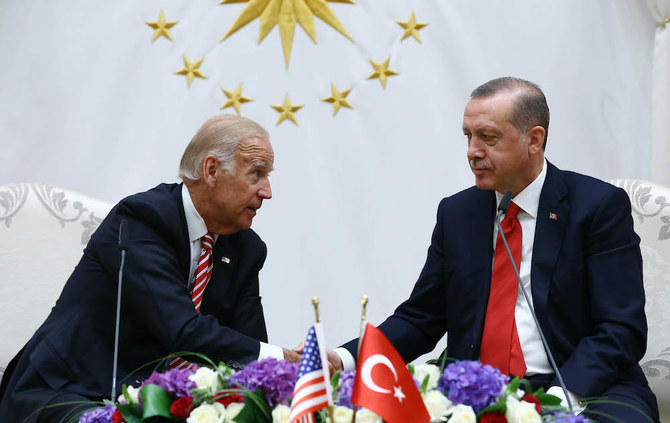
Turkey’s Erdogan congratulates Biden, urges closer US relations

Turkish President Recep Tayyip Erdogan congratulated US President-elect Joe Biden and Vice President-elect Kamala Harris on their victory in the 2020 presidential election. (File/AFP)
Short Url
Updated 10 November 2020
Follow

Turkey’s Erdogan congratulates Biden, urges closer US relations

  • Erdogan urges closer US-Turkish relations
  • He said ‘strong cooperation and alliance’ would continue to contribute to world peace

ISTANBUL: Turkish President Recep Tayyip Erdogan on Tuesday congratulated Joe Biden on his victory over Donald Trump in the US presidential election, urging closer ties between the two NATO allies.
Erdogan’s statement came a full three days after US media called the election in Biden’s favor, underscoring the close personal bond the Turkish leader enjoyed with Trump.
But Ankara and Washington also experienced tensions during Trump’s four years in office, including over US support for a Syrian Kurdish militia that Turkey views as a grave security threat.
“I congratulate you on your election success and convey my sincere wishes for the peace and welfare of the US people,” Erdogan said in a statement published by his office, urging “strong cooperation” between the sides.
Other issues standing between Ankara and Washington include Turkey’s purchase of a high-tech Russian missile defense system, and US refusal to extradite a Muslim cleric Erdogan blames for staging a failed 2016 coup.
“The challenges we face today, on the global and regional levels, require us to further develop and strengthen those relations, which are based in mutual interests and shared values,” Erdogan said.
Turkish officials have been alarmed by an interview Biden gave to The New York Times in December in which he called Erdogan an “autocrat.”
Biden criticized the Turkish leader’s policies toward the Kurds and said Washington needed to “embolden” his rivals to allow them “to take on and defeat Erdogan.”
Erdogan’s spokesman said in August that the remarks showed “pure ignorance, arrogance and hypocrisy.”
The Turkish leader did not directly address them in his statement Tuesday.
Meanwhile, Presidents Vladimir Putin of Russia, Xi Jinping of China and Jair Bolsonaro of Brazil have yet to congratulate Biden.


Lebanon declares neutrality, bolsters embassy security amid regional turmoil

Updated 6 sec ago
Follow

Lebanon declares neutrality, bolsters embassy security amid regional turmoil

  • Beirut condemns attacks on Arab neighbors
  • Wassef Awada from Supreme Islamic Shiite Council confirms to Arab News Hezbollah’s support for just and protective state

BEIRUT: Lebanon’s leaders reaffirmed neutrality amid US and Israeli strikes on Iran, emphasizing that the country must be shielded from the region’s rapidly deteriorating security crisis.
During a press conference on Saturday, Prime Minister Nawaf Salam said while he could not completely discount the risk of threats against foreign embassies on Lebanese soil, his government had already put the necessary security measures in place.
Just before the US-Israel strikes began, Israel carried out strikes on what it said was “Hezbollah infrastructure” in south Lebanon.
Salam, who convened an emergency Cabinet session to assess the fallout, moved swiftly to calm public anxiety. “We have long been taking all precautionary measures,” he said, urging Lebanese citizens not to panic.
He confirmed that supply lines by land, sea and air remained open, that Middle East Airlines continued to operate flights, and that essential goods — food, medicine and fuel — were stocked for at least two months. “There is no need for queuing or rushing to pharmacies, supermarkets or fuel stations,” he said.
Salam said that he had spoken with the leaders of Arab states targeted in Iranian attacks on US bases in Kuwait, Bahrain, the UAE and Qatar.
The Lebanese economy has slowed amid growing concerns that Hezbollah could become involved in the conflict in defense of Iran.
This anxiety has manifested in long queues at gas stations and pharmacies, as people rushed to secure fuel and medical supplies, fearing shortages if the country was dragged into a conflict it could not withstand after emerging from a devastating war with Israel.
The Association of Oil Importing Companies said that it had sufficient petroleum products in stock to meet demand for at least 15 days.
Earlier in the day, Salam posted on X, urging the Lebanese to “show wisdom and patriotism, putting Lebanon’s interests above everything else amid the dangerous developments gripping the region.
“We will not allow anyone to drag this country into adventures that threaten its security and unity,” he stressed.
Hezbollah’s leader, Naim Qassem, was expected to deliver a speech on Saturday but it was postponed due to “recent developments.” Last month, Qassem threatened in a speech to “defend Iran against any Israeli or American aggression.”
However, Sheikh Ali Al-Khatib, vice president of the Supreme Islamic Shiite Council, the highest religious authority for Lebanon’s Shiite community, stressed on Friday the Shiite community’s support of state sovereignty.
He said that Lebanon once had to take up arms as “a necessity in the absence of the state.”
“If we were forced to take up arms, it was in self-defense, and we paid a heavy price; our cities were destroyed.”
Al-Khatib said the Shiite community supported “a strong state that protects its rights, sovereignty and borders,” and called for the adoption of a national security strategy.
Asked whether Al-Khatib’s position was coordinated with Hezbollah, Wassef Awada, adviser to the Supreme Islamic Shiite Council, confirmed to Arab News that his position was in full agreement with Hezbollah and its alley, the Amal Movement.
“Hezbollah affirms its support for a just and protective state that uses all its capabilities to confront external threats. This position is not subject to change under any circumstances, and the Supreme Islamic Shiite Council remains steadfast in its stance,” he told Arab News.
Awada said that most of the Shiite community opposed intervention in the war and that Hezbollah was aware of this. He added that the Amal Movement had also been clear in its support for the state.
On Saturday morning, the sound of Israeli interceptor missiles exploding was heard in southern Lebanon and the Bekaa Valley.
The Israeli army dropped explosive devices near the Lebanese border and carried out airstrikes on Wadi Barghaz, the Litani River, the outskirts of Wadi Al-Dalafa, the highlands of Iqlim Al-Tuffah, and the Jezzine district.
These mountains and valleys, located north of the Litani River, are believed to host a Hezbollah presence. Meanwhile, Israeli reconnaissance aircraft flew over southern Lebanon, passing over Sidon and reaching the Bekaa Valley.
Israeli army said that it “attacked Hezbollah infrastructure, targeting launch sites and underground tunnel entrances used by the terrorist group to advance plots against the IDF and the State of Israel,” accusing Hezbollah of operating within this infrastructure to rebuild its power.
President Joseph Aoun stressed that “sparing Lebanon the disasters and horrors of external conflicts, and preserving its sovereignty, security and stability, are an absolute priority.”
He contacted the prime minister, Transport Minister Fayez Rassamni, US Ambassador Michel Issa, and Army Commander Gen. Rudolph Haikal. His office said that he had stressed the need for maximum readiness and tight coordination across all state institutions.
He called on all parties to put Lebanon’s national interest above everything else and pledged that the state, through all its institutions, would stand as the first and last line of defense.
The Foreign Ministry added its voice to the chorus, formally condemning “any targeting of Arab states,” with Foreign Minister Youssef Raji underscoring Lebanon’s firm commitment to staying out of the fray.
At Beirut’s Rafic Hariri International Airport, traffic dropped sharply — though Lebanon stopped short of officially canceling flights or closing its airspace. The Civil Aviation Directorate attributed the near-standstill to the closure of airspace by Gulf states, Cyprus and neighboring countries, which rendered Beirut “practically unreachable for most airlines.”
The head of the Civil Aviation Authority, Captain Mohammed Aziz, said that no decision to close Lebanese airspace had been made, adding that he remained in continuous contact with the Minister of Public Works, airport security, and air navigation to monitor developments and take appropriate action as events evolve.