

Millenia-old gold coins from the Islamic period discovered in Jerusalem

1 / 4
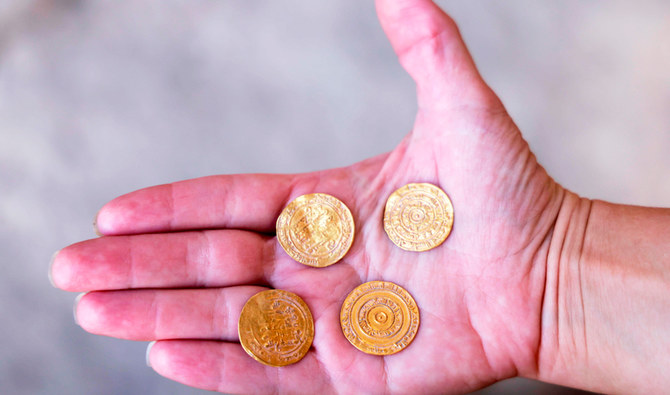
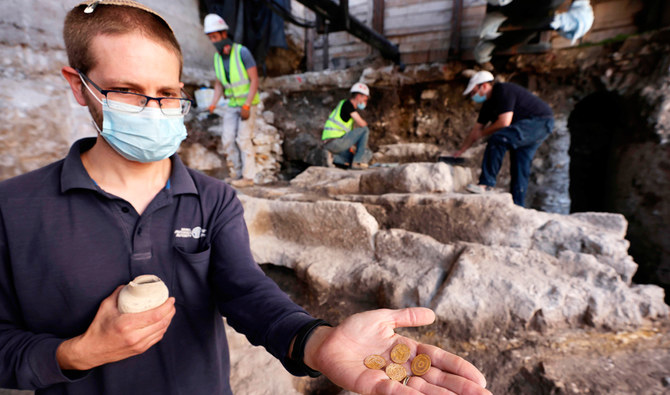
Archaeologist at the Israel Antiquities Authority Evgeniya Rabinovich shows a small pottery jug with four pure gold coins found inside it, at the archaeological rescue excavation site in the Old City of Jerusalem, on November 9, 2020. (AFP)
2 / 4
Archaeologist at the Israel Antiquities Authority David Gellman shows a small pottery jug with four pure gold coins found inside it, at the archaeological rescue excavation in the Old City of Jerusalem, on November 9, 2020. (AFP)
3 / 4
Archaeologist at the Israel Antiquities Authority Evgeniya Rabinovich shows a small pottery jug with four pure gold coins found inside it, at the archaeological rescue excavation site in the Old City of Jerusalem, on November 9, 2020. (AFP)
4 / 4
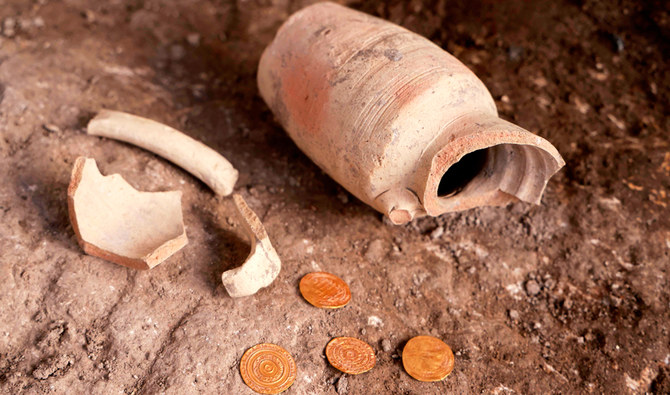
A small pottery jug with four pure gold coins found inside it by the Israel Antiquities Authority are displayed at the archaeological rescue excavation site in the Old City of Jerusalem, on November 9, 2020. (AFP)
Short Url
Updated 11 November 2020
Follow

Millenia-old gold coins from the Islamic period discovered in Jerusalem

  • The discovery, made in occupied East Jerusalem near to Al-Aqsa Mosque, has been described by the Israeli Antiquities Authority as a “rare” find

AMMAN: Archaeologists discovered a trove of gold coins in East Jerusalem over the summer that date back to around 1,100 years ago, it has emerged.

The 4 gold coins, all in good condition, were discovered on Aug. 18, but the find was only publicized on Monday.

“This is the first time we have discovered this kind of treasure in fifty years,” Palestinian Kamil Sari, the head of the northern regional office of the Israeli Antiquities Authority, told Arab News.

“After the archeologists digging near the Western Wall in the old city of Jerusalem had taken pottery jars for close cleaning and inspection, a volunteer sifting through found the coins.”

Sari said that the coins were made of pure gold, and dated to between 940 and 970 AD. Two were minted in the city of Ramleh, during the Abbasid caliphate period, and the other two were minted in Cairo under the Fatimid dynasty.

The Haifa-based archeological official told Arab News that a month ago more coins from the Islamic period were discovered.

Nazim Al-Jubeh, a Palestinian archeologist and professor of history and archeology at Bir Zeit University, told Arab News: “This was an important discovery because it helps illuminate the Abbasid period which some have tried to dismiss as being a step back in civilization after the successful Byzantine period.”

The era in question represented one of considerable change for the region, as the earlier Abbasid rulers were replaced by the Fatimids.

The discovery, made in occupied East Jerusalem near to Al-Aqsa Mosque, has been described by the Israeli Antiquities Authority as a “rare” find.

The Associated Press (AP) said that the trove, “which was unearthed by youth volunteers, also included hundreds of smaller clippings from gold coins that would have served as smaller denominations.”

AP quoted Robert Kool, a coin expert, who said “an initial analysis indicates the coins date from the late 9th century, considered the golden age of the Abbasid Caliphate that controlled most of the Near East and North Africa.”

Nazmi Al-Jubeh said that archeologists from around the world, including Israel, were slowly changing the narrative about the Abbasid, Umayyad, and Ayyubid Islamic periods.

“Previously archeologists have claimed that, since they had no major monuments representing them, that means that their civilization was nothing to talk about.”

Al-Jubeh said that the latest discovery, plus much of the discoveries of recent years, had caused historians and archeologists to revise their theories.

He said that the coins, found in occupied Palestinian lands, should be returned to Palestine as per international law.

A senior Jordanian source familiar with the situation told Arab news that Palestinians and Jordanians annually submit a report to UNESCO demanding the return of all archeological discoveries taken from the occupied territories in violation of international law.


In southeast Pakistan, Ramadan brings Hindus and Muslims closer

Updated 11 March 2026
Follow

In southeast Pakistan, Ramadan brings Hindus and Muslims closer

MITHI: Partab Shivani, a Hindu in Muslim-majority Pakistan, has fasted on and off during Ramadan for years, but this time is different as he practices abstinence for the entire holy month.
Every year, he and his friends in the southeastern city of Mithi arrange iftar, when Muslims break their daily fast, to foster peace and solidarity between the two religions.
“I believe we need to promote interfaith harmony. First, we are humans — religions came later,” Shivani, a 48-year-old social activist, told AFP, adding that he also reads the teachings of the Buddha.
“His message is about peace and ending war. Peace can spread through solidarity and by standing with one another. Distance only widens the gap between people,” he added.
Ninety-six percent of Pakistan’s 240 million people are Muslim. Just two percent are Hindu, most of them living in rural areas of Sindh province where Mithi is located.
In Mithi itself, most of the 60,000 inhabitants are Hindu.
Many of the city’s Hindus also observe Ramadan and iftar has become a social gathering where people from both faiths happily participate.
“This has been a wonderful tradition of ours for a very long time,” said Mir Muhammad Buledi, a 51-year-old Muslim friend who attended Shivani’s iftar gathering.
“It is a beautiful example of harmony between the two communities.”
Like brothers
Discrimination against minorities runs deep in Pakistan.
Following the end of British rule in South Asia in 1947, the subcontinent was partitioned into mainly Hindu India and Muslim-majority Pakistan.
That triggered widespread religious bloodshed in which hundreds of thousands were killed and millions displaced.
According to the Human Rights Commission of Pakistan, freedom of religion or belief is under constant threat, with religiously motivated violence and discrimination increasing yearly.
State authorities, often using religious unrest for political gain, have failed to address the crisis, the independent non-profit says.
But such tensions are absent in Mithi.
“I am a Hindu but I keep all the fasts during this month,” said Sushil Malani, a local politician. “I feel happy standing with my Muslim brothers.
“We celebrate Eid together as well. This tradition in the region is very old.”
Restaurants and tea stalls are closed across Pakistan during Ramadan.
Ramesh Kumar, a 52-year-old Hindu man who sells sweets and savoury items outside a Muslim shrine, keeps his push cart covered and closed until iftar.
“There is no discrimination among us if someone is Muslim or Hindu. I have been seeing this since my childhood that we all live together like brothers,” he said.
Muslim shrine, Hindu caretaker
Locals say Mithi’s peaceful religious coexistence can be traced to its remote location, emerging from the sand dunes of the Tharparkar desert, which borders the modern Indian state of Rajasthan.
Cows — considered sacred in Hinduism — roam freely in Mithi city, as they do in neighboring India.
At two Sufi Muslim shrines in the middle of the city, Hindu families arrange meals, bringing fruit, meals and juices for their Muslim neighbors to break their fasts.
“We respect Muslims,” said Mohan Lal Malhi, a Hindu caretaker of one of the shrines.
Mohan said his parents and elders taught him to respect people regardless of religion or color, and the traditions pass from one generation to the next.
Local residents said both communities consider their social relationships more important than their religious identity.
“You will see a (Sikh) gurdwara, a mosque, and a shrine standing side by side here,” Mohan said. “The atmosphere of this area teaches humanity.”