

Jerusalem museum’s Islamic art sale halted amid Israeli political pressure

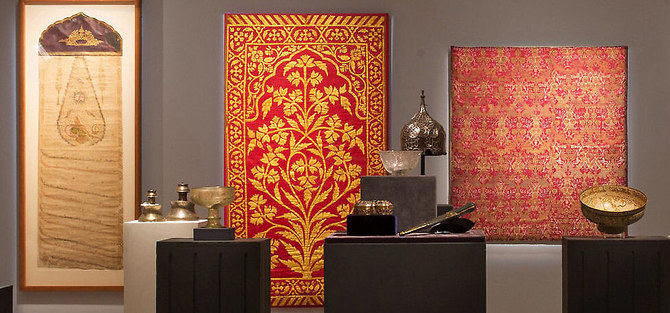
Some 190 objects from the Museum for Islamic Art in Jerusalem were planned to be sold at Sotheby’s London on October 27, 2020. (Courtesy Sotheby’s)
Short Url
Updated 27 October 2020
Follow

Jerusalem museum’s Islamic art sale halted amid Israeli political pressure

  • The museum had hoped to raise around $9.8 million by selling over 200 items through Sotheby’s auction house in London
  • Reuven Rivlin said the collection has a “greater worth and significance than their monetary value,” and said he opposes “the sale of these cultural assets from the region as a whole”

LONDON: A controversial sale of items from the Museum for Islamic Art in Jerusalem has been temporarily postponed, according to the museum’s primary donor, amid pressure from Israeli government bodies and President Reuven Rivlin.

The museum, which said it was facing financial hardship even before the coronavirus pandemic forced it to temporarily close its doors, had hoped to raise around $9.8 million by selling over 200 items through Sotheby’s auction house in London. Most of those items were not on public display, said the museum’s director, Nadim Sheiban.

The museum was founded in the 1960s by British-Jewish philanthropist Vera Bryce Salomons to showcase Islamic and Arab culture.

It also holds a large and valuable collection of watches, amassed by the founder’s father David Lionel Salomons, 60 of which the museum also planned to sell.

The museum said the proceeds would be used to keep it afloat and to fund educational programs.

But Rivlin, who lives near the museum, said the collection has a “greater worth and significance than their monetary value,” and said he opposes “the sale of these cultural assets from the region as a whole.”

Israel’s Ministry of Culture and Sport, the Antiquities Authority and the state prosecutor’s office had all looked into ways of halting the sale, without success. But now the auction, slated for Oct. 27, has been postponed.

The museum’s primary donor, the Hermann de Stern Foundation, said in a statement: “The foundation’s management hopes that the postponement will make it possible to reach agreements that will also be acceptable to the culture ministry in the coming weeks.”

Among the items set to go on sale were a helmet that once supposedly belonged to an Ottoman sultan, a Mamluk glass bowl dating from the 13th century, and a page from a copy of the Qur’an dating back over 1,000 years.

The fact that many of the items originated from outside Israel had meant the museum was able to sidestep laws preventing their export, despite their value and historical significance.

But the museum’s most prized items, such as a Breguet watch that once belonged to French Queen Marie Antoinette and valued in excess of $26 million, were not among those put up for sale.

A Sotheby’s spokesperson said raising funds for museums by selling some items, usually less likely to be on permanent display, is a practice it has plenty of experience of facilitating, and the aim of such sales is to preserve the core of a museum’s main collection for the future.

“The displays in the galleries will remain almost entirely undisturbed, remaining intact both from a spectator point of view and also from an academic and curatorial perspective,” Sotheby’s said.


Living Pyramid to bloom beyond Desert X AlUla

Updated 01 March 2026
Follow

Living Pyramid to bloom beyond Desert X AlUla

ALULA: Desert X AlUla officially closed on Feb. 28, but one of its most striking installations — the Living Pyramid —will continue to flourish. 

Tucked away within a lush oasis surrounded by ancient rock formations, Agnes Denes’ creation fuses art and nature, offering a living testament to resilience and connection.

Through her current rendition of The Living Pyramid for Desert X AlUla 2026, Denes seeks connection, likening it to bees constructing a new hive after disaster.

The pyramid structure is teeming with indigenous plants, forming layered patterns that echo the surrounding desert landscape. 

It blends harmoniously with the rocky backdrop while proudly standing apart.

“There is no specific order for the plants other than not to place larger plants on the very top of the pyramid and increase the number of smaller plants up there,” Iwona Blazwick, lead curator at Wadi AlFann in AlUla, told Arab News.

Native plants cascading down the pyramid include Aerva javanica, Leptadenia pyrotechnica, Lycium shawii, Moringa peregrina, Panicum turgidum, Pennisetum divisum, Periploca aphylla and Retama raetam. 

Aromatic and flowering species such as Thymbra nabateorum, Rhanterium epapposum, wild mint, wild thyme, Portulaca oleracea, tamarisk shrubs, Achillea fragrantissima, Lavandula pubescens, Salvia rosmarinus, and Ruta graveolens form distinct layers, adding color, texture and subtle fragrance to the pyramid.

“Each Living Pyramid is different. The environment is different, the people are different. I’m very interested in the different societies that come together on something so simple,” Denes said in a statement.

“Connection is what’s important; connection is what the world needs. I keep comparing us to a lost beehive or an anthill. And I wrote a little poem: This. And this is. Bee cries out. Abandon the hive. Abandon the hive,” she said.

Denes was born in Budapest, Hungary, in 1931 and is now based in New York. While the 95-year-old has not made it physically to the site in Saudi Arabia, she designed this structure to cater to the native plants of the area.

Her Living Pyramid series has certainly taken on reincarnations over the past decade. 

It debuted at Socrates Sculpture Park in New York in 2015, was recreated in Germany in 2017, appeared in Türkiye in 2022, and then London in 2023. 

In 2025, she showcased a version at Desert X 2025 in Palm Springs, California, and Luxembourg City. 

Most recently, in 2026, at Desert X AlUla.

While officially part of Desert X AlUla, the Living Pyramid stands apart and is housed separately, a short drive away from the other art works.

“The (Living Pyramid) artwork will stay for around a year, to showcase a full year’s effect on the plants throughout the different seasons,” Blazwick said.

After the year is up, it won’t go down. The plants will continue its metamorphosis beyond the pyramid. 

“The plants will be replanted and will have a new home within an environment that will suit their needs,” Blazwick concluded.