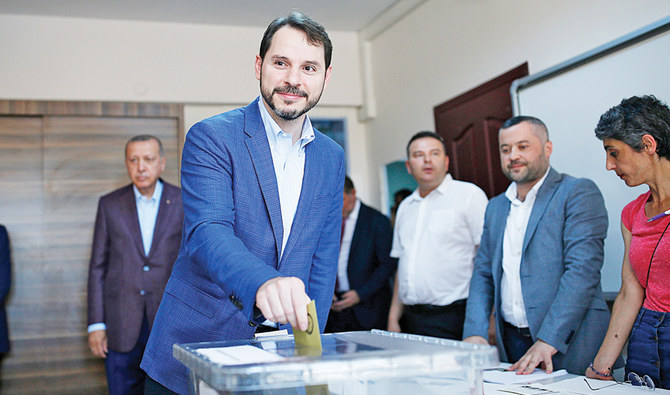

ANKARA: The surprise resignation of Turkey’s finance minister, who is also the president’s son-in-law, has capped a chaotic weekend for the country’s economic leadership.
Treasury and Finance Minister Berat Albayrak announced he was leaving in an emotional Instagram post, citing health reasons. His departure followed the sacking of central bank governor Murat Uysal by presidential decree.
Albayrak, who held the post for five years and was expected to succeed President Recep Tayyip Erdogan, leaves the economy in a dreadful state.
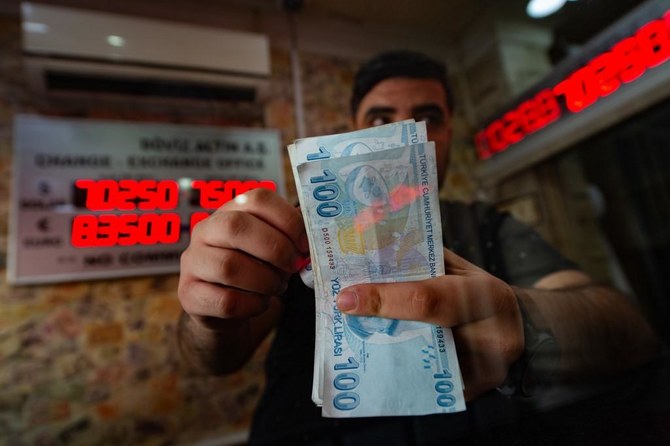
One dollar was worth TRY4.53 when he took on the ministerial job, but the lira has plummeted to lows of TRY8.54 and is one of the worst-performing emerging market currencies this year.
His resignation could be connected to a feud within the government’s inner circle as Albayrak is known to be at odds with Interior Minister Suleyman Soylu. Turkish mainstream media, which is majority-owned by pro-government companies, did not cover his resignation.
Albayrak’s bombshell comments — on not caring about the lira’s freefall and how its value could be restored if it were a government priority — may have also had a hand in his fall from grace.
Uysal and Albayrak reportedly wanted to raise interest rates last month, but were vetoed by Erdogan.
Uysal’s replacement is former finance minister and respected economist Naci Agbal, whom Albayrak was said not to get along with because they belonged to different religious sects. Agbal is said to have been appointed without Albayrak’s consent.
The dual departures have caused speculation about a Cabinet reshuffle in Ankara.
Sinem Adar, a Turkey researcher at the German Institute for International and Security Affairs, said the Instagram resignation, its accusatory tone and the long silence from the president’s office after Albayrak’s announcement warranted attention.
“Together these three events point at the weakness of the state apparatus underlined by a couple of factors,” she told Arab News.
The first was institutional destruction, a process that had been ongoing since the 2016 coup attempt. The second was the fight within the state over the control of state apparatus.
FASTFACT
Berat Albayrak’s resignation could be connected to a feud within the government’s inner circle as Albayrak is known to be at odds with Interior Minister Suleyman Soylu. His bombshell comments — on not caring about the lira’s freefall and how its value could be restored if it were a government priority — may have also had a hand in his fall from grace.
“The third has to do with personalization of power and the deep integration of Erdogan’s family into different realms of politics,” she added. “Economic crisis in this respect is a consequence and also a catalyst of the deep vulnerability of state institutions. It is reasonable to expect that the coming weeks and months will be turbulent and chaotic.”
The Turkish lira reacted positively to Albayrak’s resignation and the appointment of Agbal, jumping against the dollar.
“Both domestic and international market players were not satisfied with economy policies that were steered by Albayrak, who was found very incompetent to do so,” independent economist Emre Deliveli told Arab News. “His speeches at the international platforms, especially during JP Morgan Investor meetings held during the IMF/World Bank spring meetings, were so bad that he couldn’t boost investor confidence.”
There will be a meeting of the central bank’s Monetary Policy Committee on Nov. 19 and, as a confidence-building measure, Deliveli expected a hike in interest rates under Agbal’s governorship.
“One of the biggest mistakes of Albayrak was his insistence on low interest rates and depletion of foreign currency reserves in his efforts to support the country’s currency. However, even if these cash reserves weren’t sold, the situation couldn’t get worse than today’s financial situation.”
The Turkish elite, according to Deliveli, opted for discretionary economic policies rather than pursuing rule-based measures and orthodox policies.
“Either you don’t interfere in the economy and let respected people do their job for clearing the wreckage and stabilizing the lira, or things get worse and you will have to apply for IMF assistance at the end,” he added.
The sea-change in Turkey’s economic management team needed enough room for maneuver without political interference, otherwise the lira might continue plummeting against major foreign currencies.
Albayrak’s resignation could also be related to the US election results as he was known for his efforts to manage government ties with the White House through his personal friendship with Jared Kushner, the son-in-law of former President Donald Trump.
His departure came amid credible reports about several dozen parliamentarians from the ruling Justice and Development Party (AKP) preparing to defect to the breakaway DEVA and Future parties.
According to a recent survey by MetroPoll, public support for the AKP fell below 30 percent for the first time if a snap election was held on Sunday.