

GCC consumer behavior signals rise of the ‘homebody economy’

Many consumers are now spending less, a greater number are shifting to online shopping, and brand loyalty has suffered a setback.
Short Url
Updated 10 November 2020
Follow

GCC consumer behavior signals rise of the ‘homebody economy’

  • McKinsey data shows purchases increasingly geared towards the domestic bubble, with people more mindful about spending
  • COVID-19 lockdown measures have accelerated the trend towards digital adoption as consumers embrace online shopping

DUBAI: COVID-19 has changed consumer behavior patterns around the world, and the GCC bloc is no exception, according to new research by consultancy firm McKinsey & Company.

Besides the obvious human challenges, the study, entitled “Digital: A Spotlight on the New Consumer,” has shed light on the pandemic’s potential implications for the global economy, businesses and employment.

It found the crisis has affected consumers in six notable ways. Many are now spending less, a greater number are shifting to online shopping, and brand loyalty has suffered a setback.

Researchers also observed a greater focus on health and hygiene, more deliberate consumption and the rise of the “homebody economy” — where spending is geared towards the domestic bubble.

The shift appears to have placed digital adoption at the center of all industries. “The current crisis has provided us a bit of a glimpse of what could potentially be our future,” said Joydeep Sengupta, senior partner and leader of McKinsey’s digital and analytics practice in Eastern Europe, the Middle East and North Africa.

“Human digital interactions have overtaken human-to-human interactions.”

Although the population was already becoming more sedentary and prone to staying indoors, Sengupta says the coronavirus and resulting lockdown measures have further bolstered these habits — and in turn forced institutions to adapt. “The adoption by consumers of digital tech is further driving and accelerating the trend,” he said.
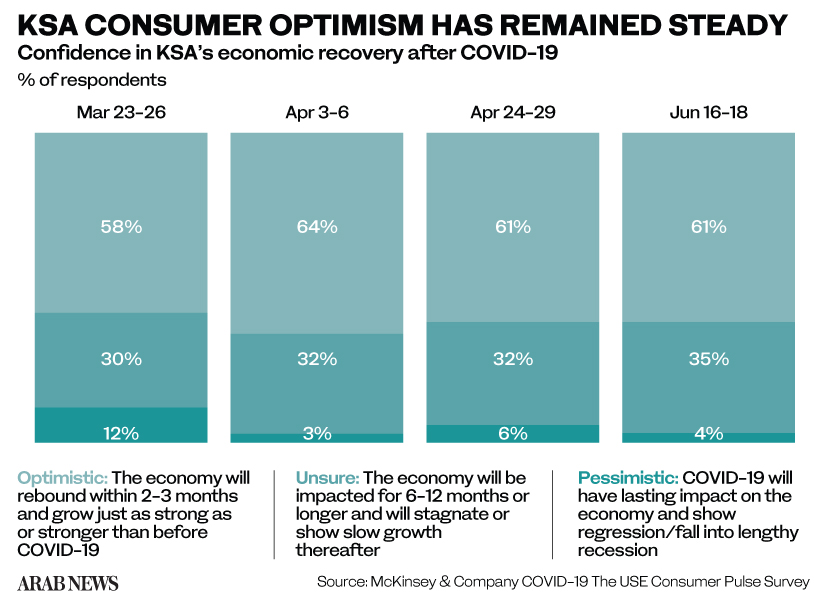
The study, conduced around the middle of this year, found that although incomes and savings have suffered for more than half of respondents in Saudi Arabia over the pandemic period, consumer confidence has remained steady throughout the crisis. Some 61 percent of Saudi respondents said they believe the economy will soon recover — making them one of the more optimistic countries polled, compared to Europeans.

And although a large proportion of Saudi consumers expect their incomes and savings to soon stabilize, a growing number believe the changes to their routines wrought by COVID-19 will last well beyond the next two months.
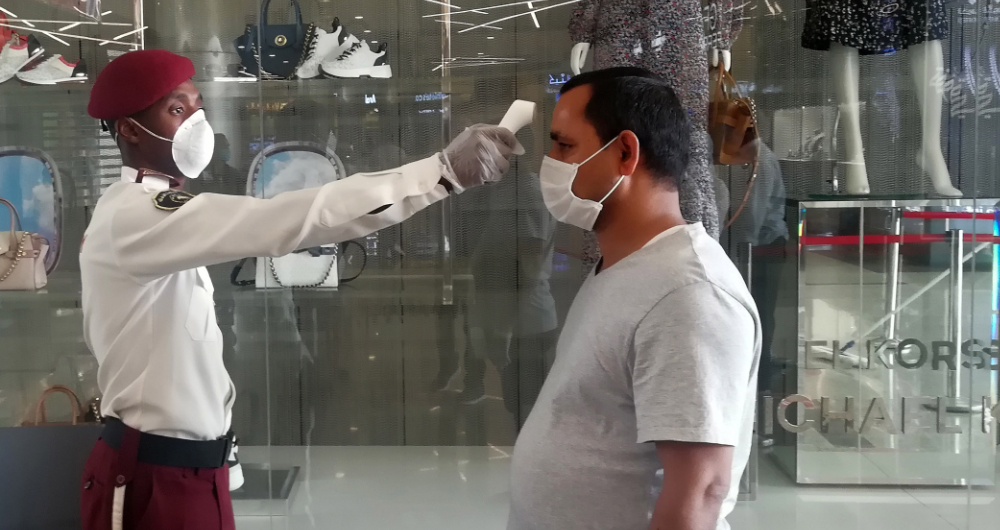


New study sheds light on the pandemic’s potential implications for the global economy, businesses and employment. (AFP)

“Consumers are not just hapless bystanders,” said Sengupta. “They’re also playing a key role in perpetuating the push by tech companies. The digital flood that’s going on is created (to a large extent) by the confusion that the consumer is creating in terms of their ever-shifting preferences and their unpredictable demands.”

The McKinsey study, which sought to unpack some of these questions, found some interesting developments in product preferences. Many Saudis polled said they are focusing more on healthy and hygienic packaging and are judging the companies they buy from based on how they treat their employees.

“In terms of health and well-being, we see consumers overall becoming much more mindful,” said Abdellah Iftahy, partner and leader of McKinsey’s consumer and retail practice in the Middle East.

“The region, which was lagging in this dimension versus other economies in the world, is now catching up and leapfrogging in terms of awareness of the consumer in general when it comes to health and well-being.



Tom Isherwood, Joydeep Sengupta and Abdellah Iftahy.

“If these retailers are anchored in clear values and what they stand for from a purpose perspective, the local content is becoming more and more important here in the region.”

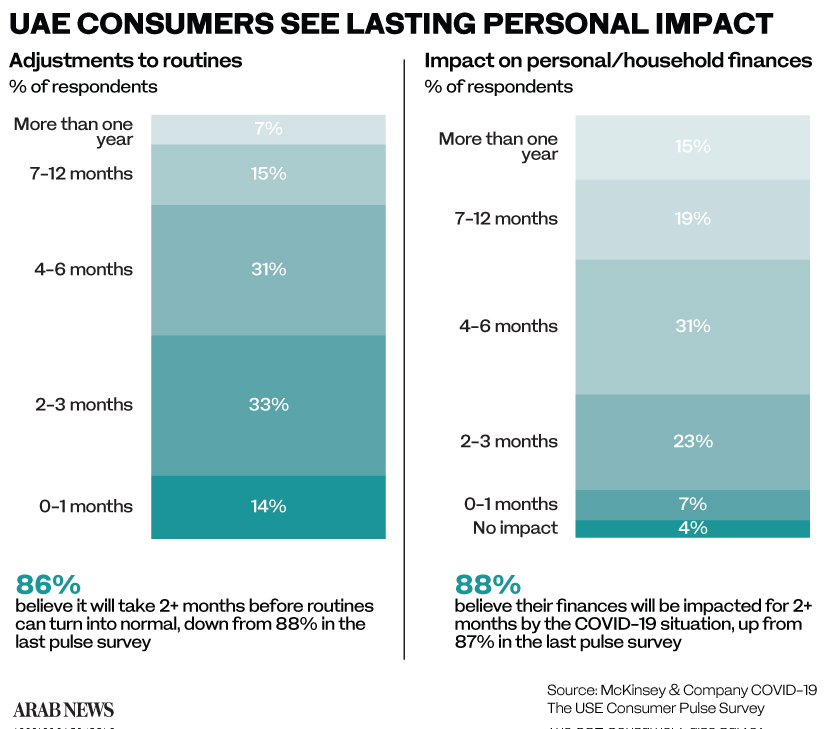
The study also found up to two-thirds of consumers in Saudi Arabia and the UAE expect their personal and household finances will be impacted in some way by the crisis for another four months to come. As such, 52 percent of Saudi consumers said they are becoming more mindful about how they spend their money, while many are adopting habits like making lists and doing their research before making purchases.

“We are seeing today, and we will see going forward, consumers that are more and more conscious and mindful about their spending and thinking about value for money as a key criterion for decision-making,” Iftahy said.

“Obviously, the whole shift to online and digital is absolutely a big trend that is here to stay. Many companies have seen some of their 10-year targets achieved within weeks, and some of these trends have been massively accelerated thanks to digital (modes) and technology.”
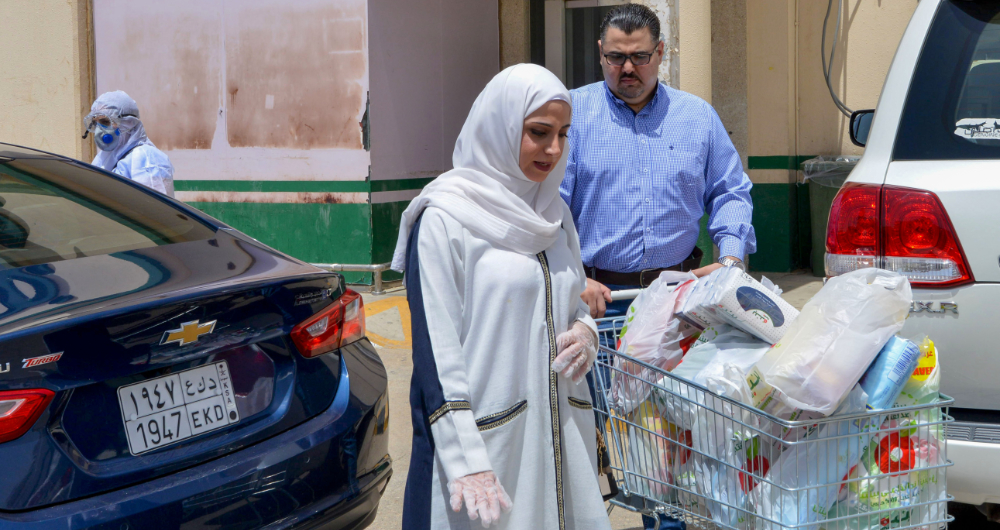


The McKinsey study found that a high rate of Saudi consumers are not regularly engaging in out-of-home activities and do not plan to return to many of these, other than grocery shopping, once the crisis passes. (AFP)

Saudi Arabia and the UAE, followed by the US and Europe, saw the biggest growth in consumers who intend to continue using online channels, even after the crisis ends. Such behavior is likely to fit nicely with the Kingdom’s Vision 2030 — especially with such a young population and many more women entering the workforce.

“Consumer behavior and consumer fundamentals in Saudi Arabia are actually great assets for the Kingdom overall to build up the digital economy in many aspects,” Iftahy said. “Saudi Arabia is one of the countries where consumers are the most connected when it comes to digital assets globally, which means getting access to them and interacting with them digitally through social media is something which is easily accessible.”

And there are clues as to why Saudis are so immersed in the online world. The McKinsey study found that a high rate of Saudi consumers are not regularly engaging in out-of-home activities and do not plan to return to many of these, other than grocery shopping, once the crisis passes.
Saudis were found to be the most wary when it came to activities such as going to big events or to the gym, while around 70 percent of GCC consumers said they are reluctant about returning to the out-of-home activities they had attended before the pandemic. This trend has further intensified digital adoption.

“One of the themes within Vision 2030 has been around digitization and we’re seeing that trend accelerate globally,” said Tom Isherwood, partner and core leader of McKinsey’s public sector and digital practice in the Middle East.

“For Saudi Arabia to navigate the coming decade in a really successful way, it will really be doubling down on that theme and not just at the government level, but also across industries as companies look at their own business models and try to figure out how to modernize and digitize more.”

Twitter: @CalineMalek


GCC offering investors ‘safe’ PPP deals; Saudi pipeline nears 300: FII

Updated 20 February 2026
Follow

GCC offering investors ‘safe’ PPP deals; Saudi pipeline nears 300: FII

RIYADH: Global investors can find a “safe harbor” in the Gulf Cooperation Council as the bloc’s public-private partnerships pipeline offers “compelling” opportunities, according to a new report.

The latest document from the Future Investment Initiative Institute highlights how economies in the region are currently driving the next wave of PPP growth. 

It cites findings from Partnerships Bulletin, which ranks Saudi Arabia as second in the global emerging markets pipeline for PPP projects up to July 2025, and also places Dubai in the top 10.

While that analysis claims the Kingdom has 98 PPP projects either formally published or announced, FII says Saudi Arabia has a further 200 currently awaiting approval.

The findings align with the goals outlined in the Kingdom’s National Privatization Strategy, launched in January, which aims to raise satisfaction levels with public services across 18 target sectors, create tens of thousands of specialized jobs, and exceed 220 PPP contracts by 2030. 

The strategy also aims to increase private sector capital investments to more than SR240 billion ($63.99 billion) by 2030.

The FII report says that around 90 percent of FDI into Saudi Arabia now flows into non-oil sectors, from advanced manufacturing and tourism to green energy and digital infrastructure. 

“That shift reflects deliberate policy choices to open markets, standardize regulatory frameworks and use public capital to de-risk new value chains,” says the document, adding: “The result is a kind of safe harbor in an otherwise low-growth, high-uncertainty world.”

It continues: “While global FDI has stagnated or declined in many regions, the GCC’s pipeline of planned infrastructure and industrial projects now exceeds $2.5 trillion, according to Boston Consulting Group data, with PPPs playing a central role in structuring and financing them. For global investors searching for yield, diversification and inflation-linked income, this represents a compelling proposition.”

Commenting on the FII Institute report, Sally Menassa, partner at international management consulting firm Arthur D. Little, said PPPs are a strategic necessity for delivering infrastructure at speed and scale, and described Saudi Arabia’s pipeline as a “powerful execution and financing tool.” 

She added: “The Kingdom’s PPP momentum must remain focused on impact, value creation and execution excellence. PPPs should not be viewed merely as a funding mechanism, but as a structural tool to enhance infrastructure performance, attract investment and support sustainable economic growth in line with Vision 2030.” 

Menassa said that Saudi Arabia’s National Privitization Strategy marks a shift from a project-by-project approach to institutionalization of efforts and value creation.

“By clarifying sector priorities, strengthening project selection criteria, and formalizing governance and investor pathways, the Strategy reduces uncertainty. This clarity enhances investor confidence and improves pipeline quality,” said the Arthur D. Little official. 

Sally Menassa, partner at international management consulting firm Arthur D. Little. Supplied.

She added: “PPP and privatization efforts in Saudi Arabia are not about divestment or the state shifting execution to the private sector, it is really about becoming more productive as a nation. It enhances efficiency, raises service standards, mobilizes private and SME participation, and attracts capital.” 

Menassa further said that the strategy could help the Kingdom achieve stronger fiscal sustainability and higher private sector GDP contribution, both of which are critical components to accelerate the Kingdom’s economic transformation under Vision 2030.

Vijay Valecha, chief investment officer at Century Financial, believes input from the private sector across all stages, from design to construction and operations, improves the efficiency of project delivery and long-term operations in Saudi Arabia. 

“Tighter governance through centralized management at the National Center for Privatization and PPP and a more streamlined process, including template contracts, a clearer regulatory environment, and a transparent pipeline, is likely to improve delivery speed,” said Valecha. 

He added: “This means faster delivery of big projects like Red Sea resorts or Neom, with private firms handling operations to drive innovation. Ultimately, the strategy supercharges diversification by making the private sector the main engine of growth, aligning perfectly with Saudi Arabia’s push for a vibrant, non-oil economy.” 

The FII Institute added that the global flow of FDI is increasingly concentrated in the Gulf Cooperation Council region, driven by ambitious national transformation agendas and deep pools of sovereign wealth.

Tony Hallside, CEO of STP Partners, outlined several factors that are boosting the PPP landscape in the region, which include large infrastructure demand from Vision-level programs and urbanization. 

“Government frameworks that standardise PPP procurement are making projects bankable. Strong regional capital pools and sovereign support will mitigate risk and attract global players. In the GCC, Saudi Arabia’s pipeline itself is one of the largest in the Middle East, indicating strong investor interest,” added Hallside. 

Underscoring the role of growing PPP in Saudi Arabia, the FII report said: “A decade ago, the Kingdom’s solar capacity was negligible, despite its vast solar resource. Through early anchor investments, long-term power purchase agreements and support for national champions, the state seeded a competitive renewables market that now attracts global players on purely commercial terms.” 

Valecha said that clearer PPP laws, standardised contracts and dedicated PPP units have reduced execution risks and made projects more bankable for global infrastructure funds and developers in the GCC region. 

He added that rapid urbanization, a young and growing population, rising data center power demand and energy transition projects create predictable, long-duration cash flows in the region. 

“This combination of policy support, fiscal necessity and structural growth is why the GCC is emerging as one of the fastest-growing PPP markets globally,” said Valecha. 

Vijay Valecha, chief investment officer at Century Financial. Supplied

Key Saudi PPP projects

Yanbu 4 Independent Water Project - supplying water to Medina and Makkah

Location Yanbu, Red Sea coast

Companies involved: Engie, Mowah, Nesma, Saudi Water Partnership Co.

Cost: $826.5 million

Expected delivery date: Operational as of 2024

Hadda Independent Sewage Treatment Plant

Location: Makkah Province

Companies involved: Metito Utilities, Etihad Water and Electricity, SkyBridge Limited Co., Saudi Water Partnership Co.

Expected delivery date: 2028 

As Sufun Solar PV Independent Power Project

Location: Hail region

Companies involved: TotalEnergies, Aljomaih Energy & Water, Saudi Power Procurement Co.

Expected delivery date: Expected to connect to the grid in 2027

Construction of greenfield international airports

Location: Taif, Abha, Qassim, and Hail

Companies involved: Currently in the planning stage; investors are being sought

One-Stop Station Project

Location: Intercity road network across the Kingdom

Companies involved: Saudi Arabia’s Roads General Authority and National Center for Privatization & Public-Private Partnership announced a full list of qualified bidders in February.

King Salman Park

Location: Riyadh

Companies involved: King Salman Park Foundation, Ajdan Real Estate, Sedco Capital

Cost: $1 billion

Project: Madinah-3, Buraydah-2, and Tabuk-2 Independent Sewage Treatment Plants

Location: Madinah, Buraydah, and Tabuk

Companies involved: Acciona Agua, Tawzea, Tamasuk, Saudi Water Partnership Co.

Cost: $627 million combined

Riyadh Metro Line 2 Extension

Location: Riyadh

Companies involved: Royal Commission for Riyadh City, Arriyadh New Mobility Consortium, led by Webuild. Riyadh Metro Transit Consultants (JV between US Parsons and France’s Egis and Systra) as project management and construction supervision consultant.

Cost: Up to $900 million

Expected delivery date: 2032


The crucial role of emerging markets

According to the FII Institute report, the ability to deliver resilient infrastructure, expand digital connectivity and accelerate the energy transition will increasingly depend on the strength and legitimacy of PPPs, as fiscal space tightens and investment needs rise. 

FII estimates a $5 trillion global infrastructure financing gap by 2040. It also points to significant regional shortfalls, including an estimated $3.7 trillion gap in the US and an annual $130 billion to $170 billion gap across Africa. In this context, PPPs are moving from a transactional procurement route to a central model for financing and delivery.

The report highlighted that emerging markets, including Saudi Arabia, are currently driving the next wave of PPP growth, with spending across low-and middle-income countries reaching $100.7 billion in 2024, up 16 percent year on year, according to figures from the World Bank. 

Moreover, emerging markets now represent around 61 percent of global PPP activity by gross domestic product share.

According to Partnerships Bulletin’s findings up to July 31 2025, the Philippines leads the emerging-market pipeline with 230 projects, followed by Saudi Arabia with 98, Kyrgyzstan with 80, Bangladesh with 71, and Peru with 54 projects.

Greece has 42 projects in the pipeline, followed by Dubai at 28, Kenya at 25, Colombia at 24, and Pakistan at 14. 

PPP: An engine of growth

When capital was cheap, PPPs were often treated as an optional extra – a way to shift specific projects off the public balance sheet, or to import private-sector efficiency into construction and operations, the FII report said. 

However, now, nations consider PPPs as a central hub of their economic strategy, as they enable the state to stretch every dollar of public investment using private capital, while retaining strategic control over what gets built, where and to what standard.

“The real differentiator is complexity. When a project presents significant financial uncertainty or unpredictable demand, or if there’s a high level of climate exposure or technological risk, a PPP can give leaders the tools to manage those issues without slowing things down,” said Bob Willen, global managing partner and chairman of Kearney, said in the FII report. 

Erik Ringvold, chief business development officer at Regional Voluntary Carbon Market Co., was quoted in the report as saying that carbon markets will benefit through PPPs, as deepened public-private partnerships could help achieve progress toward national emissions targets, while simultaneously creating economic opportunity and catalyzing new green industries. 

“Saudi Arabia has made large strides toward an emissions compliance system, with an operational carbon standard in place, and an emissions trading system announced to be launched over the coming few years,” said Ringvold. 

He added: “At VCM, we see a clear future carbon vision for Saudi Arabia. One ecosystem. One marketplace. One iconic collaboration – with the PPP model at the heart of its success.” 

PPPs for investors and citizens 

For investors, infrastructure-backed PPPs offer long-duration, often inflation-linked cash flows at a time when public markets are volatile and dominated by a narrow set of mega-cap technology stocks. 

For citizens, well-designed PPPs can mean better services, more resilient infrastructure and faster progress toward climate and development goals, without unsustainable tax rises or austerity. 

FII, however, cautioned that public consent is becoming decisive. Across seven countries, only 23 percent of citizens agree that PPPs “equally benefit everyone”, compared with 41 percent of business and government leaders.

Tony Hallside, CEO of STP Partners. Supplied

Hallside said that public consent hinges on transparency, accountability, and visible service outcomes. 

He added that governments should publish clear procurement frameworks, communicate cost-benefit and performance expectations in plain language, and measure user satisfaction and service quality over time — “reinforcing that PPPs deliver tangible improvements in infrastructure and services.” 

Menassa echoed similar views and said that communication with the public is not sufficient, but the performance and execution phase holds the key to PPP projects. 

“Winning public opinion for PPPs is rather a marathon not a race. It starts with building awareness and trust by providing transparency and demonstrating value for money, ensuring affordability and service quality of public services is maintained through strong regulatory oversight, and ensuring competitive, transparent procurement processes,” added Menassa. 

According to the Arthur D. Little official, the public must see tangible improvements in service reliability, efficiency and accountability, and acceptance will follow.

“The world can’t afford to delay the infrastructure and energy transition investments that will determine prosperity – and planetary stability – for decades to come. Nor can it fund them through public budgets alone. Financing the future is, by definition, a joint endeavour,” added the FII report.