

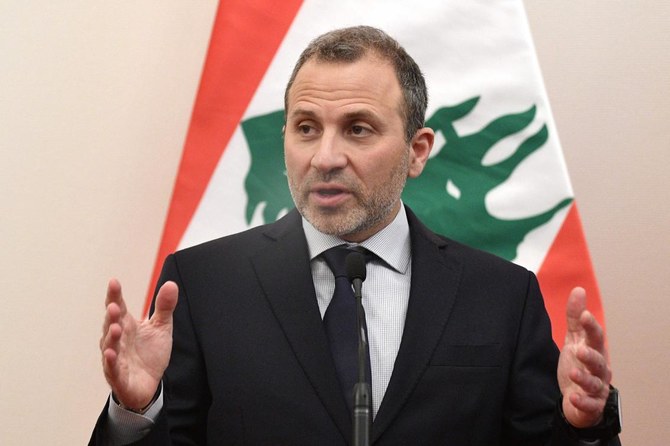

BEIRUT: Lebanon's former foreign minister Gebran Bassil told his supporters on Sunday that he would fight US sanctions against him.
Bassil, who leads the Free Patriotic Movement (FPM), has had his US assets frozen and is barred from entering the country.
Secretary of State Michael Pompeo, in announcing the sanctions, described the lawmaker as being “notorious for corruption” and accused him of contributing to a system that “aided and abetted Hezbollah's destabilizing activities.”
Bassil told the Sunday rally that Hezbollah was a Lebanese party and not, as Pompeo said, a terrorist one.
“We will assign a law firm to nullify the US Treasury’s decision due to the lack of (its) legal basis and request moral and material compensation. My appointment then will be with the American judiciary. One of the conditions for the cancellation of sanctions is that they can be canceled if the interest of America requires it, knowing that the US sanctions and the Magnitsky Act contradict the most important principles of international law, which is the principle of national sovereignty, and it is not legally applicable outside US territory.”
He said that the Lebanese must endure “injustice” to remain free in their homeland and to protect Lebanon from fragmentation and fighting.
“We remain friends of the American people, no matter how wrong their administration has done us.”
Talk of sanctions began in earnest in the summer of 2018 with the formation of Prime Minister Saad Hariri's second government, Bassil said, giving an account of what the US wanted from him and why he had not given in to its demands.
“What was required of me was to immediately sever the relationship with Hezbollah and three other points — not a word about corruption. My natural quick reaction was to reject this issue because it violates a basic principle of the FPM, which is its refusal to take instructions from any foreign country.”
Bassil said there were attempts to persuade him “to be a friend” and that he was offered the temptations of “stardom” in Lebanon and the US, as well as personal and political profits for him and the FPM.
On Nov. 4 the US gave him a 24-hour deadline to change his mind and think about the offer in his interest and in the interests of Lebanon, and he was alerted of the consequences in case sanctions were imposed.
“I did not do anything so the sanctions were issued based on corruption and human rights and they barely mentioned Hezbollah, although they only talked to me about Hezbollah.”
Bassil revealed that he informed the secretary-general of Hezbollah, Hassan Nasrallah, about what was happening.
Nasrallah, according to the FPM leader, “expressed his understanding of any position we may take and expressed his readiness for any help that we request from him, and of course I did not ask for anything.”
Bassil said the sanctions were an attempt to force him “to work politically with a big country under the weight of the carrot and the stick,” and spoke of “a treason” being committed against him by a member of his movement in Al-Kharj.
He said the individual would be prosecuted for betraying the principles of the party, its rules and its leaders, and for “working to demolish its entity, credibility, strength and institutions, intentionally and systematically, and the punishment is expulsion (from the party).”
The imposition of sanctions has not prevented Bassil from voicing his opinion on the conditions for forming a new government in Lebanon.
“Two ministerial portfolios may not be combined and portfolios and numbers should be distributed to sects and blocs. One mechanism should be adopted for naming ministers, of course, of specialists. However, nobody has a monopoly on naming specialists as if he alone knows them or owns them.”
He warned the formation of the government would be delayed if “clear and unified standards” were not adopted, and that the person responsible for the delay would be the one who set “discretionary standards” and covered them with contradictory promises with the sole objective of increasing his political stake.


