



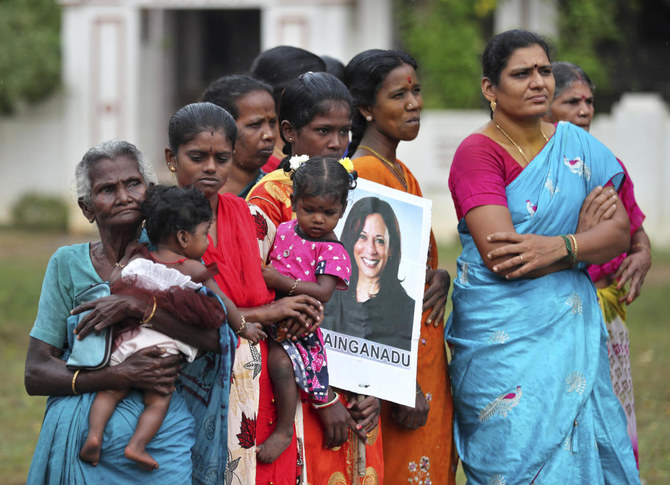

THULASENTHIRAPURAM, Tamil Nadu: It was a moment to remember.
As Kamala Harris made history on Saturday by becoming the first woman, the first black person and the first person of South Asian descent to be chosen as US vice president, residents of Thulasenthirapuram, her ancestral village in India, embraced each other amid cheers and tears of joy.
Thulasenthirapuram, located nearly 350 km from Tamil Nadu’s capital Chennai, wore a festive look on Sunday with people bursting crackers, distributing sweets and offering special prayers in the village temple. Some had even decorated the outside of their houses.
“We all know that today is a very big day for all of us,” Meenakshi Surya Prakash, an 18-year-old student and resident of the village, told Arab News.
“A woman of Indian origin has been elected as the vice president of the US. This is a proud moment for us,” she said.
Harris’s grandfather, P. V. Gopalan, was born in Thulasenthirapuram, where the family still has a temple at which villagers converge to pray.
“She is from our soil. We also expect that Kamala Harris will take every step for the betterment and welfare of Indians living in the US and India,” Prakash said.
Harris’ relatives said that they had expected her to win.
“It really feels good. I knew it would happen and I am happy about it,” Harris’ maternal aunt, Dr. Sarala Gopalan, told Arab News on Sunday.
Based in Chennai, capital of the south Indian state of Tamil Nadu, Dr. Gopalan said that she was “not tense” during the vote-counting process, anticipating that US President-elect Joe Biden would win.
“We knew that Joe Biden had a good lead, but we didn’t know how to trust the samples . . . that’s all,” she said.
Two days before Saturday’s announcement, Dr. Gopalan said that she had a brief chat with Harris, but the questions were not “political.”
“I just asked her if she is all right and all is well?” she said, smiling.
Harris has always been vocal about being proud of her roots and her mother’s role in that. After her mother’s death in 2009, Harris “continued to stay in touch” with her mother’s relatives in India.
“I am only worried about her welfare because her mother is not there, so I have to take care of her as a mother,” Dr. Gopalan said.
On Saturday night, Harris, in her first address to the nation, recalled her mother’s journey from India as a 19-year-old in 1959.
“I am grateful to the woman most responsible for my presence here today, my mother, Shyamala Gopalan Harris. When she came here from India at the age of 19, she maybe didn’t imagine this moment. But she believed so deeply in America where a moment like this is possible,” she said.
Harris’ Delhi-based maternal uncle, Balachandran Gopalan, said that he was “glued to his TV but never for once doubted her victory.”
“I have constantly been watching TV. I was expecting that. After hearing the CNN declare Biden as victorious my tension was gone. It’s a moment of pride,” Balachandran told Arab News.
“The day she was nominated to be the vice presidential candidate it was a big moment for us,” he added.
Indian Prime Minister Narendra Modi hailed Harris’ victory.
“Your success is pathbreaking, and a matter of immense pride not just for your chittis (aunts), but also for all Indian-Americans. I am confident that the vibrant India-US ties will get even stronger with your support and leadership,” Modi tweeted on Sunday.
For some women, Harris’ win represented “a new chapter.”
“What it also signifies is a new chapter in the long fight for global diversity,” Mallika Shakya of New Delhi-based South Asia University, told Arab News.
“Harris swept on to the screens of the media and social media around the world; it would have been difficult to tell a little brown girl that the sky is the limit. This is about the US media hegemony, but also about the everyday effect of this hegemony,” she said.
All eyes are also on Harris over her future approach to thorny issues within India, such as Kashmir.
In the past, she has spoken about human rights’ issues in the valley after the abrogation of the region’s special status in August last year.
She has also been critical of New Delhi’s alleged highhandedness against Muslims in the country.
However, experts said that Harris’ selection would not have any impact on the administration’s foreign policy choices.
“It would be folly to assume that Kamala Harris’ personal connections with India will have an impact on the administration’s policy choices,” Pranay Kotasthane of Bangalore-based think tank Takshashila Institution, told Arab News.
He cited the example of a recent survey by US academics, which showed that while a majority of Indian-Americans voted for the Democratic party, the “India-US relationship is very low on their demand list.”
“I expect policy continuity rather than any dramatic change. I don’t think those are issues which determine the overall US policy outlook toward India. They are important issues for which a resolution has to be found within India. US administration’s questions won’t resolve them.”


