

Fitch sees growing risk as Turkish lira hits new low

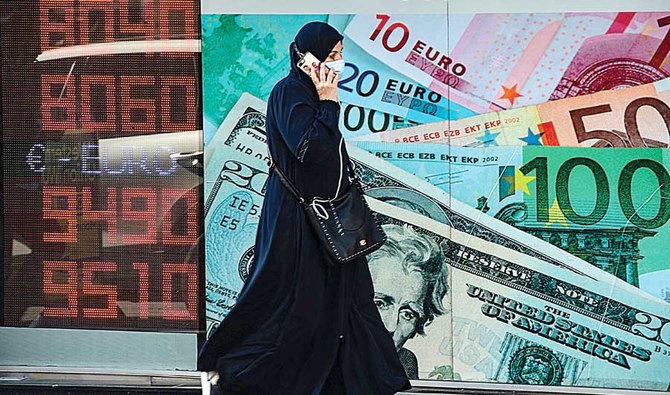
Turkey’s currency is causing great concern, having lost around 30 percent of its value this year and nearly 10 percent in the past two weeks alone. (Reuters)
Short Url
Updated 07 November 2020
Follow

Fitch sees growing risk as Turkish lira hits new low

  • Threat of worsening relations with the US could place more pressure on the currency

ISTANBUL: Turkey has not done enough policy tightening to support its lira, which tumbled to another record low on Friday, and the country’s FX reserves and external financing remain potential weak spots, according to Fitch Ratings’ key analyst.

Douglas Winslow, the agency’s primary Turkey analyst, told Reuters further pressure from the currency, double-digit inflation and depleted FX reserves “would significantly increase the chances” of a formal interest rate hike by year end.
The lira slid as much as 1.7 percent to a record low of 8.56 versus the dollar, despite the greenback’s weakness as votes were still being counted in Tuesday’s tight US election.
Turkey’s bilateral ties could suffer if Democrat Joe Biden continues to gain ground and becomes US president, adding more pressure on the lira that has dropped some 30 percent this year and nearly 10 percent in the past two weeks alone.
The Turkish central bank raised rates to 10.25 percent in September and could tighten again to head off the depreciation and address inflation stuck around 12 percent.
Yet the tightening of credit in recent months “has been insufficient to reverse the downward trend in the lira and (to a less extent) in foreign exchange reserves,” Winslow, a director on Fitch’s sovereign team, said in an email.

FASTFACT

Turkey’s FX reserves fell to $16.8 billion last month, the lowest since 2004.

Turkey is rated “junk” by the big three sovereign agencies. While Fitch’s rating of BB- is the highest, it revised the outlook to “negative” from “stable” in August citing depleted FX reserves and weak monetary policy credibility.
Winslow said the central bank has “limited independence” from political pressure for lower rates and “a track record of being slow to respond to events,” raising the risk that too-loose policy stokes external imbalances and market instability.
Yet he was more sanguine for now about two main triggers for a possible ratings downgrade: The lira has not caused “severe stresses” in the external financing position of banks or corporates; and the trend in FX reserves “has become somewhat less negative,” he said.
The central bank’s net FX reserves fell to $16.8 billion last month, the lowest since 2004, from $41.1 billion at the end of 2019. Adding to the lira’s woes, Turks’ holdings of foreign currencies and gold hit a record $221 billion last month.
Analysts say Turkey-US ties could strain further if Biden is elected and as expected toughens the US stance against Ankara’s military interventions abroad and its crackdown on dissent at home.
“To differentiate his administration from Trump’s, Biden would pay more than lip service to things like human rights, rule of law and democracy. That will be the real pressure on Turkey,” said Soli Ozel, lecturer on international relations at Kadir Has University in Istanbul.



PIF’s Humain invests $3bn in Elon Musk’s xAI prior to SpaceX acquisition

Updated 18 February 2026
Follow

PIF’s Humain invests $3bn in Elon Musk’s xAI prior to SpaceX acquisition

JEDDAH: Humain, an artificial intelligence company owned by Saudi Arabia’s Public Investment Fund, invested $3 billion in Elon Musk’s xAI shortly before the startup was acquired by SpaceX.

As part of xAI’s Series E round, Humain acquired a significant minority stake in the company, which was subsequently converted into shares of SpaceX, according to a press release.

The transaction reflects PIF’s broader push to position Saudi Arabia as a central hub in the global AI ecosystem, as part of its Vision 2030 diversification strategy.

Through Humain, the fund is seeking to combine capital deployment with infrastructure buildout, partnerships with leading technology firms, and domestic capacity development to reduce reliance on oil revenues and expand into advanced industries.

The $3 billion commitment offers potential for long-term capital gains while reinforcing the company’s role as a strategic, scaled investor in transformative technologies.

CEO Tareq Amin said: “This investment reflects Humain’s conviction in transformational AI and our ability to deploy meaningful capital behind exceptional opportunities where long-term vision, technical excellence, and execution converge, xAI’s trajectory, further strengthened by its acquisition by SpaceX, one of the largest technology mergers on record, represents the kind of high-impact platform we seek to support with significant capital.” 

The deal builds on a large-scale collaboration announced in November at the US-Saudi Investment Forum, where Humain and xAI committed to developing over 500 megawatts of next-generation AI data center and computing infrastructure, alongside deploying xAI’s “Grok” models in the Kingdom.

In a post on his X handle, Amin said: “I’m proud to share that Humain has invested $3 billion into xAI’s Series E round, just prior to its historic acquisition by SpaceX. Through this transaction, Humain became a significant minority shareholder in xAI.”

He added: “The investment builds on our previously announced 500MW AI infrastructure partnership with xAI in Saudi Arabia, reinforcing Humain’s role as both a strategic development partner and a scaled global investor in frontier AI.”

He noted that xAI’s trajectory, further strengthened by SpaceX’s acquisition, exemplifies the high-impact platforms Humain aims to support through strategic investments.

Earlier in February, SpaceX completed the acquisition of xAI, reflecting Elon Musk’s strategy to integrate AI with space exploration.

The combined entity, valued at $1.25 trillion, aims to build a vertically integrated innovation ecosystem spanning AI, space launch technology, and satellite internet, as well as direct-to-device communications and real-time information platforms, according to Bloomberg.

Humain, founded in August, consolidates Saudi Arabia’s AI initiatives under a single entity. From the outset, its vision has extended beyond domestic markets, participating across the global AI value chain from infrastructure to applications.

The company represents a strategic initiative by PIF to diversify the Kingdom’s economy and reduce oil dependence by investing in knowledge-based and advanced technologies.