- The PML-N leader blamed the country’s powerful army chief for manipulating elections, bringing the PTI administration to power
- The PPP chairman says the opposition PDM alliance was not calling for Pakistan’s military and intelligence chiefs to step down
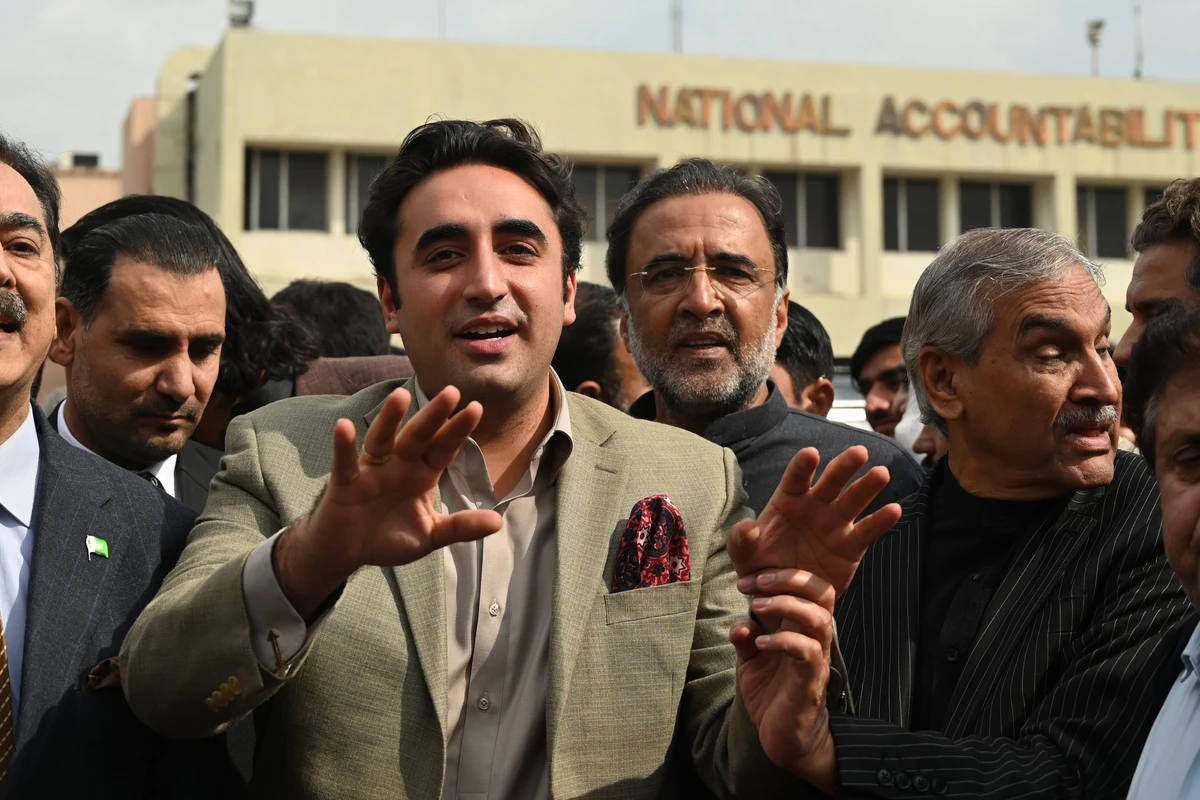
ISLAMABAD: Pakistan Peoples Party (PPP) Chairman Bilawal Bhutto Zardari said on Friday he was not aware that the former prime minister, Nawaz Sharif, was going to blame the country's army chief for manipulating the last general elections during his Gujranwala speech.
However, he maintained that Sharif would not have made such a claim without "solid evidence," adding that he was waiting for the Pakistan Muslim League-Nawaz (PML-N) founder to present the proof to the public.
In an interview with BBC Urdu, the PPP leader said that no individual could be solely held responsible for bringing Prime Minister Imran Khan and his administration to power.
"As far as Mian Nawaz Sharif is concerned, he has remained [Pakistan's] prime minister three times," he continued. "I am certain that he would not have named [the top military and intelligence officials] without clear and solid evidence. It is not the kind of allegation that can be made against anyone in a public rally. The trouble is that I have not managed to directly meet Nawaz Sharif due to the COVID-19 pandemic which would have facilitated a detailed conversation over the issue."
In response to a question, he said that Sharif did not name the top military and intelligence officials during the multiparty conference that brought together various opposition factions in the country to form the anti-government Pakistan Democratic Movement (PDM) alliance in September.
However, he acknowledged that the participants of the gathering discussed if they should single out any state institution for political criticism or keep their condemnation fairly general by excoriating the "establishment," saying that a consensus was reached over the latter option.
The PPP chairman claimed that he was "shocked" to hear Sharif's Gujranwala speech.
"It was a shock to me since we don't normally say such things in our public rallies," he explained. "But Mian Nawaz Sharif has his own political party, and I cannot control how he speaks, much like he cannot control what I say."
In the first PDM rally in Gujranwala, the PML-N leader blamed the country's powerful army chief for bringing an "incompetent" political administration to power. In his subsequent speeches, he also named the director general of Inter-Services Intelligence (ISI) for playing a role in the country's politics.
Asked if the PDM thought such statements would mount enough pressure on these individuals to make them resign, the PPP chairman said the opposition alliance did not want the top army and intelligence officials to step down.
"Let me make this clear that such a demand is neither a part of our resolution nor our position," he said, adding that it was Sharif's right, however, to adopt any political position that he considered necessary.
In response to a question about the alleged "abduction" of the Sindh inspector general police, Bilawal said there had been no contact between him and the army chief again.
The province's top cop was reportedly taken away from his residence in Karachi by paramilitary personnel and forced to file a complaint against Sharif's son-in-law, Captain (r) Muhammad Safdar, for violating the sanctity of the country's founding father's mausoleum ahead of a PDM rally in the city.
Safdar, who was visiting Karachi on the invitation of the PPP provincial administration, was also arrested from his hotel room where he was staying with his wife.
The province's top police officials, however, protested the development by applying for paid leave.
"I know that there is an inquiry going on," said the PPP leader. "I am confident that the investigation will help identify the culprits and they will also be brought to justice. At this point, I am patiently waiting to hear about the findings of the probe."