



JEDDAH/RIYADH: Saudi Arabia’s new labor reforms, announced Wednesday, will benefit foreign skilled workers in the Kingdom’s private sector while ensuring flexibility of movement say ministers.
Saudi Arabia’s Ministry of Human Resources and Social Development (MHRSD) unveiled the Labor Reform Initiative (LRI) under the National Transformation Program (NTP), which will improve the contractual relationship between workers and employers in a drive to make the job market in Saudi Arabia more attractive.
Commenting on the initiative, which was a collaboration with the Ministry of Interior, MHRSD’s Minister Ahmed Sulaiman Al-Rajhi tweeted: “We have launched a Labor Reform Initiative, one of the initiatives of the National Transformation Program, through which we seek to develop and improve the labor market environment and raise its competitiveness to enable human resources in accordance with the Kingdom’s Vision 2030.”
The initiative, which comes into effect on March 14, 2021, will help foreigners to acquire a residency status that is not tied to a specific employer or employment status, a key reform in the sponsorship system, bringing Saudi Arabia closer to labor market regulations in advanced economies.
Fadhel Saad Al-Buainain, a member of the Shoura Council and an economic expert, said the Kingdom seeks to improve the work environment for the private sector to meet the international standards. The Kingdom has implemented numerous initiatives to protect wages and improve the work environment, housing conditions and insurance.
“This initiative protects an employee’s dignity and freedom and guarantees for the employer compliance with the contract. The Saudi government is keen to reform the business sector and the labor market and to adhere to the requirements of the International Organization of Labor,” he told Arab News.
By allowing job mobility, regulating the issuing of exit and reentry visas and protecting the rights of both employee and employer, it will contribute to increasing the efficiency of the work environment.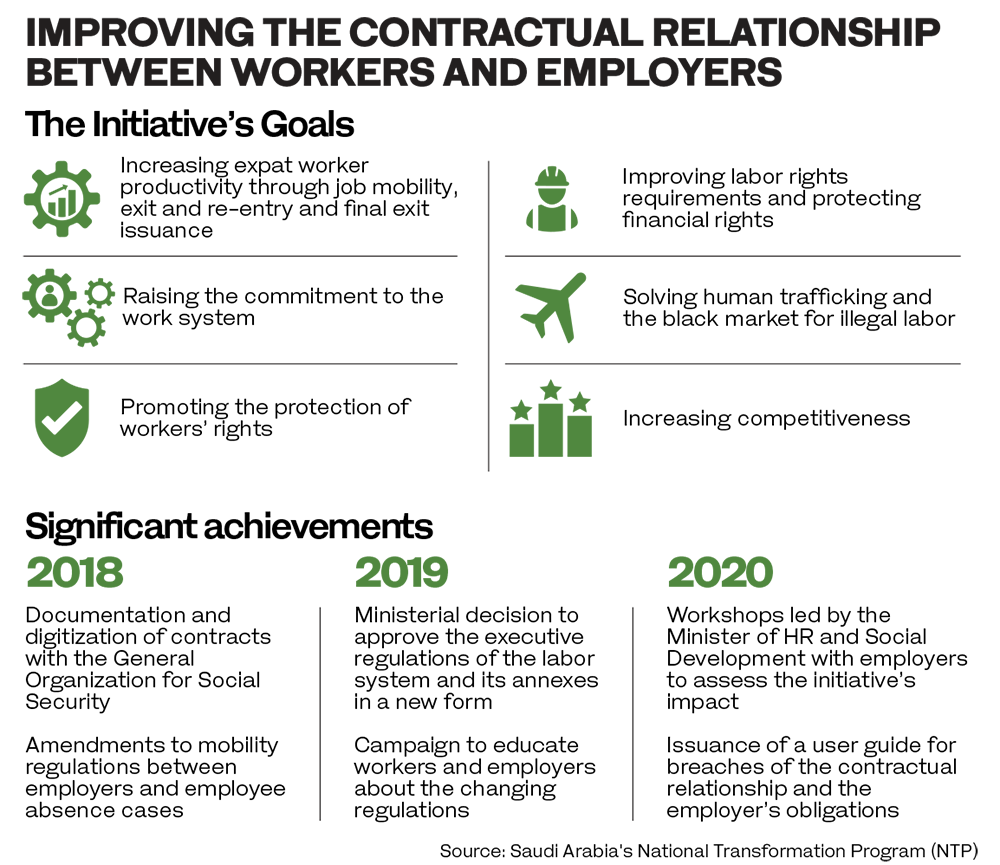
Mohammad Sabbah, a business development specialist from Jordan residing in the Kingdom for 20 years and specializing in the Saudi market, described the initiative as a step in the right direction, noting that investment in Saudi Arabia is safe. It is vital for the employee-employer relationship to be flexible as such things can develop business overall, he said.
Saudi Arabia has introduced similar initiatives in the past to relax restrictions on the mobility of foreign workers and to protect the rights of the workforce, including the Wage Protection System, the digital documentation of work contracts, the Labor Education and Awareness Initiative, and the launch of “Wedy,” an arbitration process where labor ombudsmen and case officers are available to help employees and employers in a dispute.
Under the new initiative, employers will be required to document digitally employee contracts to reduce the disparity between Saudi workers and expatriates as more than 150,000 labor disputes have been filed in the past 3 years. The MHRSD aims to solve labor cases amicably through its settlement administration. The initiative will also help to regulate the unorganized labor force in the Kingdom, which is estimated to be in the millions.
The reforms will allow expatriate workers to transfer between employers after their contract expires, without the need for the employer’s consent. The initiative also outlines conditions applicable during the validity of the contract, provided a notice period of three months and specific measures are adhered to.
The exit and reentry visa reforms will allow expatriate workers to travel outside Saudi Arabia without their employer’s approval after submitting a request. The Final Exit Visa reforms allow foreign workers to leave Saudi Arabia after the end of their employment contract without the employer’s consent. The employer will, however, be notified electronically of their departure.
The LRI outlines that employees must bear all consequences, financial or otherwise, if they break the employment contract.
Tarek Al-Akil, the president of ACE Group, said the old sponsorship system did not meet the requirements of the employer-employee relationship. He said the new measures were bold and will assist Vision 2030’s aim to catapult the Kingdom forwards.
LRI services will be made available to the public through the smartphone app Absher, the MOI’s portal that enables residents of the Kingdom to benefit from e-services provided by the sectors of the ministry and the MHRSD’s Qiwa portal.
Saudi Arabia expects the new initiative to have positive economic effects, including developing the local market and the flexibility of work, increase the productivity within the private sector, attracting highly skilled talent, and ultimately contributing to achieving the goals of the Kingdom’s Vision 2030 reform plan through the National Transformation Program.


