

Saudi labor ministry plans new foreign manpower program

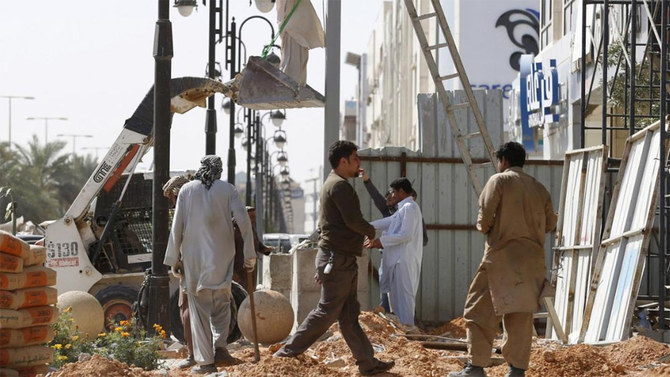
In this file photo, Laborer work to remove a pole outside a residential building in Riyadh on Feb. 9, 2016. (REUTERS)
Updated 14 November 2019
Follow

Saudi labor ministry plans new foreign manpower program

  • The Kingdom intends to gradually cancel labor visas issued under the previous system
  • Says it will prioritize certain occupational categories

ISLAMABAD: Saudi Arabia will introduce a new foreign manpower program starting next month by issuing visas for specific occupations, said Nayef Al-Omair, head of the vocational examination program at the Ministry of Labor and Social Development, in Riyadh on Tuesday.

Al-Omair noted that the ministry was categorizing the tasks and the structure of some professions for visa-issuing purposes. He also noted that the previous labor category system would be gradually be removed from the ministry’s system.

The new scheme will be optional for one year starting December 2019 after which it will become compulsory.

According to Al-Omair, the new program will be first applied to the manpower recruited from India due to it is a large size in the Saudi market.

However, it will cover seven countries, including India, the Philippines, Sri Lanka, Indonesia, Egypt, Bangladesh, and Pakistan, since workers belonging to these states constitute 95 percent of the professional manpower in the Kingdom’s local market.


Pakistan to launch 5G pilot in some cities next week — IT minister

Updated 4 sec ago
Follow

Pakistan to launch 5G pilot in some cities next week — IT minister

  • Government says 5G services to reach provincial and federal capitals within six to eight months
  • Rollout follows $507 million spectrum auction aimed at expanding mobile broadband capacity

ISLAMABAD: Pakistan will begin pilot launches of fifth-generation (5G) mobile services in some cities next week, Information Technology Minister Shaza Fatima Khawaja said on Thursday, marking the country’s first concrete timeline for introducing the next generation of high-speed mobile Internet.

The announcement follows a spectrum auction earlier this week in which Pakistan sold 480 megahertz (MHz) of telecom frequencies for about $507 million, a key step toward deploying 5G networks in a country of more than 240 million people where most mobile infrastructure still runs on fourth-generation (4G) technology.

Pakistan has more than 190 million mobile phone users, making it one of the world’s largest telecom markets by population, but the rollout of 5G has been delayed for years by regulatory hurdles, economic constraints and spectrum-allocation issues.

“I was very happy to hear the day before yesterday that some of our operators are ready for 5G services,” Khawaja told a news conference with telecom operators in Islamabad.

“So, its pilot will start in some cities next week. And in the next six to eight months, in five of our capitals of all provinces and in the federal capital, 5G services will be available to all of you people.”

Khawaja described Internet connectivity as increasingly critical for economic activity, industry and national security, saying reliable and resilient digital infrastructure would play a central role in Pakistan’s future growth.

Officials have said the government is also encouraging wider adoption of 5G-compatible devices to support the transition to faster mobile networks, noting that a large share of phones used in Pakistan are locally manufactured while premium models are imported.