On US election day, Trump says he feels ‘very good’ about chances

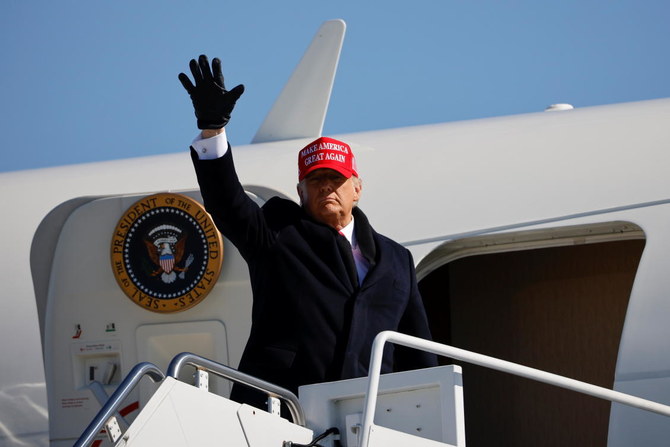
US President Donald Trump gestures as he leaves after holding a campaign rally at Fayetteville Regional Airport in Fayetteville, North Carolina, US, November 2, 2020. (Reuters)
Short Url
Updated 03 November 2020
Follow

On US election day, Trump says he feels ‘very good’ about chances

  • Trump said he expected victory in all the key states that will decide the election
  • Running behind in most opinion polls, Trump bashed opponent Joe Biden, “biased” media and the “extreme” left

WASHINGTON: President Donald Trump said he felt good about his chances for victory as US election day opened Tuesday, predicting that he would register big wins in key states such as Florida and Arizona.
“We feel very good,” a hoarse-voiced Trump told Fox News in a phone interview.
Trump said he expected victory in all the key states that will decide the election, but said he would not “play games” by declaring his win too early.
“We think we are winning Texas very big. We think we are winning Florida very big. We think we are winning Arizona very big,” he said.
“I think we are going to do very well in North Carolina. I think we are going to do well in Pennsylvania. We think we are doing very well everywhere.”
Running behind in most opinion polls, Trump bashed Democratic opponent Joe Biden, “biased” media and the “extreme” left as he repeated his argument for reelection to four more years in the White House.
“Joe Biden is not prime time” he said.
Trump called it “terrible” and “dangerous” that millions of votes mailed in might still not be counted on Wednesday.
But he downplayed allegations that he planned to prematurely declare victory Tuesday evening before enough of the vote is tallied to determine the winner.
“I think we’ll have victory, but only when there’s victory,” he said.
“Theres no reason to play games.”


Japan’s Takaichi moves toward snap election after only 3 months in office

Updated 7 sec ago
Follow

Japan’s Takaichi moves toward snap election after only 3 months in office

  • Move an attempt to capitalize on Sanae Takaichi’s popularity to help governing party regain ground
  • But it will delay a vote on a budget that aims at boosting a struggling economy and addressing soaring prices
TOKYO: Japan’s Prime Minister Sanae Takaichi dissolved the lower house of Parliament on Friday, paving the way for a Feb. 8 snap election.
The move is an attempt to capitalize on her popularity to help governing party regain ground after major losses in recent years, but will delay a vote on a budget that aims at boosting a struggling economy and addressing soaring prices.
Elected in October as Japan’s first female leader, Takaichi has been in office only three months, but she has seen strong approval ratings of about 70 percent.
Takaichi is also seeing rising animosity with China since she made pro-Taiwan remarks. And US President Donald Trump wants her to spend more on weapons as Washington and Beijing pursue military superiority in the region.
The dissolution of the 465-member lower house paves the way for a 12-day campaign that officially starts Tuesday.
Takaichi hopes to win majorities
Takaichi’s plan for an early election aims to capitalize on her popularity to expand a governing majority in the lower house, the more powerful of Japan’s two-chamber Parliament.
The scandal-tainted LDP and its coalition have a slim majority in the more powerful lower house after an election loss in 2024. The coalition does not have a majority in the upper house and relies on winning votes from opposition members to pass its agenda.
Opposition leaders criticized Takaichi for delaying passage of a budget needed to fund key economic measures.
“I believe that the only option is for the people, as sovereign citizens, to decide whether Sanae Takaichi should be prime minister,” she told a news conference Monday when announcing plans for the election. “I’m staking my career as prime minister” on it.
A hard-line conservative, Takaichi wants to highlight differences with her centrist predecessor Shigeru Ishiba.
Takaichi stresses that voters need to judge her fiscal spending moves, further military buildup and tougher immigration policies to make Japan “strong and prosperous.”
While an upbeat and decisive image has earned her strong approval ratings, especially among younger people, the LDP is not popular as it recovers from a political funds scandal. Many traditional LDP voters have shifted to emerging far-right populist opposition parties, such as the anti-globalist Sanseito.
China, Trump and corruption scandals
Meanwhile, Japan faces escalating tensions with China after Takaichi made remarks suggesting that Japan could become involved if China takes military action against Taiwan, a self-governing island that Beijing claims as its own. A furious China has increased economic and diplomatic retribution.
Takaichi wants to push further a military buildup and spending increases, while Trump has pressured Japan to spend more on defense.