



LAHORE: Last month, a group of men and women got together in the central Pakistani city of Lahore to celebrate Oktoberfest, the annual German beer and wine festival.
Many of the guests at the event had one thing in common: they belong to the Pakistan Beer and Wine Society, a six-year-old underground club of brewers who produce homemade liquor for personal consumption — and sometimes to sell to select clients.
Despite the ban on alcohol, drinking is rampant in Pakistan, but in the absence of bars and nightclubs, people partake mostly at home, behind closed doors. And while much of the alcohol is smuggled in, many resourceful Pakistanis are now making their own wine and beer at home, risking it all for a tipple.
“I am a risk taker,” said Farah, a middle-aged wine brewer from Lahore who only wanted to be identified by her first name and said she had been driven to brewing by the high prices and low quality of imported wine. “I think what I and other brewers are doing is a small act of rebellion.”
The sale and consumption of alcohol was allowed in Pakistan until restrictions were introduced by Zulfikar Ali Bhutto just weeks before he was removed as prime minister in 1977. On February 9, 1979, the regime of military ruler Zia-ul-Haq issued a prohibition order under which selling alcohol to Muslims was declared illegal and severe punishments were prescribed for Muslims caught selling or drinking alcohol.
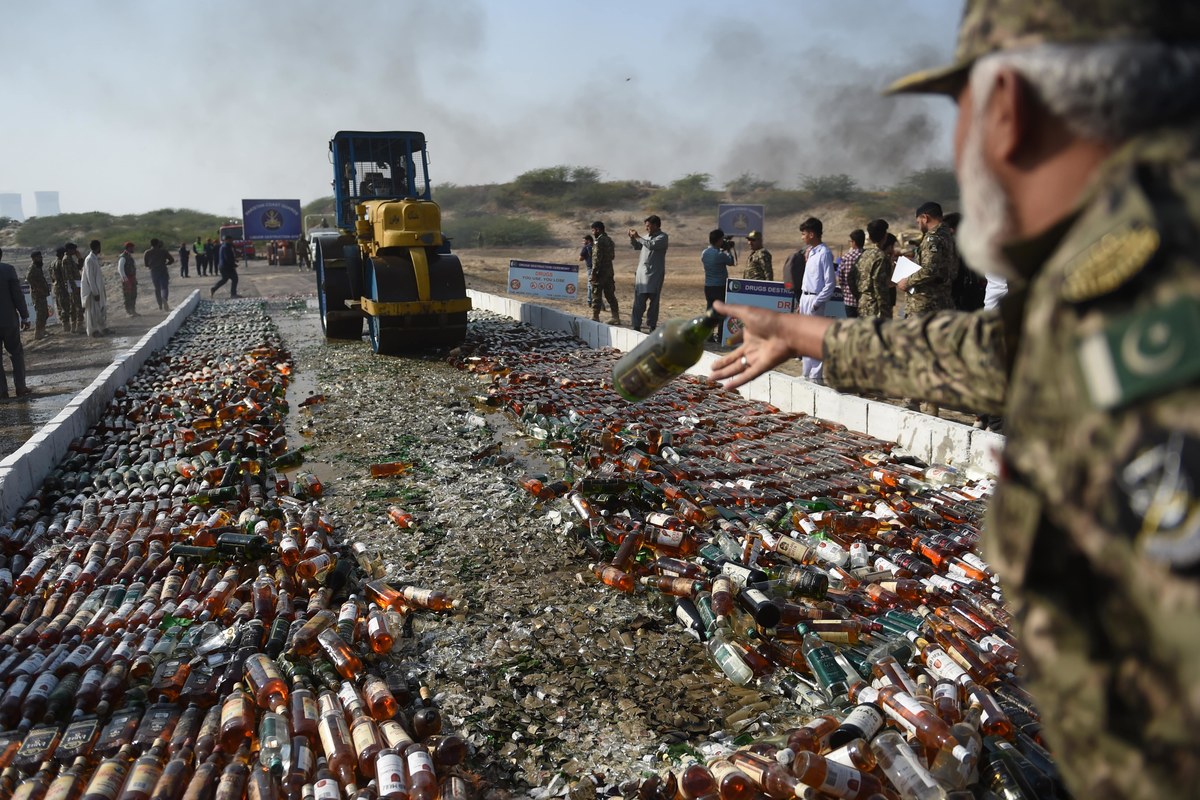
A Pakistani official uses a steamroller to crush bottles of liquor in the outskirts of Karachi on February 20, 2020, during an event organized by the Pakistan Coast Guards to destroy seized illicit alcohol and drugs smuggled into the country. ( AFP / File photo)
Since the seventies, thus, most Pakistanis have bought their liquor illicitly from bootleggers — or from alcohol shops allowed to sell only to minorities who hold permits. Pakistan even has a handful of its own breweries, including the Murree Brewery, which officially produce only for non-Muslims, or for export.
Now, more and more people are turning to home-brewing.
How common the practice is becoming is clear, according to Saqib, a member of the Beer and Wine Society, from the fact that shopkeepers at a local market in Lahore finally understood what type of bottle the home-brewer was looking for when he said he needed it to store ‘juice’.
“‘Oh, you need it for fermentation,’ they said, and pulled out the right bottle,” Saqib said, chuckling in the study of his Lahore home.
Often, members of the secretive club also turn to a Facebook group to get advice on the basics of the brewing process. The page, a closed community, has around 100 members across Pakistan.
To join the group, a person not only has to demonstrate strong connections to an existing member, but also buy the equipment and supplies needed to make homemade wine, and prepare a batch that must then be approved by a group member. If you’re lucky, you’ll also be added to a more exclusive WhatsApp group.
A Pakistani official uses a steamroller to crush bottles of liquor in the outskirts of Karachi on February 20, 2020, during an event organized by the Pakistan Coast Guards to destroy seized illicit alcohol and drugs smuggled into the country. ( AFP / File photo)
Once part of the community, brewers connect to swap tips and tricks. These days, members of the group have also been discussing how to add a ‘Pakistani touch’ to their brews.
Saqib said he uses berries, pomegranates, tomatoes, sugarcane and even tea to make wine.
“Wine made of tomato is my favorite,” Saqib said. “But it takes a long time to clear.”
The process of home-brewing includes fermenting fruits, sugar and yeast in regular plastic or food-grade buckets. After ten days, the fruits are pulled out of the buckets and moved to a carboy, where they sit for a month or so.
Most of the equipment used in home-brewing can be bought from local markets, except corks, which need to be ordered from online vendors such as AliBaba.
Once ready, some of the brewers bottle their wine to age it while others say they consume it immediately. Some also sell it.
Farah, the wine brewer from Lahore, has her own label of wine, and sells a bottle for half the price of imported wine.
“It’s a good business if one wants,” she said in an interview in the leafy courtyard of her home.
“The process [of wine making] is so precious and delicate. It takes a long time, sometimes even six months, to prepare a good bottle,” she added, pausing to pour a glass of the ruby liquid.
“Go on, quick, take a sip, it’s very good,” she teased, as a male member of her household staff appeared.
“He loves it,” Farah said. “Right now, he is going to buy fruit from a wholesale market. You know why: because he told me that it has been a few days since we made a new batch. And he doesn’t even drink!”


