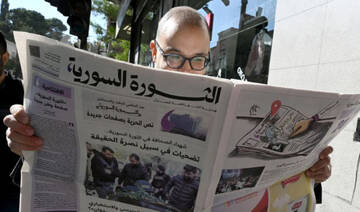
BEIRUT: Veteran British journalist Robert Fisk, one of the best-known Middle East correspondents who spent his career reporting from the troubled region and won accolades for challenging mainstream narratives has died after a short illness, his employer said Monday. He was 74.
Fisk, whose reporting often sparked controversy, died Sunday at a hospital in Dublin, shortly after he was taken there after falling ill at his home in the Irish capital. The London Independent, where he had worked since 1989, described him as the most celebrated journalist of his era.
“Fearless, uncompromising, determined and utterly committed to uncovering the truth and reality at all costs, Robert Fisk was the greatest journalist of his generation,” said Christian Broughton, managing director of the newspaper.
“The fire he lit at The Independent will burn on,” he said.
Born in Kent, in the United Kingdom, Fisk began his career on Fleet Street at the Sunday Express. He went on to work for The Times, where he was based in Northern Ireland, Portugal and the Middle East. He moved to Beirut in 1976, a year after the country’s civil war broke out, and continued to work and live from an apartment located on the Lebanese capital’s famed Mediterranean corniche until his death.
From his base in Beirut, Fisk traveled across the Mideast and beyond, covering almost every big story in the region, including the Lebanon war, the Iran-Iraq war, the Arab-Israeli conflict, the war in Algeria, the conflict in Afghanistan, Saddam Hussein’s invasion of Kuwait, the US invasion and occupation of Iraq, the Arab Spring and Syria’s civil war. His reporting earned him awards, but also invited controversy, particularly his coverage of the Syria conflict.
A fearless, bespectacled and cheerful personality bristling with energy, Fisk was often the first reporter to arrive at the scene of a story. He shunned email, smart phones and social media till the end, and strongly believed in the power of street reporting.
In 1982, he was one of the first journalists at the Sabra and Shatila camp in Beirut, where Christian militiamen slaughtered hundreds of Palestinian refugees. Earlier that year, he was also the first foreign journalist to report on the scale of the Hama massacre in 1982, when then-Syrian President Hafez Assad launched a withering assault on the rebellious city in central Syria, leveling entire neighborhoods and killing thousands in one of the most notorious massacres in the modern Middle East.
Fisk was in love with Beirut, the city he called home, sticking with it during the most difficult days of the 1975-90 civil war when foreign journalists fell victim to kidnappers. Back then, he used the offices of The Associated Press to file his stories during the war, where colleagues called him “the Fisk,” or “Fisky.”
In his book chronicling the war, Pity the Nation, he describes filing his dispatches by furiously punching a telex tape at the bureau, which he described as “a place of dirty white walls and heavy battleship-grey metal desks with glass tops and iron typewriters” and a “massive, evil-tempered generator” on the balcony.
“So sad to lose a true friend and a great journalist. The Temple of truth is gone,” said Marwan Chukri, director of the Foreign Press Center at the Information Ministry in Beirut.
Fisk gained particular fame and popularity in the region for his opposition to the Iraq war, challenging the official US government narrative of weapons of mass destruction as it laid the groundwork for the 2003 invasion.
He was one of the few journalists who interviewed Osama bin Laden several times. After the Sept. 11, 2011 attacks and the subsequent US invasion of Iraq, he traveled to the Pakistan-Afghan border, where he was attacked by a group of Afghan refugees.
He later wrote about the incident from the refugees’ perspective, describing his beating by refugees as a “symbol of the hatred and fury of this filthy war.”
“I realized – there were all the Afghan men and boys who had attacked me who should never have done so but whose brutality was entirely the product of others, of us — of we who had armed their struggle against the Russians and ignored their pain and laughed at their civil war,” he wrote.
His most controversial reporting, however, was on the conflict in Syria in the past decade. Fisk, who was often allowed access to government-held areas when other journalists were banished, was accused of siding with the government of President Bashar Assad and whitewashing crimes committed by Syrian security forces, most famously when he cast doubt on whether the government carried out chemical attacks against civilians in the Damascus suburb of Douma.
His deep attachment to Lebanon and its people consistently came through his writing. Following the massive explosion that tore through Beirut port on Aug. 4 and destroyed large parts of the city, he wrote a scathing article that summed up the country’s curse and corrupt political class.
“So here is one of the most educated nations in the region with the most talented and courageous — and generous and kindliest — of peoples, blessed by snows and mountains and Roman ruins and the finest food and the greatest intellect and a history of millennia. And yet it cannot run its currency, supply its electric power, cure its sick or protect its people,” Fisk wrote.
Fisk wrote several books, including “Pity the Nation: Lebanon at War” and “The Great War for Civilization: The Conquest of the Middle East.”
He is survived by his wife, Nelofer Pazira, a filmmaker and human rights activist.


Robert Fisk, veteran foreign correspondent, dies at 74

https://arab.news/mv8qf
Robert Fisk, veteran foreign correspondent, dies at 74

- A fearless, bespectacled and cheerful personality bristling with energy, Fisk was often the first reporter to arrive at the scene of a story
- He shunned email, smart phones and social media till the end, and strongly believed in the power of street reporting


Paris exhibition marks 200 years of Le Figaro and the enduring power of the press
- The exhibition celebrated the bicentennial of Le Figaro, offering visitors a rare opportunity to step inside the newspaper’s vast historical archive
PARIS: One of France’s most influential newspapers marked a major milestone this month with a landmark exhibition beneath the soaring glass nave of the Grand Palais, tracing two centuries of journalism, literature and political debate.
Titled 1826–2026: 200 years of freedom, the exhibition celebrated the bicentennial of Le Figaro, offering visitors a rare opportunity to step inside the newspaper’s vast historical archive. Held over three days in mid-January, the free exhibition drew large crowds eager to explore how the title has both chronicled and shaped modern French history.
More than 300 original items were displayed, including historic front pages, photographs, illustrations and handwritten manuscripts. Together, they charted Le Figaro’s evolution from a 19th-century satirical publication into a leading national daily, reflecting eras of revolution, war, cultural change and technological disruption.
The exhibition unfolded across a series of thematic spaces, guiding visitors through defining moments in the paper’s past — from its literary golden age to its role in political debate and its transition into the digital era. Particular attention was paid to the newspaper’s long association with prominent writers and intellectuals, underscoring the close relationship between journalism and cultural life in France.
Beyond the displays, the program extended into live journalism. Public editorial meetings, panel discussions and film screenings invited audiences to engage directly with editors, writers and media figures, turning the exhibition into a forum for debate about the future of the press and freedom of expression.
Hosted at the Grand Palais, the setting itself reinforced the exhibition’s ambition: to place journalism firmly within the country’s cultural heritage. While the exhibition has now concluded, the bicentennial celebrations continue through special publications and broadcasts, reaffirming Le Figaro’s place in France’s public life — and the enduring relevance of a free and questioning press in an age of rapid change.