

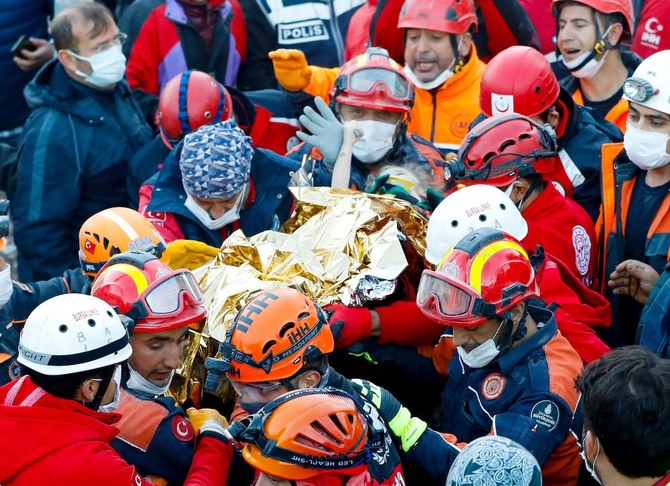
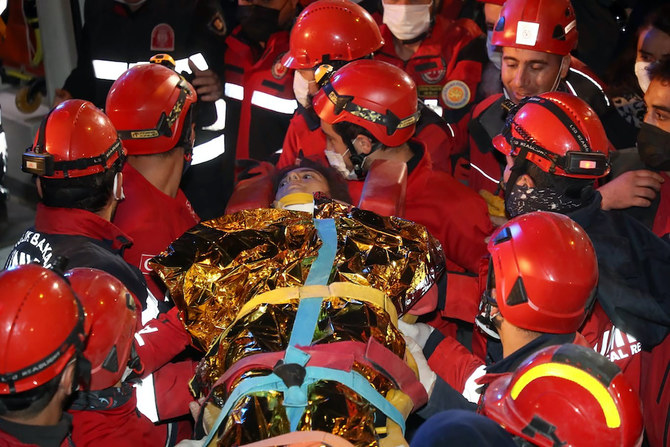

IZMIR, Turkey: In scenes that captured Turkey’s emotional roller-coaster after a deadly earthquake, rescue workers dug two girls out alive Monday from the rubble of collapsed apartment buildings three days after the region was jolted by quake that killed scores of people.
Onlookers applauded in joy and wept with relief as ambulances carrying the girls rushed to the hospital immediately after their rescues in the hard-hit city of Izmir.
The overall death toll in Friday’s quake reached 87 on Monday after teams found more bodies amid toppled buildings in Izmir, Turkey’s third-largest city.
Close to 1,000 people were injured, mostly in Turkey, by the quake that was centered in the Aegean Sea northeast of the Greek island of Samos. The death toll included two teenagers on Samos and at least 19 other people on the island were injured.
There was some debate over the quake’s magnitude. The US Geological Survey rated it 7.0, while Istanbul’s Kandilli Institute put it at 6.9 and Turkey’s emergency management agency said it measured 6.6.
Rescue workers clapped in unison Monday as 14-year-old Idil Sirin was removed from the rubble, after being trapped for 58 hours. Her 8-year-old sister, Ipek, did not survive, NTV television reported.
Seven hours later, rescuers working on another toppled building extricated 3-year-old Elif Perincek, whose mother and two sisters had been rescued two days earlier. The child spent 65 hours in the wreckage of her apartment and became the 106th person to be rescued alive, the state-run Anadolu Agency reported.
Muammer Celik of the Istanbul fire department’s search-and-rescue team told NTV television that he thought Elif was dead when he reached her inside the wreckage.
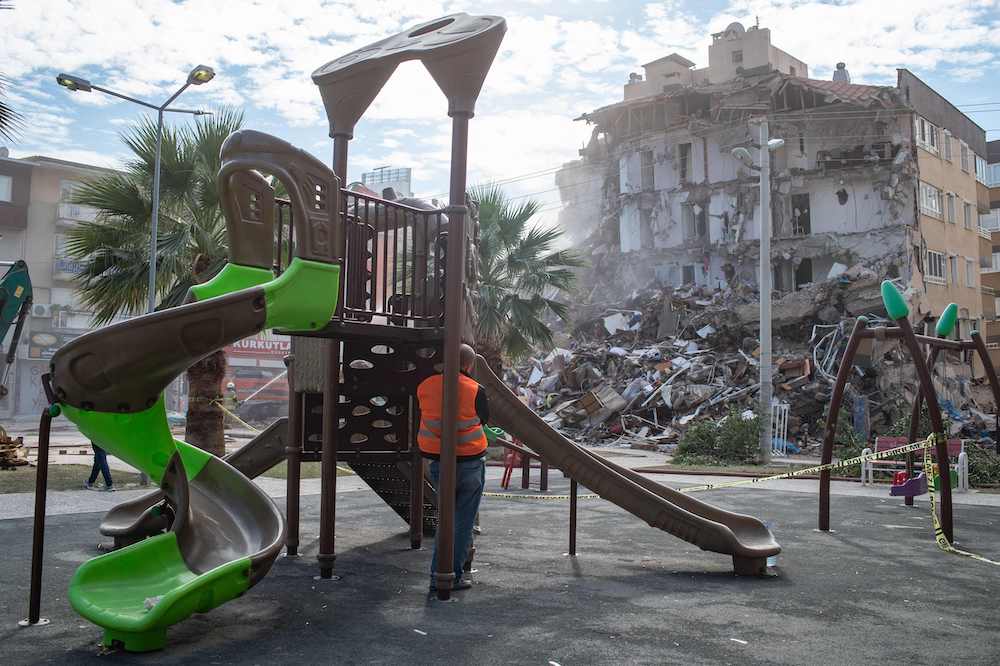
Damaged buildings are demolished in a controlled manner during the ongoing search operation for survivors and victims at the site of a collapsed building in the city of Izmir on Nov. 2, 2020, after a powerful earthquake struck Turkey’s western coast and parts of Greece two days ago. (AFP)
“There was dust on her face, her face was white,” he said. “When I cleaned the dust from her face, she opened her eyes. I was astonished.”
Celik said: “it was a miracle, it was a true miracle.”
The girl would not let go of his hand throughout the rescue operation, Celik said, adding: “I am now her big brother.”
The girl was pictured holding Celik’s thumb while being carried on a stretcher into a tent where she was treated before being taken to the hospital. Rescuers were seen shedding tears of joy and hugging each other.
Rescue workers scrambling to find more survivors used listening devices to detect any signs of life.
“Can anyone hear me?” a team leader shouted, asking possible survivors to bang against surfaces three times if they could.
Officials said 220 quake survivors were still hospitalized and four of them were in serious condition.
The quake also triggered a small tsunami that hit Samos and the Seferihisar district of Izmir, drowning one elderly woman. The tremors were felt across western Turkey, including in Istanbul as well as in the Greek capital of Athens. Hundreds of aftershocks followed.
Turkey has a mix of older buildings and cheap or illegal construction, which can lead to serious damage and deaths when earthquakes hit. Regulations have been tightened in light of earthquakes to strengthen or demolish older buildings and urban renewal is underway in Turkish cities, but it is not happening fast enough.
Turkey sits on top of fault lines and is prone to earthquakes. In 1999, two powerful quakes killed some 18,000 people in northwestern Turkey. Earthquakes are frequent in Greece as well.


