

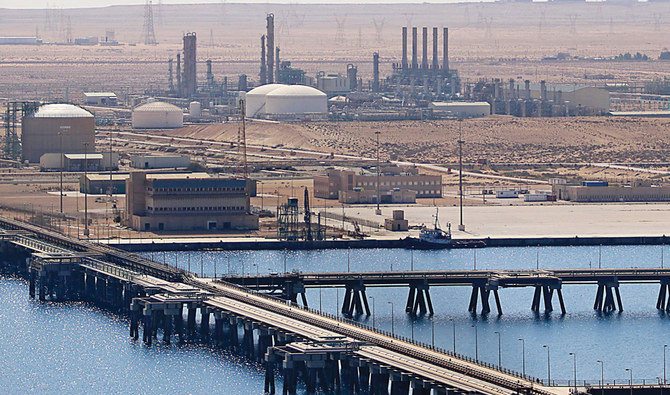
OPEC oil output rises more on Libya restart, says survey

Short Url
Updated 31 October 2020
Follow

OPEC oil output rises more on Libya restart, says survey

  • Higher Iraqi exports and hit to global demand put pressure on OPEC+ to delay planned production boost

LONDON: OPEC oil output has risen for a fourth month in October, a Reuters survey found, as a restart of more Libyan installations and higher Iraqi exports offset full adherence by other members to an OPEC-led supply cut deal.

The 13-member Organization of the Petroleum Exporting Countries has pumped 24.59 million barrels per day (bpd) on average in October, the survey found, up 210,000 bpd from September and a further boost from the three-decade low reached in June.
An increase in OPEC supply and a new hit to demand as coronavirus cases rise have weighed on oil prices, which have fallen 8 percent in October to near $37 a barrel. This puts pressure on OPEC and allies, known as OPEC+, to postpone a planned January 2021 supply boost, some analysts say.
“Oil demand is currently not supportive,” said Stephen Brennock of broker PVM. “At the bare minimum, OPEC+ will have to roll over its current production levels until the end of March.” Libya is one of the OPEC members exempted from a deal by OPEC+ to curb supply.
OPEC+ made a record cut of 9.7 million bpd, or 10 percent of global output, from May as the pandemic destroyed demand. Since August, the group has been pumping more as the cut tapered down to 7.7 million bpd, of which OPEC’s share is 4.868 million bpd.
In October, OPEC countries bound by the deal have delivered 101 percent of the pledged reduction, the survey found, steady from September. October’s increase means OPEC is pumping about 2.2 million bpd more than June’s figure, which was the lowest since 1991.
Libyan production is rising after Eastern Libyan commander Khalifa Haftar said his forces would lift their eight-month blockade of oil exports.
The survey found output increased by 250,000 bpd in October, a faster rebound than some analysts and OPEC officials expected.

FASTFACT

OPEC pumped 24.59 million barrels per day on average in October.

The second-largest increase came from Iraq, which lifted exports from its southern terminals. Compliance was still almost 100 percent, higher than Iraq managed in earlier OPEC+ deals. Top exporter Saudi Arabia kept output steady, as did Kuwait, the survey found.
There was little change in supply from Iran, which is also exempt from the OPEC cut, after an increase in September in defiance of US sanctions. Exports have been slightly lower in October, the survey found.
Among the OPEC members lowering output, the biggest reduction came from the UAE, which had pumped above its quota in August. Industry sources said the reduction suggests the UAE is still compensating for its August increase.
Venezuela, the third OPEC member exempt from the supply cut, also posted a decline.
The Reuters survey aims to track supply to the market and is based on shipping data provided by external sources, Refinitiv Eikon flows data, information from tanker-trackers such as Petro-Logistics and Kpler,
and information provided by sources at oil companies, OPEC and consultants.


Saudi Arabia, Japan trade rises 38% between 2016 and 2024, minister says

Updated 11 January 2026
Follow

Saudi Arabia, Japan trade rises 38% between 2016 and 2024, minister says

RIYADH: Trade between Saudi Arabia and Japan has increased by 38 percent between 2016 and 2024 to reach SR138 billion ($36 billion), the Kingdom’s investment minister revealed.

Speaking at the Saudi-Japanese Ministerial Investment Forum 2026, Khalid Al-Falih explained that this makes the Asian country the Kingdom’s third-largest trading partner, according to Asharq Bloomberg.

This falls in line with the fact that Saudi Arabia has been a very important country for Japan from the viewpoint of its energy security, having been a stable supplier of crude oil for many years.

It also aligns well with how Japan is fully committed to supporting Vision 2030 by sharing its knowledge and advanced technologies.

“This trade is dominated by the Kingdom's exports of energy products, specifically oil, gas, and their derivatives. We certainly look forward to the Saudi private sector increasing trade with Japan, particularly in high-tech Japanese products,” Al-Falih said.

He added: “As for investment, Japanese investment in the Kingdom is good and strong, but we look forward to raising the level of Japanese investments in the Kingdom. Today, the Kingdom offers promising opportunities for Japanese companies in several fields, including the traditional sector that links the two economies: energy.”

The minister went on to note that additional sectors that both countries can also collaborate in include green and blue hydrogen, investments in advanced industries, health, food security, innovation, entrepreneurship, among others.

During his speech, Al-Falih shed light on how the Kingdom’s pavilion at Expo 2025 in Osaka achieved remarkable success, with the exhibition receiving more than 3 million visitors, reflecting the Japanese public’s interest in Saudi Arabia.

“The pavilion also organized approximately 700 new business events, several each day, including 88 major investment events led by the Ministry of Investment. Today, as we prepare for the upcoming Expo 2030, we look forward to building upon Japan’s achievements,” he said.

The minister added: “During our visit to Japan, we agreed to establish a partnership to transfer the remarkable Japanese experience from Expo Osaka 2025 to Expo Riyadh 2030. I am certain that the Japanese pavilion at Expo Riyadh will rival the Saudi pavilion at Expo Osaka in terms of organization, innovation, and visitor turnout.”

Al-Falih also shed light on how Saudi-Japanese relations celebrated their 70th anniversary last year, and today marks the 71st year of these relations as well as how they have flourished over the decades, moving from one strategic level to an even higher one.