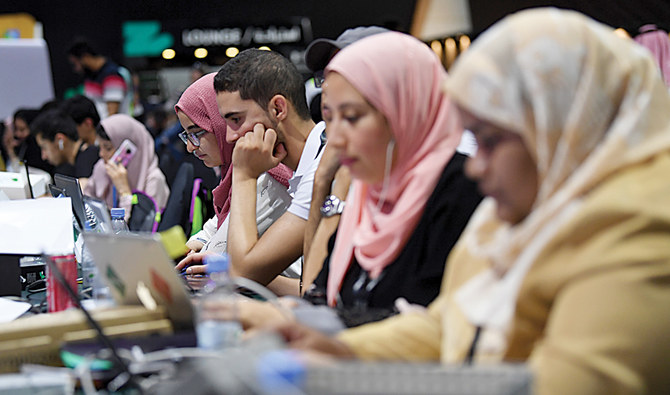

AMMAN: As COVID-19 swells the ranks of unemployed women in the Arab world, surging demand for digital skills could help many of them find work in a region where only one in four women has a job.
The pandemic has taken an especially heavy toll on retail, tourism and hospitality jobs traditionally held by women, but experts say those able to retrain could tap into growth areas like digital marketing, e-commerce and online customer support.
“This is a tremendous opportunity. These are areas where you can reskill someone relatively quickly,” said Jasmine di Florio, senior vice president at Education for Employment (EFE), a job training non-profit for young people in the Middle East and North Africa.
“We need to teach young women all kinds of digital skills, but we also need to continue to teach them human skills — things like empathy, teamwork, leadership (that) are in even greater demand now because so much is going digital.”
The fourth industrial revolution — a term referring to the new era of digital advances that is changing the way people live and work — is expected to double job opportunities for women in the region by 2030, according to a 2020 McKinsey study.
Many women are already finding new opportunities — sometimes by putting their new-found tech skills to work in jobs where they have an innate edge over men.
One of EFE’s trainees, Walaa Shahahdeh, who has her own business repairing smartphones, said her services were in high demand among women in her conservative Jordanian community who did not want men seeing personal photos on their devices.
“Technology is constantly evolving. You have to keep up to date because new devices keep coming out and repairs will never stop,” said Shahahdeh, 30, who comes from the Tafileh governorate in south-central Jordan.
“Because of high usage during coronavirus due to remote learning and work from home, devices are breaking down more often and I’m getting more calls.”
The pandemic is expected to push 700,000 Middle Eastern women out of work in 2020 — about 40 percent of the 1.7 million total jobs expected to be lost, according to Oxfam.
That is despite women in the Middle East and North Africa only accounting for a quarter of the workforce — the world’s lowest rate of female participation in the labor market.
In hard-hit countries like Lebanon, the number of unemployed women in June 2020 was up 63 percent compared with figures from 2018 and 2019, according to UN Women.
New job prospects could provide some relief, though the additional burden of unpaid work — such as childcare and supervising remote schooling, is likely to widen the digital gap between men and women in Arab states.
That could mean retraining is even more of a challenge for women, said Manuel Langendorf, a researcher on digital transformation in the region.
“People may have access to the internet but still you will find a lot of families across the region that don’t have multiple laptops or desktop computers,” he said.
“That also affects the way women will be able, and are at the moment able, to upskill or reskill.”
The digital gap between men and women in Arab countries had already increased from 19 percent to 24 percent between 2013 and 2019, according to the International Telecommunication Union.