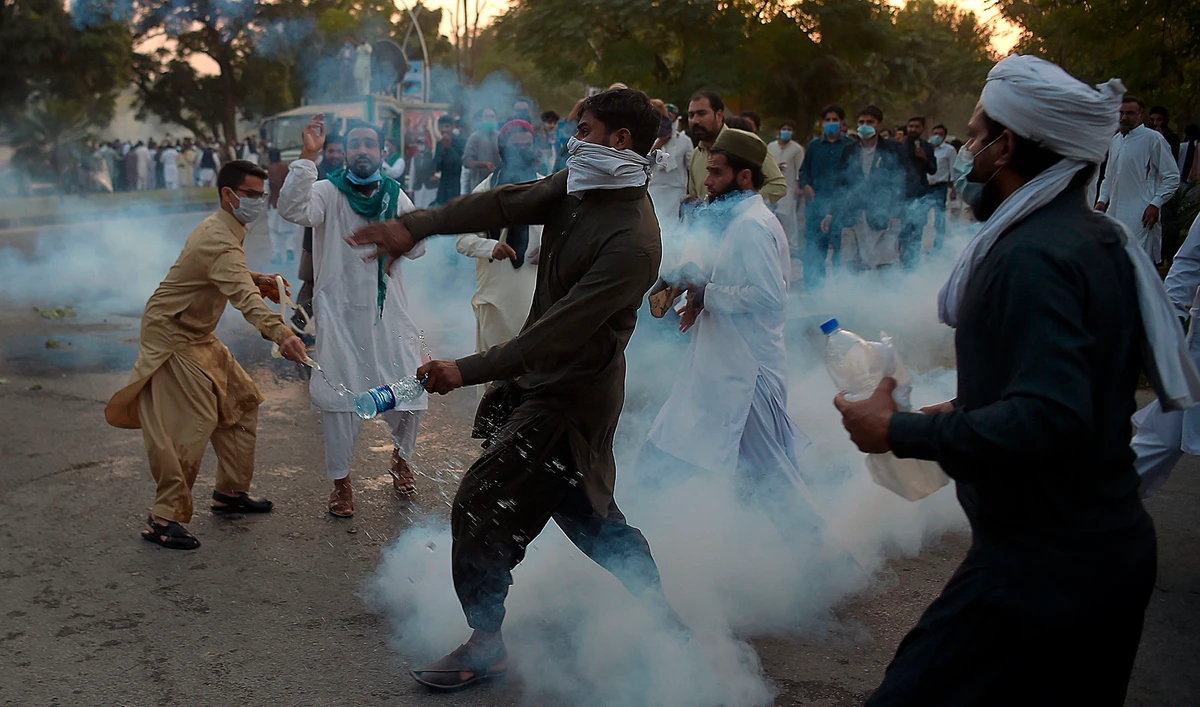
Protestors in Pakistan clash with police while marching toward French embassy

Pakistani protesters return teargas shells during a demonstration in Islamabad on Oct. 30, 2020, following French President Emmanuel Macron's comments over Prophet Muhammad's caricatures. (AFP)
Short Url
Updated 31 October 2020
Follow

Protestors in Pakistan clash with police while marching toward French embassy

  • Demonstrators in Multan burn an effigy of Emmanuel Macron as they call for an end to diplomatic relations with France
  • Similar protests were also witnessed in other parts of the Muslim world

ISLAMABAD: Thousands of emotionally charged demonstrators clashed with the police on Friday while trying to reach the French Embassy in Pakistan’s federal capital, forcing uniformed personnel of the law enforcement agency deployed to protect the Diplomatic Enclave in the city to fire tear gas and beat protestors with batons.

According to video footages broadcast by local media outlets, many of these protestors tried to cross the police barriers. Some of them even managed to climb shipping containers parked outside the diplomatic neighborhood to close its entry and exit points for security purposes.

Crowds of Islamist activists hanged an effigy of French President Emmanuel Macron from a highway overpass after pounding it furiously with their shoes. Several demonstrators were wounded in clashes with police and authorities deployed more security forces to protect the embassy.

In the country's eastern city of Lahore, thousands of worshippers celebrating the Mawlid, the birthday of the Prophet Muhammad (PBUH), took to the streets, chanting anti-France slogans, raising banners and clogging major roads en route to a Sufi shrine.

In Multan, a city in Pakistan's eastern Punjab province, thousands more burned an effigy of Macron and demanded that Pakistan sever ties with France and boycott French goods.

Similar demonstrations were also witnessed in other Muslim countries where people poured out of prayer services to join anti-France protests on Friday, as the French president’s vow to protect the right to caricature the Prophet Muhammad (PBUH) continued to roil the Muslim world.

In Jerusalem, hundreds of Palestinians protested against Macron outside the Al-Aqsa Mosque, the third holiest site in Islam, chanting, “With our souls and with our blood we sacrifice for our prophet, Muhammad (PBUH).” Some youths scuffled with Israeli police as they exited the esplanade into the Old City. Israeli police said they successfully dispersed the gathering and detained three people.

A few hundred demonstrators in Lebanon's capital Beirut flocked toward the Palais des Pins, the official residence of the French ambassador to Lebanon, but found their way blocked by lines of police officers in riot gear. Carrying black and white flags with Islamist insignia, the Sunni Islamist activists cried, “At your service, oh prophet of God.” Some slung stones at police who responded with tear gas.

Anti-France protests in Lebanon are an embarrassment for Prime Minister-designate Saad Hariri, who is trying to form a new government that would implement a French plan for reform in Lebanon. France, Lebanon's former colonial ruler, has been helping chart a course for the country out of its severe economic and financial crisis.

A huge crowd of some 50,000 noisily chanting protesters also rallied in Bangladesh's capital of Dhaka, burning effigies of Macron and holding signs that read, “Say no to Islamophobia," “Stop racism,” and “Boycott French products.” Authorities deployed hundreds of riot police and used barbed wire to cordon off the country's main mosque.

In Afghanistan, members of the Islamist party Hizb-e-Islami set the French flag ablaze. Its leader, Gulbuddin Hekmatyar, warned Macron that if he doesn't “control the situation, we are going to a third world war and Europe will be responsible.”

The protests come amid rising tensions between France and Muslim-majority nations, which flared up earlier this month when a young Muslim beheaded a French schoolteacher who had shown caricatures of the Prophet Muhammad (PBUH) in class.

Those images, republished by the satirical magazine Charlie Hebdo to mark the opening of the trial for the deadly 2015 attack against the publication, have stirred the ire of Muslims across the world who consider depictions of the prophet blasphemous.
Pakistan, Bangladesh explore potential JF-17 aircraft sale, strengthening air force cooperation

Updated 9 sec ago
Follow

Pakistan, Bangladesh explore potential JF-17 aircraft sale, strengthening air force cooperation

  • Bangladesh Air Force chief, defense delegation meet Pakistan Air Force chief in Islamabad
  • JF-17 Thunder is Pakistan’s multi-role fighter jet that it jointly developed with China

KARACHI: Pakistan’s Air Chief Marshal Zaheer Ahmed Baber Sidhu and a high-level Bangladeshi defense delegation on Tuesday discussed strengthening air force cooperation and the potential sale of JF-17 Thunder aircraft, the Pakistan military’s media wing said.

Pakistan’s JF-17 Thunder, a multi-role fighter jet jointly developed with China, has become the backbone of the Pakistan Air Force (PAF) over the past decade, designed to replace aging legacy aircraft.

Bangladesh Air Force (BAF) Air Chief Marshal Hasan Mahmood Khan led a high-level defense delegation meeting with Sidhu at the Air Headquarters in Islamabad, the Inter-Services Public Relations (ISPR) said. 

“The meeting focused on strengthening operational cooperation and institutional synergy, with emphasis on training, capacity building and collaboration in aerospace advancements,” the military’s media wing said.

“Detailed discussions were also held on potential procurement of JF-17 Thunder aircraft,” the ISPR added.

Sidhu reaffirmed Pakistan’s commitment to supporting the BAF through a comprehensive training framework, from basic to advanced flying and specialized courses across PAF institutions, the ISPR said. He also assured fast-tracked delivery of the Super Mushshak trainer aircraft, along with a complete training and long-term support ecosystem, it added.

Super Mushshak is a lightweight, two to three-seater single-engine aircraft. It can operate from short, unprepared strips, according to the Pakistan Aeronautical Complex.

Khan expressed interest in benefiting from the PAF’s operational expertise and sought assistance in maintenance support for his country’s aging fleet, the ISPR said. Khan also discussed the integration of air defense radar systems between both nations to enhance air surveillance.

The Bangladeshi delegation visited key PAF facilities, including the National ISR & Integrated Air Operations Center, PAF Cyber Command, and the National Aerospace Science & Technology Park, during their visit, the ISPR said.

“The visit underscored the strong historical ties between Pakistan and Bangladesh and reflected a shared resolve to deepen defense cooperation and build a long-term strategic partnership,” the statement said.

The JF-17 fighter jet has seen extensive operational use in recent years, taking part in air-to-air and air-to-ground missions across multiple theaters. The aircraft was used in counterterrorism operations in North Waziristan in 2014 and 2017. It was also involved in the 2017 downing of an Iranian drone near the southwestern Balochistan border and in Operation Swift Retort during the 2019 aerial skirmish with India.

The fighter jet also featured in Pakistan’s 2024 cross-border strikes inside Iran and Afghanistan targeting militant groups and was deployed again in combat roles during the May 2025 conflict with India. Pakistan claimed it had downed six Indian fighter jets during the conflict, which New Delhi rejected. 

Pakistan’s military announced in November last year that it signed a memorandum of understanding with a “friendly country” to procure the JF-17 Thunder aircraft during the Dubai Airshow 2025.

The meeting between both sides also took place as Pakistan draws closer to Bangladesh, amid Dhaka’s increasingly strained ties with India. India and Bangladesh’s relations have remained tense since the ouster of former Bangladesh PM Sheikh Hasina in 2024.

Hasina fled to India following violent student-led protests in 2024. New Delhi has so far not accepted Bangladesh’s request to extradite the former prime minister.