

Captured Indian pilot’s return showed Pakistan’s 'mature response' — military

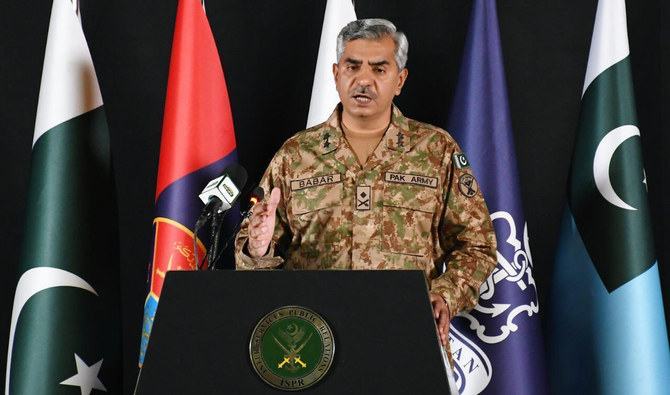
Inter-Services Public Relations (ISPR) director general Maj. Gen. Babar Iftikhar speaks during a press conference at the Pakistan Army headquarters in Rawalpindi on Feb. 27, 2020. (Photo courtesy: ISPR/File)
Short Url
Updated 30 October 2020
Follow

Captured Indian pilot’s return showed Pakistan’s 'mature response' — military

  • Major General Babar Iftikhar responds to an opposition politician who claimed the government released the prisoner due to fear of war
  • The spokesman says Pakistan gave India a ‘bloody nose’ that still hurts

ISLAMABAD: Pakistan released an Indian pilot, Wing Commander Abhinandan Varthaman, after shooting down his fighter jet during an aerial dogfight over Kashmir in February 2019 to give peace a chance in the region, said the chief of the military’s media wing on Thursday, adding it was “misleading and disappointing” to attribute the country’s decision to anything but its “mature response” as a responsible state.
The statement of Director General Inter-Services Public Relations (DG ISPR) Major General Babar Iftikhar came a day after former National Assembly speaker and senior Pakistan Muslim League-Nawaz leader Sardar Ayaz Sadiq said that the government had released the Indian pilot due to fear of an imminent attack from India.
“A statement was given yesterday that tried to distort facts related to a national security issue,” Iftikhar said without naming anyone. “I am here to set the record straight.”
Addressing a news conference with “one-point agenda,” he said that Pakistan’s armed forces displayed their ability to respond to “Indian aggression” last year before releasing the captured pilot in accordance with the Geneva Convention.
“We gave them a bloody nose and it is still hurting,” he said while referring to Pakistan’s response to India’s violation of its airspace in February last year.
The former National Assembly speaker claimed on Wednesday that the government had asked parliamentary leaders to let Abhinandan go, predicting an attack from the country’s nuclear-armed neighbor.
However, Sadiq issued a clarification on Thursday, saying that Indian media was “misreporting” his statement.
Alluding to his words in the National Assembly, the DG ISPR said that the negative narrative was “directly affecting the national security” of Pakistan, adding that India was taking full advantage of it.
“This narrative is being used to minimize India’s defeat and loss,” he said. “It also amounts to creating undue controversy around Pakistan’s clear supremacy and victory over India, and I think this is not acceptable to any Pakistani.”
Asked about recent statements of opposition leaders against the military leadership, he said the armed forces were an organized institution and its rank and file could not be separated.
“No one can create differences between the rank and file of the armed forces,” he said. “There is complete unity and it will continue to remain that way.”
An 11-party opposition alliance, the Pakistan Democratic Movement (PDM), has accused the security establishment of meddling in politics and helping Prime Minister Imran Khan’s rise to power in the 2018 general elections.
“This political polarization will continue. It will increase. There may emerge a situation where there is a severe constitutional crisis,” Adnan Rehmat, a political analyst, told Arab News. “The opposition would never have targeted state institutions if the government had not subjected its leaders to undue and unfair pressure.”


PML-N leaders, however, denied that they wanted a clash with any institution to make political gains.
“Our protests and struggle against the government is purely democratic and constitutional. We don’t intend to clash with our state institutions,” Malik Abrar Ahmed, a senior PML-N leader, told Arab News.
The country’s army chief, General Qamar Javed Bajwa, also held a meeting with the prime minister on Thursday to discuss “professional matters pertaining to Pakistan Army, internal and external security situation,” according to the PM Office.


Pakistan says defense pact with Saudi Arabia elevated brotherly ties to ‘new heights’

Updated 25 February 2026
Follow

Pakistan says defense pact with Saudi Arabia elevated brotherly ties to ‘new heights’

  • Pakistan, Saudi Arabia signed strategic defense pact last year pledging aggression against one will be treated as attack on both
  • Deputy PM Ishaq Dar says enduring bonds with Islamic and Arab nations form vital pillar of Pakistan’s foreign policy 

ISLAMABAD: Deputy Prime Minister Ishaq Dar said on Wednesday that Pakistan’s defense pact with Saudi Arabia elevated its brotherly ties with the Kingdom to “new heights,” stressing that close ties with Arab and Islamic nations form a key pillar of Islamabad’s foreign policy. 

Pakistan and Saudi Arabia signed a Strategic Mutual Defense Agreement on Sept. 17 last year, pledging that aggression against one country would be treated as an attack on both, enhancing joint deterrence and formalizing decades of military and security cooperation.

Both nations agreed in October 2025 to launch an economic cooperation framework to strengthen trade and investment ties. 

“In the Middle East, our landmark Strategic Mutual Defense Agreement with Saudi Arabia has elevated our brotherly ties to new heights,” Dar said while speaking at the Pakistan Governance Forum 2026 event in Islamabad. 

The Pakistani deputy prime minister was speaking on the topic “Navigating International Relations Amidst Changing Geo-Politics.”

Dar noted that Pakistan has reinforced partnerships with other Middle Eastern nations such as the UAE, Qatar, Jordan, Oman, Egypt and Bahrain. He said these partnerships have yielded “concrete agreements” in investment, agriculture, infrastructure, and energy sectors. 

“Our enduring bonds with Islamic and Arab nations form a vital pillar of our foreign policy, and we will continue to expand our partnerships across Asia, Latin America, and Africa,” he said. 

Dar pointed out that the presidents of Kazakhstan, Uzbekistan and Kyrgyzstan have undertaken visits to Pakistan in recent months, reflecting Central Asian nations’ desire to boost cooperation with Islamabad.

On South Asia, the Pakistani deputy PM said Pakistan has successfully transformed its fraternal ties with Bangladesh into “a substantive partnership.”

“Similarly, the trilateral mechanism involving China, Pakistan, and Bangladesh has been launched with a view to expanding and deepening regional cooperation and synergy,” the Pakistani minister said. 

He said Islamabad has strengthened its “all-weather” partnership with China via the second phase of the multi-billion-dollar China-Pakistan Economic Corridor agreement and “unwavering support” from both sides for each other’s core interests. 

Dar said Pakistan had also reinvigorated its partnership with the US, advancing cooperation in trade, technology, investment, and regional stability. 

“This calibrated approach has enhanced our ability to navigate complexity with skill and confidence, ensuring that our national interests are served without compromising our core foreign policy principles,” he said.