

US-India defense pact will disturb ‘strategic balance’ in South Asia, Pakistani experts warn

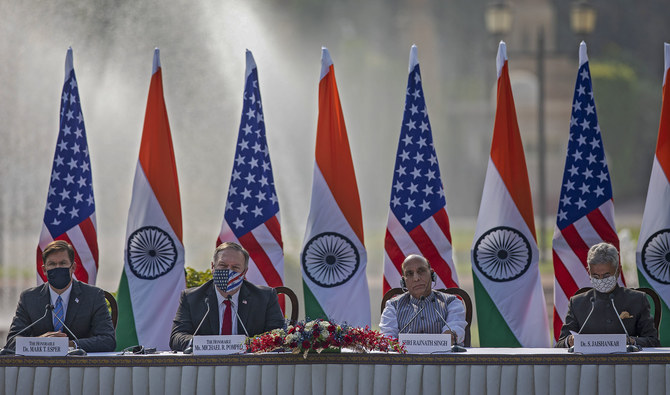
From left, US Secretary of Defence Mark Esper, US Secretary of State Mike Pompeo, Indian Defence Minister Rajnath Singh and Foreign Minister Subrahmanyam Jaishankar during a joint press conference at Hyderabad House in New Delhi on Oct. 27, 2020. (AP)
Short Url
Updated 28 October 2020
Follow

US-India defense pact will disturb ‘strategic balance’ in South Asia, Pakistani experts warn

  • Defense analysts say US decision to use India against China will put regional security and stability at risk
  • The US-India deal will give New Delhi access to sensitive satellite data that is considered vital for hitting missiles and other targets with precision

ISLAMABAD: A security agreement signed between the United States and India on Tuesday would disturb strategic balance in South Asia by emboldening New Delhi to pursue its hegemonic ambitions in the region, defense experts said on Wednesday.
The two countries signed the defense pact, Basic Exchange and Cooperation Agreement on Geospatial Cooperation (BECA), during a high-profile visit of the US state and defense secretaries, Mike Pompeo and Mark Esper, to New Delhi for 2+2 talks.
The defense pact has been signed at a time when India is engaged in border standoffs with two of its neighbors, Pakistan and China.
“This defense deal is apparently aimed to counter the growing influence of China in the region, but we fear that India’s military buildup will ultimately be used against Pakistan,” Lt Gen (r) Amjad Shoaib, a defense analyst, told Arab News.
Under the agreement, the US will allow India access to a range of sensitive geospatial and aeronautical data that is considered vital for hitting missiles, drones and other targets with precision.
“The US is preparing India against China in the region, and this is quite a dangerous move for the whole region,” Shoaib continued. “This will disturb the strategic balance in South Asia besides pushing an arms race with countries like Pakistan.”
He said that India would bully its neighbors, especially smaller states like Nepal, to fulfill its hegemonic designs.
Shoaib noted that the US defense pact with India was “clearly aimed” at undermining the China-Pakistan Economic Corridor – a $60 billion infrastructure development project – since New Delhi was more than likely to engage in hostilities with Islamabad and Beijing.
“Pakistan should develop a cogent defense partnership with China to boost its military arsenal and be ready to respond to any aggression by India,” he suggested.
Pakistan’s foreign office has also “taken note” of the US-India defense pact, saying it had been consistently highlighting the threats posed to strategic stability in South Asia as a result of provision of advanced military hardware, technologies and knowledge to India.
“India’s massive acquisition of armaments and expansion of its nuclear forces, including introduction of new destabilizing weapon systems, are developments with serious repercussions for peace and stability in South Asia,” it said in a statement on Tuesday.
The foreign office also reacted to a joint statement issued by the two countries after the ministerial dialogue that “called on Pakistan to take immediate, sustained and irreversible action to ensure that no territory under its control is used for terrorist attacks.”
“Gratuitous and self-serving references in joint statements cannot mask the fact that it is India that continues to be the nerve center of state-terrorism in the region including Indian Illegally Occupied Jammu & Kashmir [IIOJK], besides being a safe haven for the perpetrators of hate crimes against Muslims and Islamophobia,” said the foreign office.
“By seeking to project itself as ‘victim’ of terrorism, India cannot divert attention from the gross human rights violations being perpetrated by Indian occupation forces and the resulting humanitarian crisis in IIOJK,” it added.
India is one of the world’s biggest defense equipment buyers, but around 60-70 percent of its inventory is supplied by Russia.
Mosharraf Zaidi, a political and security analyst, said the US-India defense pact was “part of a very substantial and major push” by the Americans to consolidate their linkages and ingress into the region, essentially because of the level of competitiveness between the US and China.

“If there was that level of sharing between the US and India that obviously would have very significant impact on Pakistan’s own risk and threat assessment,” he told Arab News.
“What I think the BECA doesn’t allude to at least in terms of the open source discussions about it is whether or not the provisions of BECA relate to Pakistan or not,” he said, hoping that Pakistani authorities would take it up with America.


Pakistan president meets UAE counterpart, explores trade, investment opportunities

Updated 27 January 2026
Follow

Pakistan president meets UAE counterpart, explores trade, investment opportunities

  • Asif Ali Zardari is in UAE on four-day visit to strengthen bilateral ties, review bilateral cooperation
  • Both sides discuss regional, international developments, reaffirm commitment to promote peace

ISLAMABAD: President Asif Ali Zardari met his UAE counterpart Sheikh Mohammed bin Zayed Al-Nahyan in Abu Dhabi on Tuesday during which both sides explored new opportunities in trade, investment, energy and other sectors, Zardari's office said. 

Zardari arrived in Abu Dhabi on Monday evening with a high-level delegation on a four-day official visit to the UAE to review trade, economic and security cooperation. 

"The leaders discussed ways to further deepen the longstanding and brotherly relations between Pakistan and the UAE," a statement from Zardari's office said about his meeting with the UAE president. 

"They reviewed the full spectrum of bilateral cooperation and explored new opportunities in trade, investment, energy, infrastructure, technology, and people-to-people exchanges, highlighting the significant potential for expanding economic and strategic partnership.

Zardari highlighted the significance of Al-Nayhan's visit to Pakistan last month, the statement said, expressing appreciation for the UAE's continued support for strengthening bilateral ties.

It said both sides also exchanged views on a range of regional and international developments, reaffirming their commitment to promoting peace, stability and sustainable development.

The meeting was also attended by Pakistan's First Lady Aseefa Bhutto-Zardari, the Pakistani president's son Bilawal Bhutto-Zardari, who is also the chairman of the Pakistan Peoples Party, Interior Minister Mohsin Naqvi and Pakistan's ambassador to the UAE. 

ZARDARI MEETS AD PORTS CEO

Zardari earlier met AD Ports Group CEO Captain Mohamed Juma Al-Shamisi to discuss the group's investment initiatives in Karachi. 

"Both sides agreed that the expansion and modernization of port infrastructure would strengthen trade flows and support Pakistan’s broader economic development and country’s seaborne trade," the President's Secretariat said in a statement.

It added that Zardari described the AD Ports Group's long-term investment and expanding role in Pakistan's maritime and logistics sector as a key pillar of Pakistan–UAE economic cooperation.

Pakistan and the UAE maintain close political and economic relations, with Abu Dhabi playing a pivotal role in supporting Islamabad during periods of financial stress through deposits, oil facilities and investment commitments. 

The UAE is Pakistan's third-largest trading partner, after China and the United States, and a key destination for Pakistani exports, particularly food, textiles and construction services.

The Gulf state is also home to more than 1.5 million Pakistani expatriates, one of the largest overseas Pakistani communities in the world, who contribute billions of dollars annually in remittances, a crucial source of foreign exchange for Pakistan’s economy.

Beyond trade and labor ties, Pakistan and the UAE have steadily expanded defense and security cooperation over the years, including military training, joint exercises and collaboration in counter-terrorism and regional security matters.