EU condemns Erdogan’s Macron comments as ‘unacceptable’

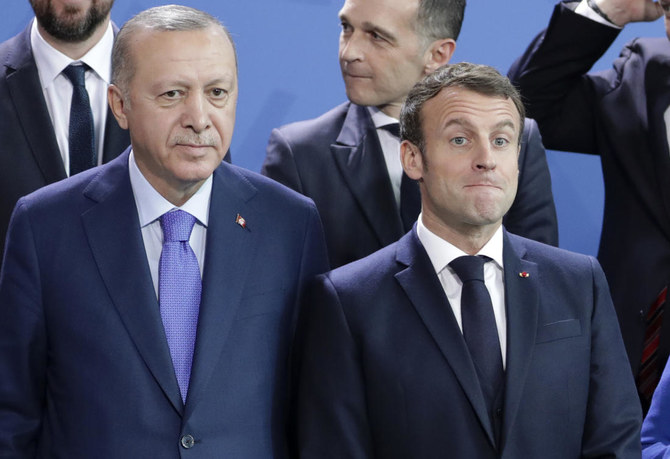
In this Sunday, Jan. 20, 2020 file photo, Turkey's President Recep Tayyip Erdogan, left and French President Emmanuel Macron stand, during a group photo at a conference on Libya at the chancellery in Berlin, Germany. (AP)
Short Url
Updated 25 October 2020
Follow

EU condemns Erdogan’s Macron comments as ‘unacceptable’

  • The EU's top diplomat described comments by Erdogan regarding Macron as "unacceptable”
  • Erdogan accused Macron of having a “problem” with Islam and with Muslims

BRUSSELS: The EU’s top diplomat Josep Borrell on Sunday condemned Turkish President Recep Tayyip Erdogan for making what he described as “unacceptable” comments about his French counterpart Emmanuel Macron.
On Saturday, France had said it was recalling its envoy to Turkey for consultations after Erdogan said Macron needed his mental health checked.
“The remarks by President Recep Tayyip Erdogan regarding President Emmanuel Macron are unacceptable,” Borrell tweeted.
“Call to Turkey to cease this dangerous spiral of confrontation.”
Erdogan accused Macron of having a “problem” with Islam and with Muslims for defending the right to show cartoons of the Prophet Muhammad — an act for which a French schoolteacher was murdered last week.
France and Turkey are at loggerheads over a range of issues including maritime rights in the eastern Mediterranean, Libya, Syria and the conflict between Armenia and Azerbaijan over Nagorno-Karabakh.
And ties between Ankara and Brussels are similarly fraught, particularly with regard to Turkey’s oil and gas exploration activities in the eastern Mediterranean.
At a summit at the beginning of October, EU leaders adopted a carrot and stick approach, offering Ankara the prospect of closer ties and better trade if it commits to “pursuing dialogue in good faith and abstaining from unilateral actions.”
But it warned that the EU was prepared to use sanctions — possibly including broad-based economic measures — if Turkey persists with what Brussels sees as the illegal infringement of Cypriot waters.
“The conclusions of the European Council entail a real offer to relaunch our relationship, but political willingness is needed on the part of the Turkish authorities on this positive agenda,” Borrell tweeted on Sunday.
“Otherwise, Turkey will be even more isolated,” he added.


Nestle acknowledges delay before baby milk recall

Updated 5 sec ago
Follow

Nestle acknowledges delay before baby milk recall

  • The company in December recalled batches of its infant formula in 16 European countries
  • Nestle said routine checks at its Dutch plant at the end of November 2025 had detected “very low levels” of cereulide

GENEVA: Swiss food giant Nestle has acknowledged that it waited days for a health-risk analysis before alerting authorities after detecting a toxin in its baby milk at a Dutch factory.
But in an open letter to campaign group Foodwatch France Friday it denied accusations of negligence.
The company in December recalled batches of its infant formula in 16 European countries after detecting cereulide, a bacterial toxin that can cause diarrhea and vomiting.
French newspaper Le Monde reported Friday that traces of cereulide had been found in late November — 10 days before the first recalls of the product — because the company waited for a “health?risk analysis” before informing regulators.
Nestle said in a statement online that routine checks at its Dutch plant at the end of November 2025 had detected “very low levels” of cereulide after new equipment was installed in a factory.
It said there was no maximum limit for cereulide indicated by regulations.
The company halted production and launched further tests, which in early December confirmed minute quantities in products that had yet to leave the warehouse.
Nestle said it informed Dutch, European and other national authorities on December 10 and began a precautionary recall of all products made since the new equipment was installed — 25 batches across 16 European countries.

- Response to Foodwatch -

Friday’s open letter responded to claims by Foodwatch France, which a day earlier announced it was filing a legal complaint in the French courts against Nestle on behalf of several families whose babies had fallen ill.
Nestle denied Foodwatch’s suggestions that its product recall had been late without any reasonable excuse and that it had displayed “alarming negligence.”
They said they had acted in December and January as soon as they had identified there was an issue, said the company.
“We recognize the stress and worry that the recall has caused for parents and caregivers,” it said.
“To date, we have not received any medical reports confirming a link to illness associated with our products,” it added.
The company has said from the start of the affair that the recall stemmed from a “quality issue” and that it had seen no evidence linking its products to illness.
French authorities launched an investigation into the deaths in December and January of two babies who were thought to have drunk possibly contaminated powdered milk.
Nestle said in its statement that “nothing indicates any link between these tragic events in these two instances and the consumption of our products.”