

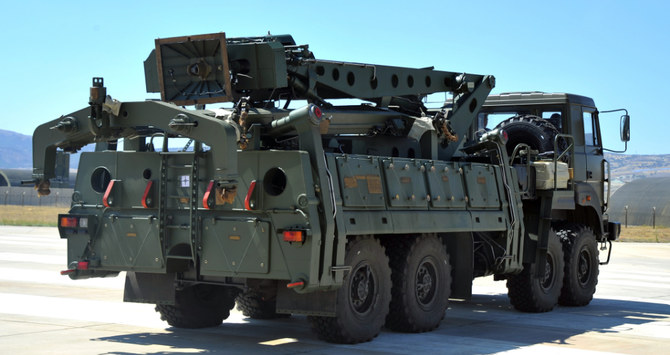

ANKARA: Turkey on Thursday officially confirmed the fears of its NATO allies that it had carried out testing of its controversial Russian-made S-400 missile defense system.
Trials of the $2.5 billion anti-aircraft weaponry bought last year from Moscow took place last week in the northern Turkish province of Sinop, just across the Black Sea from Russian territory.
In a Bloomberg interview, Turkish Defense Minister Hulusi Akar said that the S-400 would not be integrated into NATO’s command-and-control infrastructure, but would instead be “used as a standalone system similar to the use of Russian-made S-300 weapons that exist within NATO.”
With this comparison, Akar implicitly referred to Athens, currently the top challenger to Turkey, which possesses the Russian-produced missiles in its arsenal.
Experts believe that the official statement on Turkey’s testing of the Russian air defense system could stoke tensions between Ankara and Washington, which claims that the missiles pose a serious threat to alliance military equipment.
Meanwhile, NATO defense ministers met on Thursday to discuss issues affecting the alliance’s security.
Ozgur Unluhisarcikli, Ankara office director of think tank The German Marshall Fund of the US, said Turkey’s argument that the S-400 would be a standalone system not connected to NATO’s radar network had been made several times but had failed to reassure the Americans.
The main concern of the NATO allies is that the S-400 could be used to gather sensitive intelligence via systems linked to the F-35 stealth fighter, the next-generation warplane of the alliance.
But Ankara has said that its acquisition of the Russian missiles was necessary to defend itself against current and emerging security threats in its region.
Turkey’s participation in the co-production of the F-35 system was suspended by Washington last year as punishment for buying the Russian military hardware. However, the US had held back from imposing sanctions while the missiles remained in crates, but harsh economic measures are expected to kick in once the missiles are activated.
US Senate Foreign Relations Chair Jim Risch said this week that further sanctions against Turkey, as part of the Countering America’s Adversaries Through Sanctions Act (CAATSA), for testing the S-400s still topped his agenda for initiation after the presidential election.
New Jersey Sen. Bob Menendez also issued a statement last week in which he said: “Turkey must be sanctioned immediately.”
Unluhisarcikli told Arab News: “The S-400s being used as a standalone system is unlikely to prevent CAATSA sanctions being imposed on Turkey.”
Ankara has been delaying the activation of the system since April, the planned date for its operationalization. Last month, during a visit to Turkey, NATO Secretary-General Jens Stoltenberg repeated that the S-400 system could not be integrated into the NATO air and missile defense system.
But Unluhisarcikli believes that the efficiency of the S-400 as a standalone system is highly dubious.
Joe Macaron, a Middle East foreign-policy analyst at the Arab Center, said the US did not trust Turkey to block any Russian attempt to infiltrate the F-35 system.
“The Turkish message about not integrating them into the NATO system is being met with suspicions because Turkey has been playing both the US and Russia for a while and benefiting from their bilateral tensions,” he said.
He felt that Turkey had a two-fold objective. “The first is linked to US domestic politics with Turkish President Recep Tayyip Erdogan struggling to get his US counterpart Donald Trump’s attention in the middle of his campaign or he is using the election season to force new preconditions for a potential Joe Biden presidency.
“And second, Erdogan feels a shifting US policy toward Turkey and testing the Russia defense system is a signal that he wants to talk with Washington. Whether Trump or Biden wins, there is no easy recipe for US policy toward Turkey,” Macaron added.


