Video shows missile fired where Turkey cleared way for S-400 test, prompting US warning

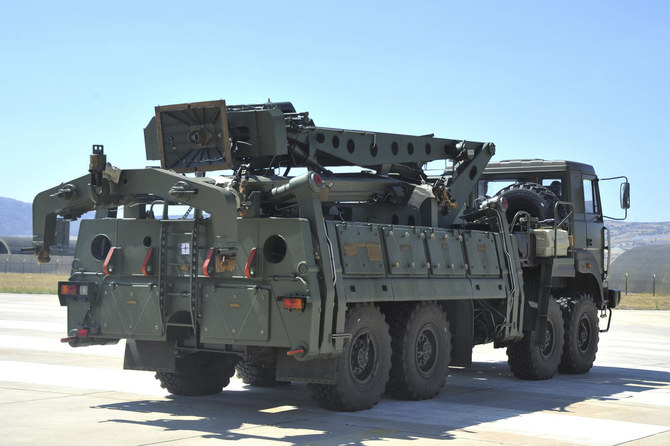
A truck carrying parts of the S-400 air defense systems, exits a Russian transport aircraft after landing at Murted military airport outside Ankara, Turkey. (File/AP)
Short Url
Updated 16 October 2020
Follow

Video shows missile fired where Turkey cleared way for S-400 test, prompting US warning

  • The video, taken in the coastal city of Sinop, showed a narrow column of smoke headed high into the blue sky
  • Tests of the S-400s, if verified, could stoke tensions between Turkey and the United States

ISTANBUL/WASHINGTON: A missile was fired into the sky on Friday on Turkey’s Black Sea coast where the military was expected to test its Russian-made S-400 defense systems, according to local video obtained by Reuters, drawing a strong warning from the US State Department.
The video, taken in the coastal city of Sinop, showed a narrow column of smoke headed high into the blue sky. In recent days Turkey had issued notices restricting air space and waters off the coastal area to allow firing tests.
Tests of the S-400s, if verified, could stoke tensions between Turkey and the United States, which sharply opposed Ankara’s purchase of the weapons from Moscow on grounds they compromise shared NATO defense systems.
State Department spokeswoman Morgan Ortagus said the United States has expressed to the most senior levels of the Turkish government that the acquisition of Russian military systems such as the S-400 is unacceptable, adding that Washington has been clear on its expectation that the system should not be operationalized.

Opinion

This section contains relevant reference points, placed in (Opinion field)

“We have also been clear on the potential serious consequences for our security relationship if Turkey activates the system,” Ortagus said.
“If confirmed, we would condemn in the strongest terms the S-400 test missile launch as incompatible with Turkey’s responsibilities as a NATO  Ally and strategic partner of the United States,” she added.
A US official, speaking on the condition of anonymity, confirmed that Turkey had tested the S-400 system on Friday but did not provide details.
Turkey’s defense ministry said it would neither deny nor confirm missile tests.
Washington reacted last year by suspending Turkey from its F-35 jet program and has threatened sanctions.
Defense analyst Turan Oguz said a preliminary assessment of the color, intensity, angle and route of the smoke in the video coincided with S-400 missiles. The angle of the column suggested the target “must not be too high,” he added.
Last year the military conducted radar tests of the surface-to-air defenses, which is among the world’s most advanced and can spot and track incoming aircraft at medium and long ranges.
Turkey signed the S-400 deal with Russia in 2017. Deliveries of the first four missile batteries, worth $2.5 billion, began in July last year.
Last week — after reports of the planned tests circulated — two US senators called again for President Donald Trump’s administration to impose sanctions on Turkey.


Hundreds mourn in Syria’s Homs after deadly mosque bombing

Updated 27 December 2025
Follow

Hundreds mourn in Syria’s Homs after deadly mosque bombing

  • Officials have said the preliminary investigations indicate explosive devices were planted inside the mosque but have not yet publicly identified a suspect

HOMS: Hundreds of mourners gathered Saturday despite rain and cold outside of a mosque in the Syrian city of Homs where a bombing the day before killed eight people and wounded 18.
The crowd gathered next to the Imam Ali ibn Abi Talib Mosque in the Wadi Al-Dhahab neighborhood, where the population is predominantly from the Alawite minority, before driving in convoys to bury the victims.
Officials have said the preliminary investigations indicate explosive devices were planted inside the mosque but have not yet publicly identified a suspect.
A little-known group calling itself Saraya Ansar Al-Sunna claimed responsibility for the attack in a statement posted on its Telegram channel, in which it indicated that the attack intended to target members of the Alawite sect, an offshoot of Shia Islam whom hard-line Islamists consider to be apostates.
The same group had previously claimed a suicide attack in June in which a gunman opened fire and then detonated an explosive vest inside a Greek Orthodox church in Dweil’a, on the outskirts of Damascus, killing 25 people as worshippers prayed on a Sunday.
A neighbor of the mosque, who asked to be identified only by the honorific Abu Ahmad (“father of Ahmad“) out of security concerns, said he was at home when he heard the sound of a “very very strong explosion.”
He and other neighbors went to the mosque and saw terrified people running out of it, he said. They entered and began trying to help the wounded, amid blood and scattered body parts on the floor.
While the neighborhood is primarily Alawite, he said the mosque had always been open to members of all sects to pray.
“It’s the house of God,” he said. “The mosque’s door is open to everyone. No one ever asked questions. Whoever wants to enter can enter.”
Mourners were unable to enter the mosque to pray Saturday because the crime scene remained cordoned off, so they prayed outside.
Some then marched through the streets chanting “Ya Ali,” in reference to the Prophet Muhammad’s cousin and son-in-law whom Shiite Muslims consider to be his rightful successor.