


BEIRUT: Lebanese President Michel Aoun has said parliamentary consultations to name the country’s next prime minister for the formation of a new government will take place on Thursday.
Aoun previously delayed the meetings for a week because “some parliamentary blocs had requested the postponement due to the emergence of issues that must be addressed.”
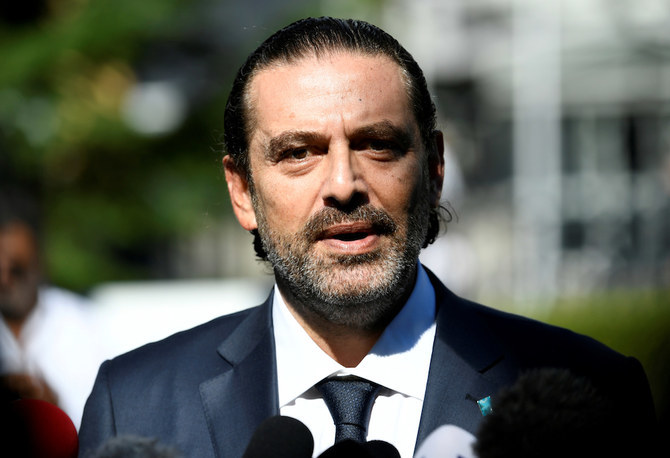
Saad Hariri is overwhelmingly likely to be named prime minister. Hariri previously said he was nominated “based on the French initiative, which is the last chance to save the country.” The Free Patriotic Movement was among the most prominent objectors to his appointment.
Hariri submitted his government’s resignation a year ago in response to public protests against the Lebanese leadership.
Before deciding on the date, Aoun addressed the Lebanese public, the first time a president has done so before parliamentary consultations.
He said the onus is on the new prime minister to pull the country out of its financial crisis.
In his speech, Aoun said that he would not resign and vowed to see through the formation of a new government.
“Today I am required to assign the head of the government and then take part in the formation of the next government in accordance with the provisions of the constitution.
“Many deep political changes have occurred in the region due to regional and international factors. Things may turn upside down.
“Will the person to be assigned the formation of the government commit to addressing the corruption and launching the reform workshop?” Aoun said.
Addressing MPs, he warned: “This is your responsibility. You are responsible for parliamentary oversight and accountability in the name of the people you represent. You are urged, in the name of Lebanon’s greater good, to turn to your patriotic conscience and sense of responsibility toward your people and your country.
“I hope that you will think carefully about the implications of the assignment on the formation of the government, the reform projects and the international rescue initiatives, because the deteriorating situation cannot continue after today,” he said, adding: “Burdens are accumulating and mounting on the citizens.”
Aoun has faced severe criticism for Lebanon’s failed reforms and the country’s forensic audit. “I adopted the change and reform project in an attempt to save the country from the clutches of factional, personal and authoritarian interests that brought us all to where we are today. But those who are affected stood in my face,” he said.
The president said the likely outcome of the parliamentary consultations will be an agreement by 59 MPs to name Hariri as prime minister. Hezbollah has yet to announce its position despite sources saying the party favors Hariri.
The Lebanese Parliament is missing eight of its usual 128-member roster after several MPs resigned in response to public pressure following the Beirut port explosion.
Among the parliamentary blocs that will reject Hariri on Thursday are Lebanese Forces, Talal Arslan’s bloc, Syrian National Social Party, Consultative Meeting, Free Patriotic Movement and a number of independent MPs.
The Future Movement’s parliamentary bloc refused to comment on Aoun’s speech, while several MPs criticized it. MP Bilal Abdullah said: “We did not understand anything from the president’s speech, nor did we get the message he wished to convey. We will nominate no one but Hariri.”
Hariri said on Oct. 8 that his leadership is required for “a government of independent technocrats that neutralizes political parties and implements within six months the reforms laid down by the French initiative.”
Meanwhile, the General Labor Union and the Union Coordination Committee warned in a Wednesday meeting that the country’s situation could become so dire that “people would take to the streets due to hunger and illness.”
General Secretary of the Lebanese Economic Organizations Nicolas Chammas said: “France did not exaggerate when it said that Lebanon, as an entity, might disappear.”
Bechara Asmar, head of the General Labor Union, said: “We are in a state of great tragedy. We fear that people will take to the streets and block the roads, and then there would be no going back.”
On Wednesday evening tensions erupted in downtown Beirut between anti-Hariri protesters and supporters of the Future Movement. Security forces tried to separate the two sides.


