

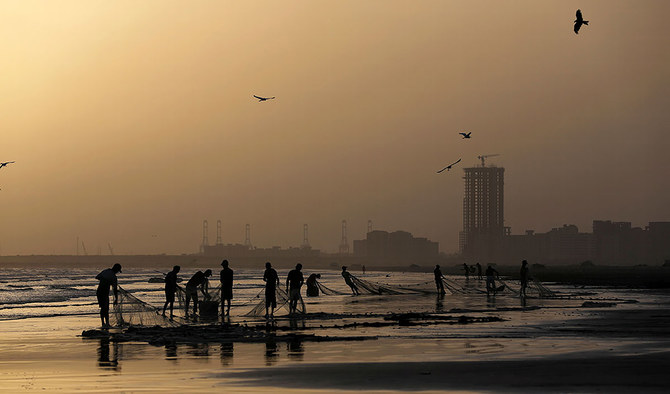

KARACHI: A pressure group that represents Pakistani fishermen has said a government plan to allow Chinese companies to carry out deep-sea fishing in the country’s territorial waters could threaten the survival of at least three million people who depend on the sea for livelihood.
Last month, 12 Chinese deep-sea trawlers docked at the port of Karachi, unleashing fear among local fishermen who say commercial fishing vessels and bottom-trawling would deplete fish stocks in the exclusive federal sea zones off the Sindh and Balochistan provinces.
Bottom trawling - dragging nets across the sea floor to scoop up fish - stirs up the sediment lying on the seabed, displaces or harms some marine species, causes pollutants to mix into plankton and move into the food chain and creates harmful algae blooms or oxygen-deficient dead zones.
The coastal line of Sindh and Balochistan is 1,050 km long, Mohammad Ali Shah, Chairman Pakistan Fisherfolk Forum, told Arab News last week, saying around three million fishermen relied on the sea to survive.
A new fishing policy is expected but yet to be revealed by the government, he said.
“The deep-sea trawler policy has not yet been approved but before that they [China] have brought these trawlers,” Shah said, calling the arrival of the Chinese vessels at Karachi port last month ‘illegal.’
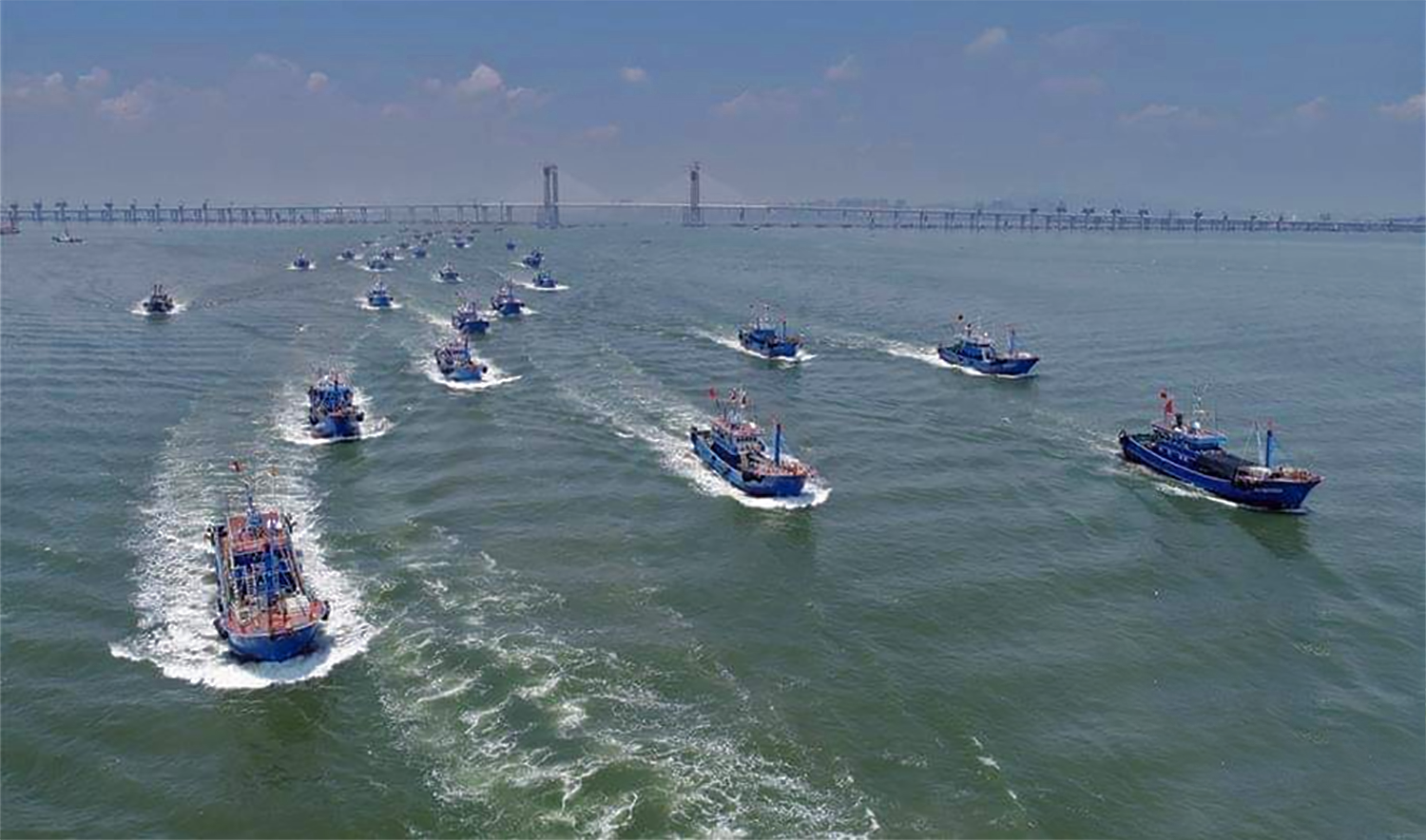
In this undated photo, fishing vessels of Fujian Fishery Company move from the Gwadar port towards Karachi, Pakistan (Photo courtesy: Fishermen Cooperatives Society)
In 2018, the government enacted a deep-sea fishing licensing policy that both fishermen's representative bodies and provincial government bodies opposed, calling it a constitutional violation and an encroachment on the livelihoods of fishermen in the coastal provinces.
Fears about foreign fishing companies eating up local communities are not new.
For years, fishermen in the southwestern city of Gwadar in Balochistan province - a flagship of the $60 billion China-Pakistan Economic Corridor - have protested against foreign trawlers.
Tensions first began to mount when the Fisheries Department disclosed its plan to issue licenses to various foreign fishing vessels to operate in an exclusive economic zone in 2016.
But last week, the federal minister for maritime affairs, Ali Haider Zaidi, told Arab News the country’s new deep-sea fishing policy would not allow Chinese trawlers to engage in unregulated deep-sea fishing. Bottom trawling, he said, would be banned under the new policy.
“Importing boats is not illegal,” he said. “How you use them has to be regulated.”
Pakistan divides its sea into three zones, where zone-3 (from 20 to 200 nautical miles) is controlled by the federal government. Up to 12 nautical miles (zone-1) is the domain of the provinces Sindh and Balochistan and between 12 to 20 nautical miles the sea is declared a buffer zone.
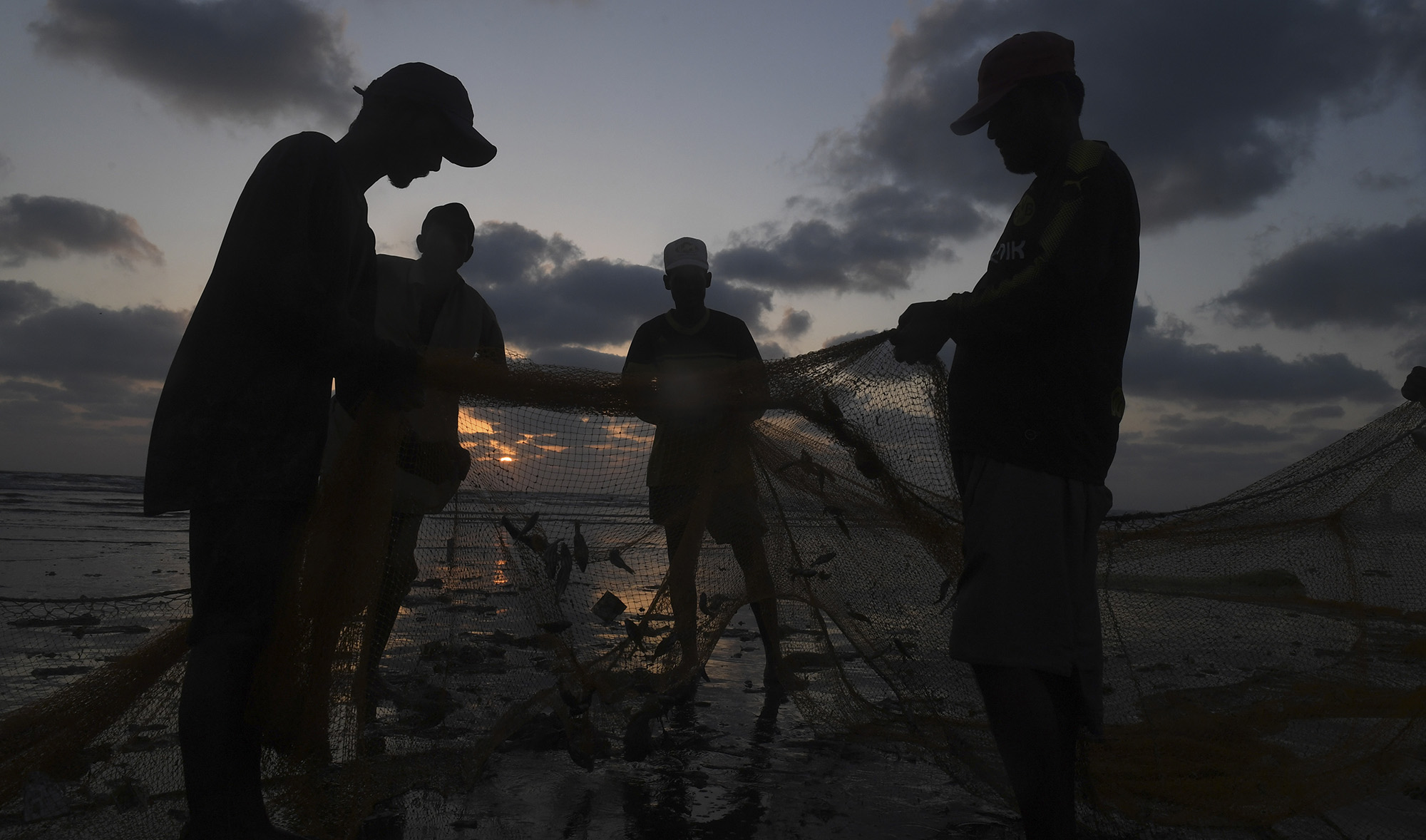
Fishermen remove fish from a net at the Clifton beach in Pakistan's port city of Karachi on Oct. 6, 2020. (AFP/File)
Local fishermen are not allowed to fish in zone-3 and foreign fishing vessels are not permitted to fish in the other two zones under the existing policy.
The Fishermen's Cooperative Society (FCS), which issued the permit to the Chinese trawlers, said the Chinese fishing vessels would not use the destructive bottom trawling method and instead help ‘upgrade’ Pakistan’s fishing industry and export.
Official figures put the annual value of Pakistan’s fish exports at roughly $450 million.
“Bringing Chinese trawlers for deep sea fishing is in line with the government’s deep-sea fishing policy and aimed at upgrading and modernizing fishing, besides providing job opportunities to local fishermen,” Abdul Berr, Chairman of the Fishermen's Cooperative Society, told Arab News.
“Around 3,500 fishermen will get employment opportunities with the arrival of the world’s latest fishing boats and modern small boats,” Berr said.
He added: “First, 70 percent of the staff at trawlers and processing facilities will be local. There will be no fishing in provincial territorial waters. The trawlers will bring all their catch to Karachi where it will be processed in factories and then exported.”
Small local fishermen would receive modern fiber boats on ‘easy instalments,’ Berr said, a step towards replacing their obsolete boats.
But Sindh’s minister for livestock and fisheries, Abdul Bari Pitafi, said the mega fishing ships would wipe out sea-life, even if they were only operating in the federal government’s zone-3.
“We will...also oppose its [trawlers’] operations in zone-3 because they will just wipe out sea-life including the fish’s seed,” Pitafi told Arab News.
In 2016, a survey carried out by the Food and Agriculture Organisation revealed that more than 72 percent of the fish stock in Pakistan’s coastal areas had already declined.
“One trawler does a catch that is equal to a catch by 100 of our fishing boats,” Younus Khaskheli, a fisherman, said. “And their fishing net is the most dangerous one, because it hunts thousands of tons of fish.”
Tens of thousands of fishing boats are registered in Pakistan, he said, with fishermen from Sindh, Balochistan, Punjab, Khyber Pakhtunkhwa and even Bangladesh fishing in these waters.
“Our sea stock will end; the country will lose the income of billions and our fishermen will become jobless,” Khaskheli said. “There won’t be any food left in the sea.”


