RAWALPINDI: Pakistan bowler Umar Gul, who earned the nickname “Gul-dozer” for his rattling of stumps, has called time on his 17-year cricket career.
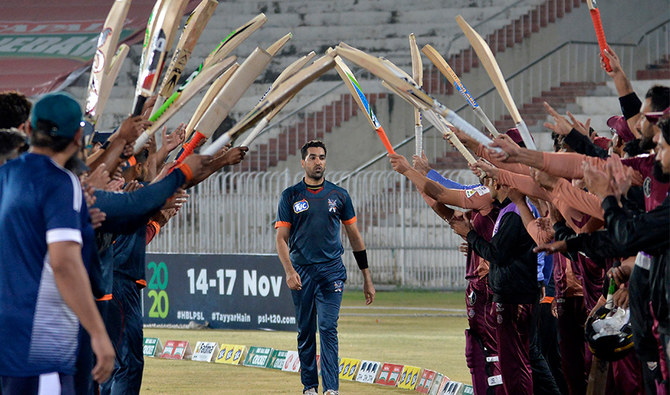
With no crowds to bid farewell to the national hero because of coronavirus restrictions, the Twenty20 World Cup winner bowed out to a guard of honor from teammates and opponents after his final match — a disappointing defeat — in Rawalpindi on Friday.
“I want to be remembered as someone who tried his best for the country and it’s flattering that I was called ‘Gul-dozer’ during this memorable journey in cricket,” the 36-year-old told AFP.
It was a topsy-turvy journey for Gul, whose affair with cricket began on the crowded streets of Peshawar.
He entered the international arena exactly a month after the legendary pace duo of Wasim Akram and Waqar Younis retired following Pakistan’s disastrous 2003 World Cup.
It was like the baton of swing bowling had been passed from one generation to another, Gul recalled.
“It was tough to fill those shoes but I tried my best and it was great to lead Pakistan to the final of the Twenty20 World Cup in 2007 and then to the title two years later,” he said.
He finished with 163 Test and 179 ODI wickets, but he achieved his greatest success in Twenty20 cricket, the start of his career coinciding with the launch of the shortest format in 2003.
Gul was at his destructive best in England in 2009, finishing as the top wicket taker of the Twenty20 World Cup with 13. That included a mesmerizing five wickets for just six runs in the semifinal win over New Zealand.
“Winning the World Cup was the highest point of my career,” he said. “I remember those were very tough days and there was unrest in our country so our win brought smiles back on the faces.”
At the time, Pakistan’s military was fighting an insurgency from militants in the northwestern region of the country.
Gul attributes his Twenty20 skills to the early days of his love for the game.
“I grew up playing 20-20-over matches in the streets and then Ramadan cricket where you look for wickets in a 20-over innings,” he said.
But his baptism was in Test cricket, where he became an instant hero in 2004.
In only his fifth Test, Gul destroyed a star-studded Indian batting order in a Lahore Test with figures of 5-21. His victims included the great Sachin Tendulkar, Rahul Dravid, Virender Sehwag and VVS Laxman.
The feat almost halted a burgeoning career, causing a stress fracture in his back.
He later featured in the inaugural Indian Premier League in 2008, topping the chart for the Kolkata Knight Riders with 12 wickets in six games — the only time Pakistan players were allowed to feature in the world’s most lucrative league.
But the 2011 World Cup semifinal against India — in the one-day format — turned out to be the most bitter of his career.
He was targeted by the top order and finished with figures of 0-69 in eight overs for the match in Mohali, India.
“Before that match I was the top wicket taker for my team so India targeted me and to add to that we lost that match,” Gul reminisced.
With his playing years now behind him, next for Gul is a move into coaching: “I will try to make new Bulldozers for my country ... it is my duty to the nation.”


Pakistan’s ‘Gul-dozer’ calls time on cricket career
https://arab.news/286qn
Pakistan’s ‘Gul-dozer’ calls time on cricket career

- Bowler Umar Gul bowed out to a guard of honor from teammates and opponents after his final match on Friday
- He achieved his greatest success in Twenty20 cricket, the start of his career coinciding with the launch of the shortest format in 2003

Pakistan stocks edge higher as export financing, industrial power tariffs are cut
- KSE-100 index gained 1,607.26 points, or 0.88%, to close at 183,945.38
- Rebound follows steep sell-off a day earlier amid regional geopolitical tensions
ISLAMABAD: Pakistan’s stock market rebounded on Friday, with the benchmark index gaining more than 1,600 points, as analysts pointed to cuts in export refinancing rates and lower electricity tariffs for industrial consumers as key drivers of the recovery.
The KSE-100 index rose 1,607.26 points, or 0.88%, to close at 183,945.38, up from 182,338.12 a day earlier, according to Pakistan Stock Exchange (PSX) data.
The uptick followed Prime Minister Shehbaz Sharif’s announcement of a Rs4.4 per unit cut in electricity tariffs for industrial consumers, alongside a reduction in the export refinance rate from 7.5% to 4.5%.
“Stocks staged an early recovery at the PSX on institutional buying in oversold scrips after the prime minister’s assurance to renegotiate the IMF deal, along with cuts in the export refinance rate to 4.5% and industrial power tariffs by Rs4.4 per unit,” Arif Habib Commodities Chief Executive Officer Ahsan Mehanti told Arab News.
He added that higher global crude oil prices and earnings-season speculation also acted as catalysts for bullish activity.
According to local media reports last week, Pakistan is seeking flexibility in IMF lending conditions for the 2026–27 budget and aims to renegotiate its agreement to complete the remaining $7 billion under the Extended Fund Facility (EFF) and a $1.4 billion Resilience and Sustainability Facility (RSF) by September 2027.
The rebound came a day after Pakistani stocks plunged 6,042.26 points on Thursday, a drop analysts attributed to heavy selling and heightened geopolitical tensions between Iran and the United States.
Those concerns intensified after US President Donald Trump warned Iran this week that “time is running out” to reach a deal on its nuclear program, amid a steady buildup of US military forces in the Gulf.


