Lebanese take to the streets to mark protest anniversary

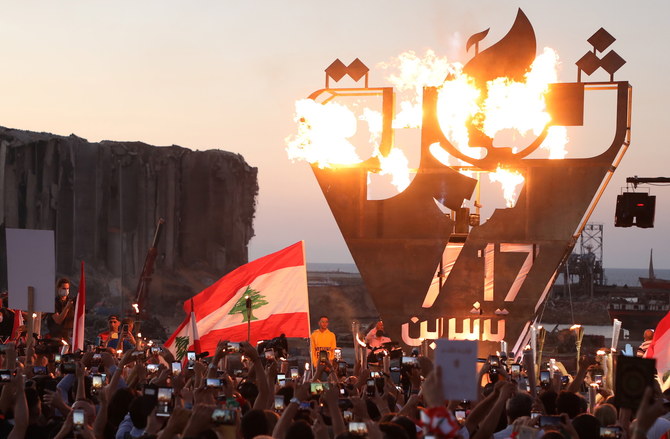
Anti-government demonstrators take pictures of a metal sculpture spelling out the word "revolution" topped by flames during a protest as Lebanese mark one year since the start of nation-wide protests, near Beirut's port, Lebanon October 17, 2020. (Reuters)
Short Url
Updated 17 October 2020
Follow

Lebanese take to the streets to mark protest anniversary

  • The explosion at Beirut port served as a shocking reminder to many of the rot at the heart of their political system
  • On Saturday, hundreds of people brandishing placards and Lebanese flags gathered in Martyrs' Square in Beirut

BEIRUT: Thousands of Lebanese protesters marked the one-year anniversary of nationwide demonstrations on Saturday by marching from Martyrs’ Square in the heart of Beirut to the central bank and government offices where they renewed calls for an end to Lebanon’s sectarian political system.

Activist groups from the southern cities of Sidon and Tyre, as well as Baalbeck, Bekaa and Tripoli in the north, joined the protest, which brought Martyrs’ Square back to life after weeks of inactivity. Wearing masks, the protesters waved Lebanese flags and demanded the overthrow of the “criminal” ruling class.

The march continued to Beirut port, where protesters lit a “torch of the Oct. 17 revolution” to commemorate victims of the explosion that devastated large areas of the capital on Aug. 4.

Almost 180 people were killed and more than 6,500 injured in the blast, which left Lebanon reeling after a year of financial scandals and political stalemate.

In that time, the country has plunged into bankruptcy, the Lebanese lira has collapsed and the dollar exchange rate has skyrocketed on the black market.

Tens of thousands of people have lost their jobs, and more than 20 percent of companies and institutions have closed their doors. Meanwhile, the poverty rate has soared from 28 percent to 55 percent, with some indicators predicting it will reach 75 percent.

The central bank’s reserves have dropped from $30 billion to $17 billion and the gross domestic product from $55 billion to $31 billion. Inflation has reached 100 percent.

Amid mounting popular anger at the country’s political class, Saad Hariri’s government resigned, Hassan Diab’s government quit after the Beirut blast and Mustafa Adib stepped down after failing to form a government in line with a French rescue initiative led by President Emmanuel Macron.  

Hariri recently offered himself as a “natural candidate” to head the new government, but President Michel Aoun postponed parliamentary consultations after the Free Patriotic Movement objected to the appointment.

Amid these dramatic developments, protesters say they have no intention of backing down.

“Our positions have not changed,” activist Mahmoud Faqih told Arab News.

“The recent developments have made it even clearer that the ruling class has lost legitimacy and must be removed from power. We have proven that we are the alternative power to heal the wounds of the people.”

Faqih said the coronavirus pandemic has slowed the revolution’s momentum, which has also been affected by “many active protesters deciding to leave Lebanon.”

However, “during the past year, initiatives have taken place between revolutionary groups to increase coordination and establish an opposition front,” he said.

Another activist, Ziad Abdel Samad, said: “This year has shown that our rulers are criminals who commit crimes against their own people. The ruling class has lost all legitimacy in their people’s eyes.”

He said that “frustration and desperation” had forced many activists to leave the country.

“Nothing has changed. The ruling class is still fighting over the quota system, even in light of the French initiative.”

However, Abdel Samad said that the creation of opposing political blocs in the wake of the protests might lead to the “emergence of new alternative officials.”

“The revolution has created a new equation on the political scene. On its one-year anniversary, the revolution is still getting foreign support.”

Meanwhile, US Secretary of State Mike Pompeo tweeted: “One year ago today, the Lebanese people began taking to the streets demanding reforms, better governance and an end to the endemic corruption that has stifled Lebanon’s tremendous potential. Their message remains clear and undeniable — business as usual is unacceptable.”

The UN Special Coordinator for Lebanon, Jan Kubis, said that he “stood beside Lebanon and its people, and the necessary reforms that should be carried out by an effective government.”

Kubis said that “the massive wave of protests brought to the streets hundreds of thousands, and even millions, of Lebanese across all the Lebanese regions and across political and sectarian divides to express their profound disappointment in the ruling class and the sectarian political and administrative system that has promoted corruption and nepotism in the country.”


Syria moves military reinforcements east of Aleppo after telling Kurds to withdraw

Updated 43 min 52 sec ago
Follow

Syria moves military reinforcements east of Aleppo after telling Kurds to withdraw

  • The United States, which for years has supported Kurdish fighters but also backs Syria’s new authorities, urged all parties to “avoid actions that could further escalate tensions” in a statement by the US military’s Central Command chief

ALEPPO: Syria’s army was moving reinforcements east of Aleppo city on Wednesday, a day after it told Kurdish forces to withdraw from the area following deadly clashes last week.
The deployment comes as Syria’s Islamist-led government seeks to extend its authority across the country, but progress has stalled on integrating the Kurds’ de facto autonomous administration and forces into the central government under a deal reached in March.
The United States, which for years has supported Kurdish fighters but also backs Syria’s new authorities, urged all parties to “avoid actions that could further escalate tensions” in a statement by the US military’s Central Command chief Admiral Brad Cooper.
On Tuesday, Syrian state television published an army statement with a map declaring a large area east of Aleppo city a “closed military zone” and said “all armed groups in this area must withdraw to east of the Euphrates” River.
The area, controlled by Kurdish forces, extends from near Deir Hafer, around 50 kilometers (30 miles) from Aleppo, to the Euphrates about 30 kilometers further east, as well as toward the south.
State news agency SANA published images on Wednesday showing military reinforcements en route from the coastal province of Latakia, while a military source on the ground, requesting anonymity, said reinforcements were arriving from both Latakia and the Damascus region.
Both sides reported limited skirmishes overnight.
An AFP correspondent on the outskirts of Deir Hafer reported hearing intermittent artillery shelling on Wednesday, which the military source said was due to government targeting of positions belonging to the US-backed, Kurdish-led Syrian Democratic Forces.

Declaration of war’

The SDF controls swathes of the country’s oil-rich north and northeast, much of which it captured during Syria’s civil war and the fight against the Daesh group.
On Monday, Syria accused the SDF of sending reinforcements to Deir Hafer and said it would send its own personnel there in response.
Kurdish forces on Tuesday denied any build-up of their personnel and accused the government of attacking the town, while state television said SDF sniper fire there killed one person.
Cooper urged “a durable diplomatic resolution through dialogue.”
Elham Ahmad, a senior official in the Kurdish administration, said that government forces were “preparing themselves for another attack.”
“The real intention is a full-scale attack” against Kurdish-held areas, she told an online press conference, accusing the government of having made a “declaration of war” and breaking the March agreement on integrating Kurdish forces.
Syria’s government took full control of Aleppo city over the weekend after capturing its Kurdish-majority Sheikh Maqsud and Ashrafiyeh neighborhoods and evacuating fighters there to Kurdish-controlled areas in the northeast.
Both sides traded blame over who started the violence last week that killed dozens of people and displaced tens of thousands.

PKK, Turkiye

On Tuesday in Qamishli, the main Kurdish city in the country’s northeast, thousands of people demonstrated against the Aleppo violence, with some burning pictures of Syrian President Ahmed Al-Sharaa, an AFP correspondent said, while shops were shut in a general strike.
Some protesters carried Kurdish flags and banners in support of the SDF.
“Leave, Jolani!” they shouted, referring to President Sharaa by his former nom de guerre, Abu Mohammed Al-Jolani.
“This government has not honored its commitments toward any Syrians,” said cafe owner Joudi Ali.
Other protesters burned portraits of Turkish Foreign Minister Hakan Fidan, whose country has lauded the Syrian government’s Aleppo operation “against terrorist organizations.”
Turkiye has long been hostile to the SDF, seeing it as an extension of the Kurdistan Workers’ Party (PKK) and a major threat along its southern border.
Last year, the PKK announced an end to its long-running armed struggle against the Turkish state and began destroying its weapons, but Ankara has insisted that the move include armed Kurdish groups in Syria.
On Tuesday, the PKK called the “attack on the Kurdish neighborhoods in Aleppo” an attempt to sabotage peace efforts between it and Ankara.
A day earlier, Ankara’s ruling party levelled the same accusation against Kurdish fighters.
The Britain-based Syrian Observatory for Human Rights reported 45 civilians and 60 soldiers and fighters from both sides killed in the Aleppo violence.
Aleppo civil defense official Faysal Mohammad said Tuesday that 50 bodies had been recovered from the Kurdish-majority neighborhoods after the fighting.