

Lahore High Court summons foreign office over Pakistanis imprisoned in Iran

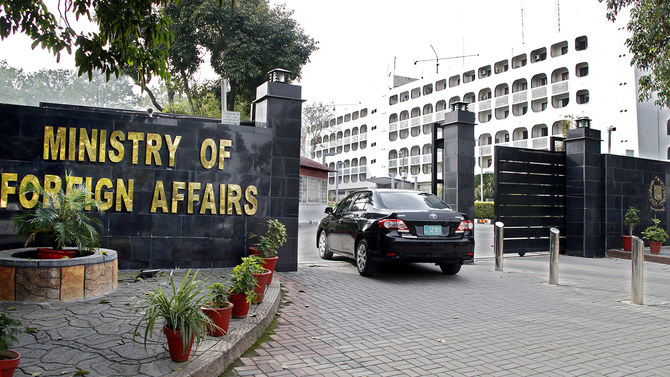
This photograph taken on Jan. 22, 2020, shows the premises of Ministry of Foreign Affairs in Islamabad. (AN photo)
Short Url
Updated 15 October 2020
Follow

Lahore High Court summons foreign office over Pakistanis imprisoned in Iran

  • 174 Pakistanis currently detained in Iran, 75% of them on charges of drug-trafficking
  • “These are Pakistani citizens and information about them cannot be withheld,” Justice Waheed says

ISLAMABAD: Lahore High Court Justice Shahid Waheed this week ordered the Pakistan Foreign Office to submit a list of Pakistanis imprisoned in Iran and for a relevant officer to appear in person before the court on the next hearing.   

Barrister Sarah Belal informed the court that according to the government, there were 174 Pakistanis currently detained in Iran, 75% of them on charges of drug-trafficking. She added that in 2017 Iran passed a law that enabled prisoners sentenced to death for narcotics offenses to have their sentences commuted to life imprisonment.

“The Iranian Courts will not review the death sentences automatically. Instead, the Government of Pakistan will have to ensure effective representation of its citizens before the concerned judicial authority,” Belal said, adding that it was the Pakistani government’s duty under the constitution to protect its citizens wherever in the world they may be.

“These are Pakistani citizens and the information about them cannot be withheld,” Justice Waheed said while hearing the petition filed by Justice Project Pakistan on behalf of Pakistanis imprisoned in Iran for alleged drug offences. The case was last heard over two years ago during which Justice Waheed had admonished the federal government for seeking more time to submit details of Pakistanis on death row in Iran.

In 2012, the Lahore High Court had set a precedent in a petition filed by JPP by seeking details of Pakistanis detained in the now defunct Bagram air base-turned-prison in Afghanistan that eventually led to the repatriation of 43 Pakistanis.

Pakistanis in foreign jurisdictions are particularly vulnerable and therefore might not be able to file reviews themselves. Despite being informed of the Amendment and the urgent need to file reviews, the Ministry of Foreign Affairs and the Pakistani Embassy in Tehran have not provided updates on the steps taken to facilitate Pakistani prisoners entitled to relief, JPP said.

The former federal information minister Fawad Chaudhary in a press conference in September 2018 had stated that the matter of Pakistanis on Iran’s death row was discussed in detail with Iran’s foreign minister Jawad Zarif during his two-day visit to Pakistan. In June, the Iranian deputy minister for human rights announced that Tehran was willing to extradite 44 Pakistani prisoners on humanitarian grounds due to the COVID-19 outbreak but was awaiting a response from Pakistani authorities.

Ali Haider Habib, spokesperson of Justice Project Pakistan, added: “Consular access is a human right which imposes distinct but complementary obligations on both prosecuting and home states. The failure of the home state to provide adequate consular assistance amounts to a violation of its responsibility to protect the right to life. The Pakistani government must follow the honourable court’s directives to provide the relevant records and adhere to its constitutional responsibility towards these prisoners who are particularly vulnerable amid a pandemic that has already claimed hundreds of lives in the jails of Iran.”


Pakistan warns of more rain, snow in north, urges tourists to avoid travel

Updated 5 sec ago
Follow

Pakistan warns of more rain, snow in north, urges tourists to avoid travel

  • Heavy snow has blanketed parts of Khyber Pakhtunkhwa, Galiyat, Azad Kashmir and Gilgit-Baltistan, cutting off several towns and villages
  • Communications Minister Aleem Khan has directed authorities to ensure highways remain open, fully operational under all circumstances

ISLAMABAD: The Pakistan Meteorological Department (PMD) on Friday warned of more rain and snowfall in northern parts of the country, urging tourists to avoid unnecessary travel as authorities moved to prevent weather-related emergencies.

Rescuers evacuated dozens of stranded residents and tourists to safety as heavy snowfall blanketed several mountainous areas, particularly in the Khyber Pakhtunkhwa (KP) province, blocking roads and cutting off villages.

KP’s Khyber, South Waziristan and Swat districts were the most affected by heavy snowfall on Thursday, where authorities were clearing roads and providing food, warm clothes and bedding to affectees, according to Rescue 1122.

Heavy snowfall was also witnessed in Azad Kashmir, Gilgit-Baltistan, Murree and Galiyat where several vehicles were stuck on roads, while residents complaint of power outages in some areas, local media widely reported on Friday.

“The system causing rain/snowfall is active over northern parts of the country,” the PMD said in its advisory on Friday noon, predicting more showers and snow in the next few hours.

“Tourists [are] advised to stay vigilant and avoid unnecessary travel during rain and snowfall.”

Weather authorities this week forecast intermittent rains and snowfall in northern regions of the country between Jan. 21 and Jan. 24, with heavy snowfall likely in upper and hilly areas of the province.

Tens of thousands of tourists flock to Pakistan’s scenic north every winter to witness snowfall, often neglecting warnings from disaster management authorities.

In Jan. 2022, at least 21 people, including children, died after they were stuck in freezing temperatures during a snowstorm in the Pakistani hill station of Murree.

In view of the situation, Federal Minister Abdul Aleem Khan on Friday directed the National Highway Authority (NHA) to ensure that all highways remain open and fully operational under all circumstances.

“Minister has instructed NHA field staff to remain on high alert and to maintain 24/7 monitoring of weather conditions on highways in snowfall-affected areas,” the Pakistani information ministry said.

“He emphasized that ensuring uninterrupted traffic flow on national highways, particularly in upper regions, is a top priority.”