

Main suspect in motorway gang-rape case arrested from Pakistan’s Faisalabad

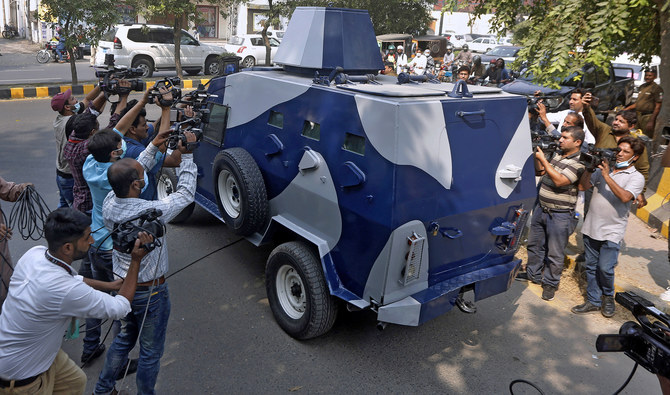
Video journalists film an armored vehicle carrying Abid Malhi, a key assailant suspected in the gang rape of a woman on a desolate highway, following his court appearance in Lahore on Oct. 13, 2020. (AP)
Short Url
Updated 13 October 2020
Follow

Main suspect in motorway gang-rape case arrested from Pakistan’s Faisalabad

  • The arrest of Abid Malhi ends a month-long manhunt in a case that has shocked the nation
  • Pakistan has seen at least 3,500 rapes this year, according to the group War Against Rape

ISLAMABAD: Abid Malhi, the main suspect in last month’s motorway gang-rape, was arrested by police on Monday, a spokesman for the government said, ending a month-long manhunt in a case that has shocked Pakistan.
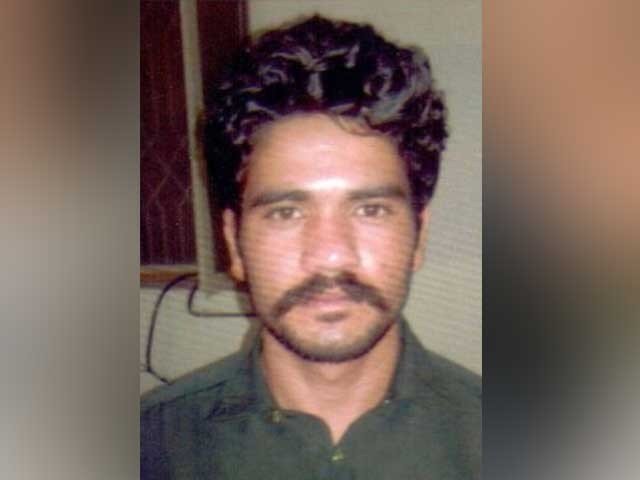


Abid Malhi, prime suspect of motorway gang rape case. (FILE)

Last month, a woman was gang-raped alongside a major highway, in front of her children in a case that sparked nationwide protests and calls for the accountability. On September 14, six days after the rape, the Counter Terrorism Department arrested Shafqat Ali from a house in Okara city in Pakistan’s Punjab province. His DNA samples matched the samples found on the rape survivor’s clothes.
A second set of DNA evidence pointed at Malhi, who police have been hunting ever since, as rights activists and citizens have demanded that the Pakistani government do more to stem violence against women, including ensuring perpetrators are held accountable in a country that has seen at least 3,500 rapes this year, according to the group War Against Rape.
“Abid Malhi has been arrested,” a communications adviser to the Pakistani prime minister said in a tweet. “Inshallah [God willing], he will be punished according to the law.”

The Pakistani president tweeted:
“Arrest of the 2nd motorway accused rapist is a matter of national relief. An efficient trial of the accused and the ‘severest exemplary’ punishment possible under the law must be given to all those found guilty. Let everyone feel safe in Pakistan, specially our women & children.”


Pakistan launches double-decker buses in Karachi after 65 years to tackle transport woes

Updated 31 December 2025
Follow

Pakistan launches double-decker buses in Karachi after 65 years to tackle transport woes

  • Karachi citizens will be able to travel in double-decker buses from Jan. 1, says Sindh government
  • City faces mounting transport challenges such as lack of buses, traffic congestion, poorly built roads

ISLAMABAD: The government in Sindh province on Wednesday launched double-decker buses in the provincial capital of Karachi after a gap of 65 years, vowing to improve public transport facilities in the metropolis. 

Double-decker buses are designed to carry more passengers than single-deck vehicles without taking up extra road space. The development takes place amid increasing criticism against the Sindh government regarding Karachi’s mounting public transport challenges and poor infrastructural problems. 

Pakistan’s largest city by population faces severe transportation challenges due to overcrowding in buses, traffic congestion and limited bus options. Commuters, as a result, rely on private vehicles or unregulated transport options that are often unsafe and expensive.

“Double-decker buses have once again been introduced for the people of Karachi after 65 years,” a statement issued by the Sindh information ministry said. 

Sindh Transportation Minister Sharjeel Inam Memon and Local Government Minister Syed Nasir Hussain Shah inaugurated the bus service. The ministry said the facility will be available to the public starting Jan. 1. 

The statement highlighted that new electric bus routes will also be launched across the entire province starting next week. It added that the aim of introducing air-conditioned buses, low-fare services, and fare subsidies is to make public transport more accessible to the people.

The ministry noted that approximately 1.5 million people travel daily in Karachi using the People’s Bus Service, while around 75,000 passengers use the Orange Line and Green Line BRT services.

“With the integration of these routes, efforts are being made to benefit up to 100,000 additional people,” the ministry said.