Jordan's King Abdullah swears in new government to speed reforms

1 / 3
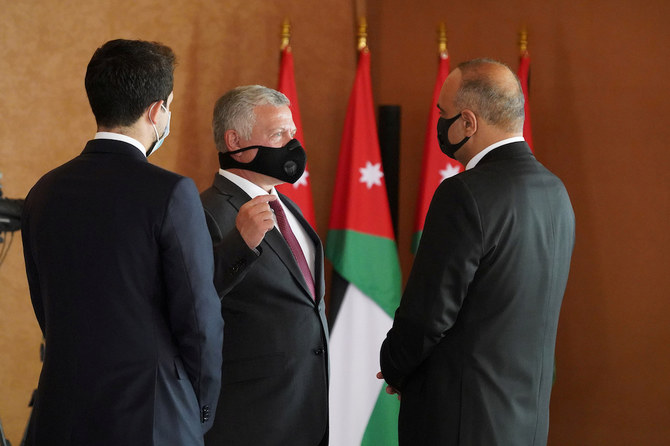
Jordan's King Abdullah and Crown Prince Hussein talk to newly-appointed Prime Minister Bisher al Khasawneh during a swearing-in ceremony of the new government in Amman, Jordan October 12, 2020. (Reuters)
2 / 3
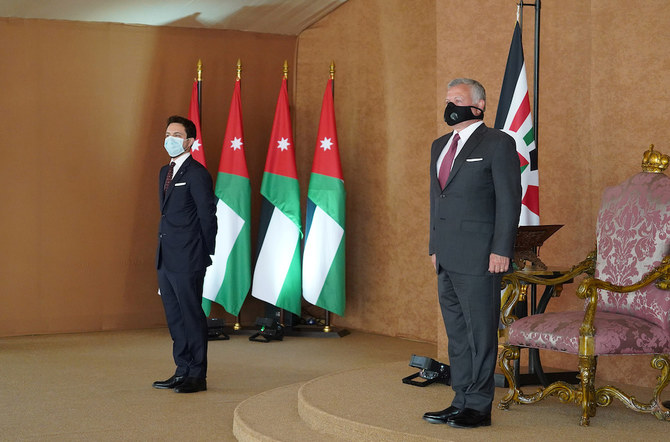
Jordan's King Abdullah and Crown Prince Hussein attend a swearing-in ceremony of the new government in Amman, Jordan October 12, 2020. (Jordanian Royal Palace/Handout via Reuters)
3 / 3
Jordan's newly-appointed Prime Minister Bisher al Khasawneh takes oath during a swearing-in ceremony of the new government in Amman, Jordan October 12, 2020. (Reuters)
Short Url
Updated 13 October 2020
Follow

Jordan's King Abdullah swears in new government to speed reforms

  • The king appointed Bisher al-Khasawneh as the new prime minister
  • The new Cabinet consists of 31 ministers, but more than half of them have served in previous Cabinets as well

AMMAN: Jordan's King Abdullah on Monday swore in a new government led by veteran diplomat Bisher al Khaswaneh that will seek to accelerate IMF-backed reforms as the economy faces its sharpest contraction in decades due to the coronavirus crisis.
British-educated Khasawneh, 51, was appointed on Wednesday to replace Omar al Razzaz, at a time of rising popular discontent about worsening economic conditions and curbs on public freedoms under emergency laws to contain the pandemic.
The new premier, who comes from a family that has long held senior political posts, has spent most of his public career as a veteran diplomat and peace negotiator with Israel with a last stint as palace adviser.
Foreign Minister Ayman Safadi and Finance Minister Mohamad Al Ississ, who oversees the country's reform program with the International Monetary Fund (IMF), kept their posts in a 32-member cabinet dominated by a mix of technocrats and conservative politicians who held sway in previous governments.
The new government faces an uphill task to revive growth in an economy that is expected to shrink by around 6% this year as it grapples with its worst economic crisis in many years, with unemployment and poverty aggravated by the pandemic.
Jordan this month saw a near-doubling of total infections since the first cases in early March, bringing warnings of a collapse in health services if it gets out of control.
Khasawneh will oversee parliamentary elections due on Nov 10. The contest will take place under an electoral law that marginalises the main Islamist opposition and independent political parties to keep a majority of pro-government deputies.
Outgoing premier Razzaz, appointed in 2018 to calm protests over IMF austerity moves, had faced criticism for his handling of the pandemic and use of emergency laws to silence dissent.
International rights groups lambasted the authorities for arresting hundreds of teacher activists after dissolving their opposition-led elected union last July.
The detention of dissidents and activists for criticising government policies raised alarm over a tighter authoritarian grip, rights groups and independent politicians say.


US military transfers first 150 Daesh detainees from Syria to Iraq

Updated 3 sec ago
Follow

US military transfers first 150 Daesh detainees from Syria to Iraq

  • Transfer follows Syrian government forces taking control of Al-Hol camp from SDF
  • US Central Command says up to 7,000 detainees could be transferred to Iraqi-controlled facilities
AL-HOL, Syria: The US military said Wednesday it has started transferring detainees from the Daesh group being held in northeastern Syria to secure facilities in Iraq.
The move came after Syrian government forces took control of a sprawling camp, housing thousands of mostly women and children, from the US-backed Syrian Democratic Forces, or SDF, which withdrew as part of a ceasefire. Troops on Monday seized a prison in the northeastern town of Shaddadeh, where some Daesh detainees escaped and many were recaptured, state media reported.
The Kurdish-led SDF still controls more than a dozen detention facilities holding around 9,000 Daesh members.
US Central Command said the first transfer involved 150 Daesh members, who were taken from Syria’s northeastern province of Hassakah to “secure locations” in Iraq. The statement said that up to 7,000 detainees could be transferred to Iraqi-controlled facilities.
“Facilitating the orderly and secure transfer of Daesh detainees is critical to preventing a breakout that would pose a direct threat to the United States and regional security,” said Adm. Brad Cooper, CENTCOM commander. He said the transfer was in coordination with regional partners, including Iraq.
US troops and their partner forces detained more than 300 Daesh operatives in Syria and killed over 20 last year, the US military said. An ambush last month by Daesh militants killed two US soldiers and one American civilian interpreter in Syria.
An Iraqi intelligence general told The Associated Press that an agreement was reached with the US to transfer 7,000 detainees from Syria to Iraq. He said that Iraqi authorities received the first batch of 144 detainees Wednesday night, after which they will be transferred in stages by aircraft to Iraqi prisons.
The general, who spoke on condition of anonymity because he was not authorized to speak to the media, said the Daesh members who will be transferred to Iraq are of different nationalities. He said they include around 240 Tunisians, in addition to others from countries including Tajikistan and Kazakhstan and some Syrians.
“They will be interrogated and then put on trial. All of them are commanders in Daesh and are considered highly dangerous,” the general said. He added that in previous years, 3,194 Iraqi detainees and 47 French citizens have been transferred to Iraq.

Regional threat despite battle setbacks

The Daesh group was defeated in Iraq in 2017, and in Syria two years later, but the group’s sleeper cells still carry out deadly attacks in both countries. The SDF played a major role in defeating Daesh.
Tom Barrack, the US envoy to Syria, said in a statement on Tuesday that the SDF’s role as the primary anti-Daesh force “has largely expired, as Damascus is now both willing and positioned to take over security responsibilities.”
He added that the “recent developments show the US actively facilitating this transition, rather than prolonging a separate SDF role.”
Syria’s Foreign Ministry welcomed the transfer of detainees, calling it “an important step to strengthen security and stability.”
Earlier on Wednesday, a convoy of armored vehicles with government forces moved into the Al-Hol camp following two weeks of clashes with the SDF, which appeared closer to merging into the Syrian military, in accordance with government demands.
At its peak in 2019, some 73,000 people were living at Al-Hol. Their number has since declined with some countries repatriating their citizens.
The camp is still home to some 24,000, most of them women and children. They include about 14,500 Syrians and nearly 3,000 Iraqis. Some 6,500 others, many of them loyal Daesh supporters who came from around the world to join the extremist group, are separately held in a highly secured section of the camp.
The Syrian government and the SDF announced a new four-day truce on late Tuesday after a previous ceasefire broke down.