60 percent Pakistanis experienced mental health issues during virus lockdown — study 

A street vendor selling facemasks sits as he waits for customers on a street in Rawalpindi on July 5, 2020. (AFP)
Short Url
Updated 14 October 2020
Follow

60 percent Pakistanis experienced mental health issues during virus lockdown — study 

  • A global research organization says confinement, financial distress and job losses raised stress levels in the country 
  • Top psychiatrist at PIMS claims more than 10,000 local health workers attended sessions to deal with stress-related issues

ISLAMABAD: About 60 percent of Pakistanis experienced moderate to high levels of mental health issues while eight in 10 individuals showed some symptoms of mental illness during the coronavirus pandemic, according to a global research firm, IPSOS, which recently carried out a study for an organization affiliated with the Pakistan Mental Health Coalition.
“The purpose of this survey was to check serious mental health problems that were caused by challenges posed by lockdowns, confinement, financial distress, job losses and fear of getting COVID-19,” said Irfan Mustafa, whose organization, Taskeen, commissioned the study.


Talking to Arab News ahead of International Health Day today, he said the telephonic survey was carried out with a nationwide representative sample of individuals belonging to underprivileged communities at the end of June this year. However, the result of the study was released earlier this month.



People wearing facemasks cross a street beside an auto-rickshaw with a graffiti depicting actor Heath Ledger (L) in his role as the Joker, in Rawalpindi on June 26, 2020. (AFP)

Mustafa said his organization focused on promotion of mental health and prevention of psychological illnesses through education, awareness and advocacy.
He claimed that survey results were accurate since the margin of error was between three and four percent, adding that any statistical deviation within that range was accepted internationally for such surveys.
According to the study, 44 percent people either lashed out at others or indulged in substance abuse as a coping mechanism whilst 26 percent engaged in self-harm. The survey described economic downturn as a major reason for stress since 72 percent of the respondents complained of anxiety and depression due to the financial challenges caused by COVID-19. Among those who participated in the survey, 67 percent said that government statements and media messages increased their stress level.
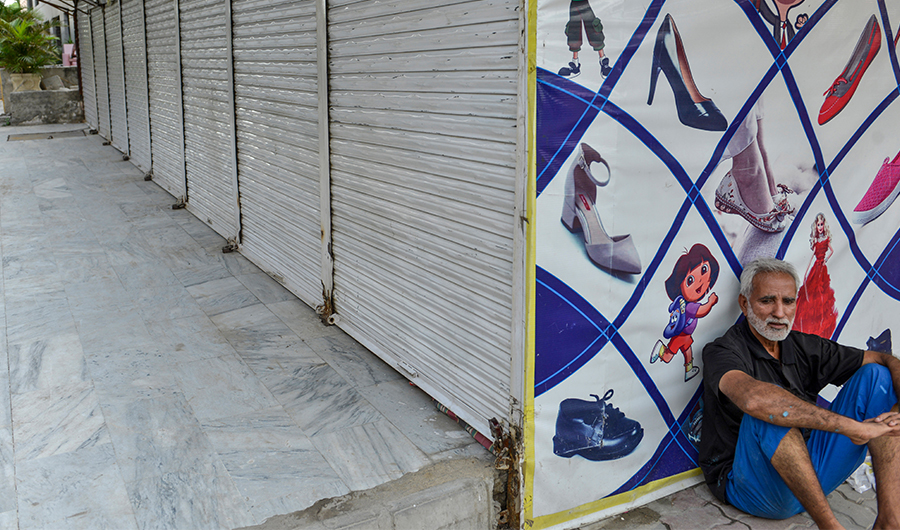


A shopkeeper sits next to a shuttered market in Rawalpindi on July 29, 2020. (AFP)

Dr. Rizwan Taj, head of the psychiatry department at the Pakistan Institute of Medical Science (PIMS), said the health ministry was ready to deal with mental health issues from the beginning of the pandemic.
“All viral infections have their mental health effects which include depression and anxiety,” he told Arab News. “The coronavirus situation is novel and more serious because it has affected life around people. It has turned it upside down.”
Taj said the government had launched a program for health workers, which was attended by over 10,000 doctors and paramedics, to help them deal with stress-related issues.
“We were able to hold a large number of sessions, workshops and created a 24-hour helpline for health care professionals in Islamabad,” he informed. “Now, we are looking at the second part of the problem which is the mental health issues of general public.”

According to the World Health Organization, mental disorders account for more than four percent of the total disease burden in Pakistan and approximately 24 million people in the country need psychiatric assistance. However, the global agency also claims that allocated resources for screening and treatment of mental health disorders are not enough to meet the burgeoning need.
The WHO also maintains that Pakistan only has 0.19 psychiatrists per 100,000 inhabitants, which is among the lowest across the world.


Pakistan plans $80 million seafood zone at Karachi harbor to target Gulf markets

Updated 45 min 51 sec ago
Follow

Pakistan plans $80 million seafood zone at Karachi harbor to target Gulf markets

  • Plan aims to move exports away from raw seafood toward higher-value processed products
  • Project will be developed under public-private partnership or build-operate-transfer model

KARACHI: Pakistan plans to develop a seafood processing and export zone at Karachi’s Korangi Fisheries Harbor that could cost up to $80 million to boost value-added exports and position the country as a supplier to the Gulf and other regional markets, Maritime Affairs Minister Muhammad Junaid Anwar Chaudhry said on Saturday.

The proposed 100-acre project aims to shift Pakistan away from exporting raw seafood by building modern processing, cold-chain and packaging infrastructure linked to international buyers, as Islamabad looks to expand its blue economy and deepen maritime trade ties with the region.

In a statement, Chaudhry said the zone would be developed, financed and operated under a public-private partnership or build-operate-transfer (BOT) model, with private investors running the facilities and the Qur’angi Fisheries Harbor Authority retaining regulatory oversight.

“The estimated project cost ranges between $60 million and $80 million, based on regional benchmarks from countries such as Vietnam, China and Ecuador, which have developed similar seafood parks,” Chaudhry said.

He said the facility would include 20 to 25 medium- to large-scale seafood processing units for fish, shrimp and cephalopods, alongside large-scale cold storage, blast freezing, packaging facilities, logistics and export terminals, and a wastewater treatment plant to ensure environmentally compliant operations.

“Packaging and labeling units would operate under international food safety and quality standards, including HACCP and ISO certifications, offering vacuum packing, modified atmosphere packaging and retail-ready solutions,” he said, referring to Hazard Analysis and Critical Control Points, a preventive food safety system.

ISO certification verifies that a company’s management systems meet international standards.

The minister said the zone would be used exclusively for commercial seafood processing, packaging, cold storage and export-oriented activities, with multi-temperature storage ranging from minus 18 to minus 40 degrees Celsius and ice plants capable of producing 50 to 100 tons daily.

Chaudhry said the preferred investment structure is a BOT concession under which the private partner would finance, develop and operate the project for an expected 20-year tenure, with ownership reverting to the harbor authority at the end of the concession period.

He added that the estimated internal rate of return was projected between 13 percent and 17 percent, with revenue generated through lease rentals, processing fees, logistics services and export-linked earnings.

“The project will position Pakistan as a key maritime trade and seafood export hub serving Gulf, East African and Asian markets,” Chaudhry said.