

Pakistan seeks operationalization of World Bank’s $20 billion framework to advance reform priorities

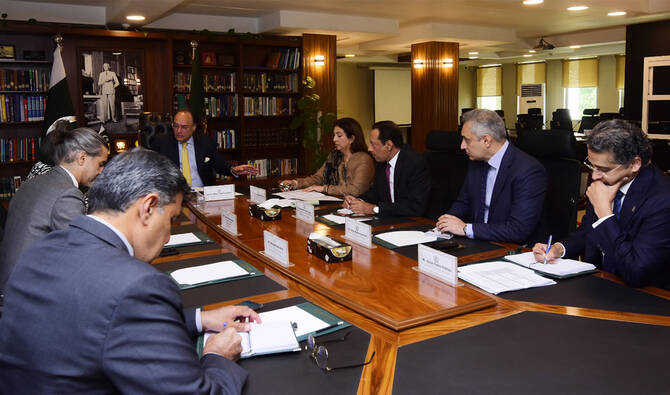
Finance Minister of Pakistan, Muhammad Aurangzeb (center), conducting a meeting with World Bank’s Country Director Bolormaa Amgaabazar in Islamabad, Pakistan, on February 25, 2026. (Government of Pakistan)
Short Url
Updated 25 February 2026
Follow

Pakistan seeks operationalization of World Bank’s $20 billion framework to advance reform priorities

  • Pakistan’s finance chief meets World Bank Country Director Bolormaa Amgaabazar in the capital
  • The Bank’s 10-year Country Partnership Agreement for Pakistan was approved in January last year

ISLAMABAD: Pakistan’s Finance Minister Muhammad Aurangzeb on Wednesday called for the operationalization of the World Bank Country Partnership Framework (CPF) to advance the government’s key reform priorities during a meeting with the Bank’s country director, according to a statement.

The Bank’s Board of Directors approved a 10-year CPF deal with Pakistan, indicating $20 billion in financing for Pakistan under the framework. The amount will include public and private financing from the World Bank Group, with roughly half expected to come from private-sector operations led by the International Finance Corporation (IFC).

“The Finance Minister emphasized the importance of effective operationalization of the CPF, particularly in priority areas such as population management and climate change,” the finance ministry said in a statement after Aurangzeb’s meeting with the Bank’s Country Director Bolormaa Amgaabazar.

“He underscored the need for strong coordination between federal and provincial governments to ensure coherence in policy design and implementation.”

Discussions focused on population, human capital development, climate resilience, agricultural reform and energy sector sustainability, it added.

The ministry said both sides exchanged views on enhancing institutional coordination, improving transparency in project design and strengthening monitoring mechanisms to deliver intended outcomes. It highlighted that the World Bank expressed readiness to continue supporting agricultural transformation efforts in collaboration with the IFC.

“Both sides agreed to continue technical-level engagements to explore feasible solutions in line with Pakistan’s reform agenda and fiscal framework,” the finance ministry added.

Climate resilience and population control are major concerns for policymakers in Pakistan, a country whose population exceeds 241 million, making it the world’s sixth-most populous country. Limited infrastructure, health care, and educational opportunities place added strain on public services, contributing to unemployment and poverty.

The South Asian nation is also among the countries most affected by climate change. Unusually heavy monsoon rains in 2022 killed more than 1,700 people and caused over $30 billion in damages. Torrential rains and floods since late June last year have claimed more than 1,000 lives, as authorities continue surveys to assess the full extent of the destruction.


Former militant leader attempts back-channel diplomacy between Pakistan and Afghanistan — sources 

Updated 4 sec ago
Follow

Former militant leader attempts back-channel diplomacy between Pakistan and Afghanistan — sources 

  • Maulana Fazlur Rehman Khalil, a US-designated “terrorist,” arrives in Kabul leading three-member delegation
  • Source close to Khalil says his visit aims to ease tensions between Kabul and Islamabad amid ongoing clashes 

ISLAMABAD: A prominent former Pakistani militant leader with close ties to the Afghan Taliban arrived in Kabul this week in an effort to ease tensions between Afghanistan and Pakistan, three sources with direct knowledge of the matter said on Tuesday.

The visit takes place as the South Asian neighbors have engaged in their worst fighting in years following Pakistani airstrikes on major Afghan cities last month, increasing volatility in a region now also on edge over US and Israeli strikes on Iran. 

Islamabad has said its airstrikes, which have at times directly ​targeted the Afghan Taliban government, are aimed at ending Afghan support for militants carrying out attacks on Pakistan. The Taliban has ​denied aiding militant groups.

Maulana Fazlur Rehman Khalil, who founded the popular militant entity Harkat-ul-Mujahideen (HuM), arrived in Kabul this week, according to three sources, two based in Kabul and one in Islamabad. 

A first Kabul-based source who declined to be identified said Khalil was leading a three-member delegation comprising Pakistani clerics Abdullah Shah Mazhar and Sajjad Usman to explore ways to reduce recent tensions between Pakistan and Afghanistan.

“Fazlur Rehman Khalil, along with two other clerics, is in Kabul in a bid to ease tension between the two countries,” the source in Afghanistan close to Khalil told Arab News.

“Khalil has very good relations with the Taliban and he should be using the same influence to ease tension, but given the current condition, any positive result is unlikely. If not highly unlikely.”

Khalil was placed on Washington’s Specially Designated Global Terrorists list in September 2014 for his alleged involvement in “terrorist” activities. The US declared HuM a foreign terrorist organization in 1997, and it re-emerged as Ansar-ul-Umma in 2013.

A second source based in Kabul and close to the Afghan Taliban confirmed Khalid’s visit but declined to comment on its purpose. 

Afghan government spokesperson Zabihullah Mujahid did not respond to Arab News’ requests for comment on the matter. Pakistan’s foreign office spokesperson Tahir Andrabi also did not respond to questions about Khalil’s alleged visit. 

A third official, a Pakistani in Islamabad, said the trip was not sanctioned by Pakistan.

“On a personal visit,” the source described Khalil’s trip, speaking on condition of anonymity as he was not authorized to speak to the media.

Turkiye and Iran have both offered to mediate and resolve the conflict between Pakistan and Afghanistan since it began last month. Attempts by Turkiye and Qatar to broker a truce last year temporarily reduced tensions but failed to produce a lasting settlement between Islamabad and Kabul. 

Ties have plummeted in recent years as Pakistan accuses Afghanistan of sheltering militants, particularly those belonging to the Tehreek-e-Taliban Pakistan (TTP). Kabul denies the allegations.

The dispute intensified after a series of deadly attacks inside Pakistan in recent months, prompting Islamabad to carry out air strikes across the border that it said targeted militant hideouts. Afghan officials condemned the strikes, saying they killed civilians and violated Afghanistan’s sovereignty. Pakistan claims to have killed over 580 Afghan Taliban operatives in “Operation Ghazab lil Haq.” 

While Afghanistan has voiced the desire for dialogue, Pakistan has repeatedly ruled out talks, saying it will continue targeting militant hideouts in Afghanistan through Operation Ghazab lil Haq till Kabul desists from supporting militants. 

Analysts suggest the involvement of individuals with militant backgrounds in diplomacy indicates that back-channel negotiations remain a priority.

“Although the delegation’s mandate has not been officially confirmed or denied by Pakistan, but the presence of these influential individuals in Kabul demonstrates that negotiations are as important as military operations,” Majid Nizami, a Lahore-based political analyst, told Arab News.

“Their militancy past and their ties to the Pakistani state indicate that, despite the mutual accusations and the state narrative of a military solution, behind-the-scenes negotiations are still taking place.”