Israel signs deal with Jordan to open airspace

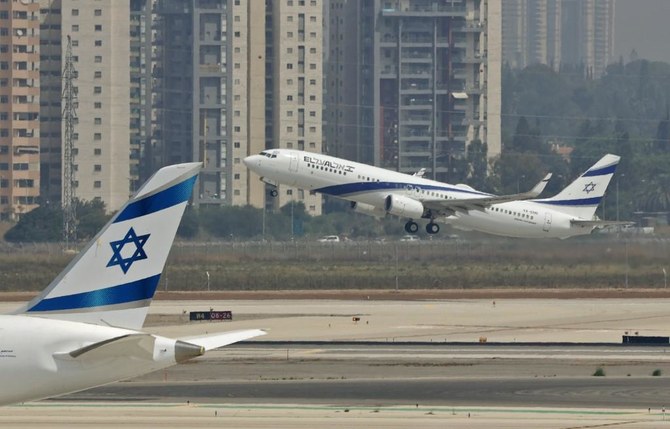
El Al's airliner lifts off from the tarmac in the first-ever commercial flight from Israel to the UAE at Ben Gurion Airport. (File/AFP)
Short Url
Updated 08 October 2020
Follow

Israel signs deal with Jordan to open airspace

  • With commercial planes now able to fly through the Israel-Jordan corridor, flights from Bahrain and the UAE will be shorter
  • European air traffic control agency Eurocontrol, based in Brussels, helped make the aviation deal happen

JERUSALEM: Israel has signed an aviation agreement with Jordan that will allow flights from the United Arab Emirates and Bahrain to fly through Israeli airspace, it said on Thursday.
The deal had been discussed for years, but the neighbors were only able to finalize it after Israel and the two Gulf Arab states signed a historic agreement last month to normalize ties, Israel’s Transportation Ministry said.
Jordanian officials had no immediate comment.
With commercial planes now able to fly through the Israel-Jordan corridor, flight times for some routes between Asia and Europe and North America, including flights from Bahrain and the United Arab Emirates, will be shorter, the Israeli ministry said.
Its statement did not specify any other countries that could benefit from the new arrangement.
“The agreement will significantly cut flight times to Gulf countries, Asia and the Far East, leading to fuel savings and less pollution,” it said.
European air traffic control agency Eurocontrol, based in Brussels, helped make the aviation deal happen, the ministry said.
Boosting civil aviation was an important part of last month’s historic diplomatic accords signed in Washington at a ceremony hosted by US President Donald Trump.
In those agreements, Israel, Bahrain and the United Arab Emirates agreed it was critical to ensure regular and direct flights to promote relations.


Israel police to deploy around Al-Aqsa for Ramadan, Palestinians report curbs

Updated 17 February 2026
Follow

Israel police to deploy around Al-Aqsa for Ramadan, Palestinians report curbs

  • The Al-Aqsa compound is a central symbol of Palestinian identity and also a frequent flashpoint

JERUSALEM: Israeli police said Monday that they would deploy in force around the Al-Aqsa Mosque during the Muslim holy month of Ramadan, which begins this week, as Palestinian officials accused Israel of imposing restrictions at the compound.
Over the course of the month of fasting and prayer, hundreds of thousands of Palestinians traditionally attend prayers at Al-Aqsa — Islam’s third-holiest site, located in east Jerusalem, which Israel captured in 1967 and later annexed.
Arad Braverman, a senior Jerusalem police officer, said forces would be deployed “day and night” across the compound, known to Jews as the Temple Mount, and in the surrounding area.
He said thousands of police would also be on duty for Friday prayers, which draw the largest crowds of Muslim worshippers.
Braverman said police had recommended issuing 10,000 permits for Palestinians from the occupied West Bank, who require special permission to enter Jerusalem.
He did not say whether age limits would apply, adding that the final number of people would be decided by the government.
The Palestinian Jerusalem Governorate said in a separate statement it had been informed that permits would again be restricted to men over 55 and women over 50, mirroring last year’s criteria.
It said Israeli authorities had blocked the Islamic Waqf — the Jordanian?run body administering the site — from carrying out routine preparations, including installing shade structures and setting up temporary medical clinics.
A Waqf source confirmed the restrictions and said 33 of its employees had been barred from entering the compound in the week before Ramadan.
The Al-Aqsa compound is a central symbol of Palestinian identity and also a frequent flashpoint.
Under long?standing arrangements, Jews may visit the compound — which they revere as the site of their second temple, destroyed by the Romans in 70 AD — but they are not permitted to pray there.
Israel says it is committed to maintaining this status quo, though Palestinians fear it is being eroded.
Braverman reiterated Monday that no changes were planned.
In recent years, a growing number of Jewish ultranationalists have challenged the prayer ban, including far?right politician Itamar Ben-Gvir, who prayed at the site while serving as national security minister in 2024 and 2025.